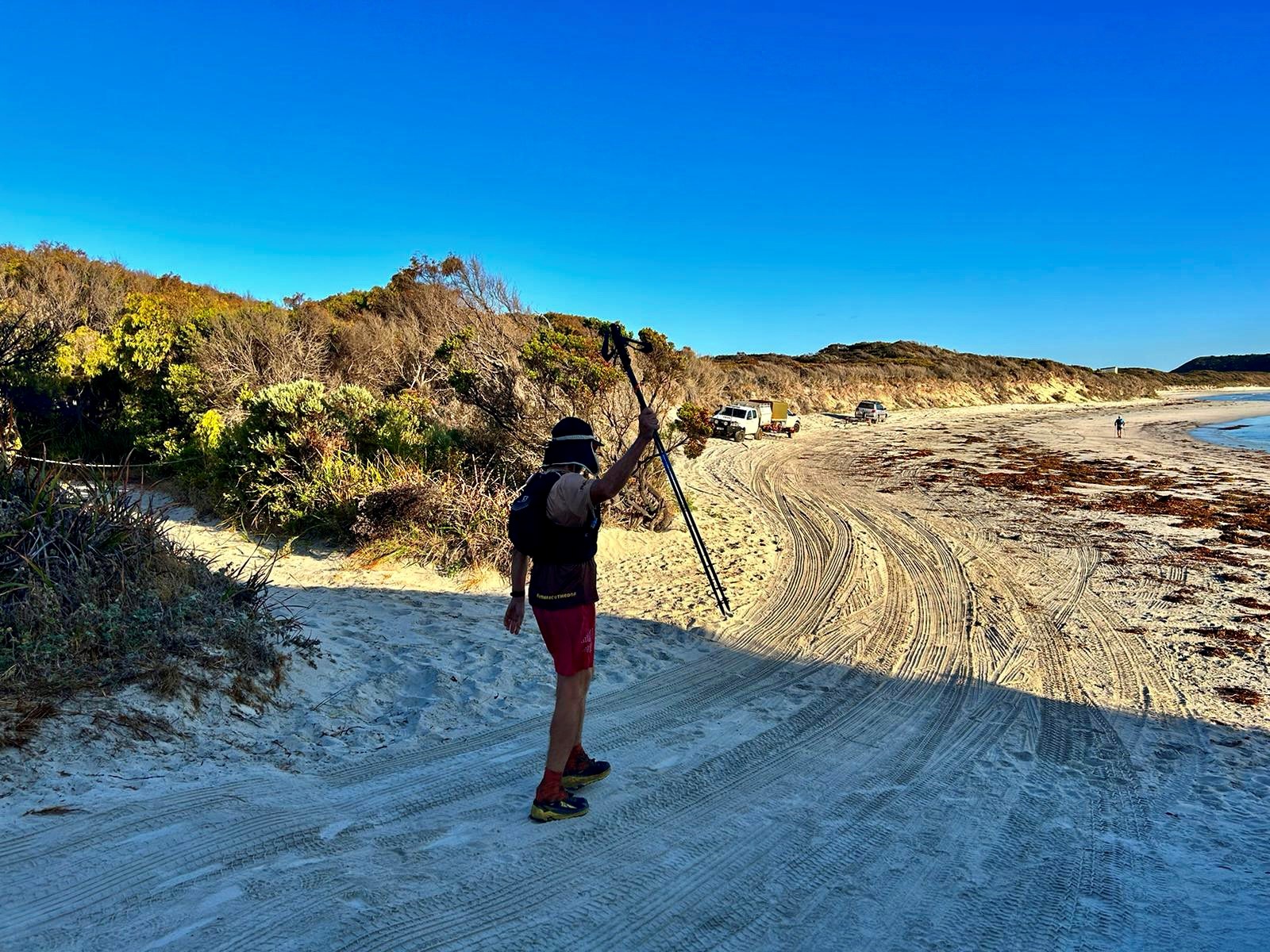
Addicted to running, is that a blessing or a curse ?

I wrote a post many years ago (below) on addiction to running and it rings true today as much as it did then. Since 2002 when I started my marathon running career I’ve ran fifty marathons and sixty-five ultra marathons including seven two hundred milers, as well as many one hundred milers and thirteen back yard ultras with twelve of those twenty four hours or more. That’s a total of one hundred and fifteen marathons, or longer, events in twenty-four years.
I may have dropped the weekly distance but have added in regular gym visits as I move towards my sixtieth time around the sun, next February. I still average close to seventy kilometres a week with maybe three gym visits where I do Pilates and lift weights. With this average mileage I can still compete in multi-day events and finish nearer the top of the field than the back, at the moment. To this end I can enter harder and harder (montane winter and summer spine next year for example https://www.thespinerace.com/) events which need more general fitness (cardio) and a good mental outlook to propel me to the finish line, compared to marathons where it’s mainly marathon specific training.

At the moment I am incredibly excited about the Winter Spine in January. two hundred and sixty-eight miles in freezing conditions running the full length of the Pennine Way in England. ( https://www.thespinerace.com/race/montane-winter-spine/ ) This will be my first two hundred miler plus event in cold , actually freezing, conditions as the seven previous adventures have been in Australia. Training wise I won’t have any opportunities to mimic the conditions I will face so have put my faith in ridiculously expensive kit that will keep me warm. My logic is you dress for the conditions, and it seems only very, very rich people run in subzero conditions, judging by the cost of the equipment. I estimate it will be near to two thousand dollars to properly kit myself out for the winter spine with the only bonus I can reuse most of the clothing for the summer spine.
This will be money well spent if I get caught in a blizzard, in subzero conditions, at the top of one of the many climbs. It will be more than the difference between a DNF and a finish, we’re talking life or death! So why enter these type of events? Because as you get closer to the finish line in life you realise your time to do ‘epic sh*t’ is limited and you’re fighting father time and your body which would much prefer to sit on the couch with a hot chocolate and talk about the good old days, instead of creating more good old days. With this attitude you are also more likely to finish harder events because you know you are probably only going to get one shot as there are other epic adventures waiting for you down the line.
Last weekend I ran my fiftieth marathon on the back of one good fourteen run a few weeks prior to the start, that was it. No marathon training but experience and stubbornness to get me to the finish line. I got there and this has ignited my marathon ‘show pony‘ runner I thought was dead and buried. I will be chasing a better time in October for marathon number fifty-one but before then have the Transcend Ultra next month ( https://transcendtrails.com/ ) and then the Ultra Series WA Lighthorse 24-hour race in November, ( https://www.ultraseries.com.au/ ) before heading overseas for the Winter Spine in January 2027. Post the Winter Spine I have my favourite backyard Ultra, Herdys backyard ultra, in March ( https://www.herdysfrontyard.com.au/ ) and then the Delirious West 200 miler in April ( https://www.deliriouswest200miler.com.au/ ) before returning the Pennine Way in June for the summer version of the winter spine, I’ll get to see the terrain in the light of day rather than the darkness of a British winter in January.
It looks like I’m as addicted to running as I was ten or so years ago when I wrote the post below, so if this a blessing or a curse? Difficult to answer really as it depends on whose perspective you are asking the question. My kids and Wife would probably see it as a curse but understand the alternative is probably worse i.e. me not running and be a grumpy old sod , they see this version of me for a short period before racing, us runners call it tapering. Running and racing gives me purpose and I’ve never as alive as when I’m in the middle of nowhere, on a trail, at two in the morning absolutely goosed with hundreds of kilometres ahead of me. Doing longer and longer events gives me more time alone in the dark pushing my limits.
Are there alternatives to running for a committed runner. I believe so but with my personality it will of course be all in. When I was younger I loved BMX riding, in my early teens, then mountain biking and then I discovered surfing. I loved all of these sports and would envisage sometime in the distant future to return to one or all of them. These are always my backup plans for when my knees eventually give in. Have also been watching YouTube videos on sailing and maybe I can add a sailboat to my skill set allowing me to search for waves far away from the crowds, in a similar way I search for loneliness on the trails, just need to persuade Karen, Jasmin and the dogs to join me. Until then I will be continually searching the internet for harder and harder events, did someone say Arctic ultra, unsupported?
Remember it’s the not the number of breaths you take, it’s the number of times your breath has been taken away.
When does the norm become a problem ?
As a runner I keep an excel spreadsheet recording distance and race times. I have this from post my second Comrades campaign in 2009, so currently just over 7 years. My excel sheet is just about recording distance but my mate Jon, who is an accountant by the way, has taken it to a new level and his also has times so he can work out average pace etc. It is a thing of beauty with pivot tables everywhere. All these excel sheets are now really defunct as GPS watches and Strava combined to allow runners to store all their runs online and have all the data at their fingertips. Combine this with a software package like training peaks and what you can produce is incredible.
This morning while I ran my ‘old faithful’ 10k for the 144th time (thanks for that Strava.) and started to think about how a ‘normal’ week for me has morphed from 50k as I started my journey in 2009 to nearly 200k last week. I remember thinking 100k was a massive number and one I would never aspire to (at the time Jon would be running that distance regularly, we all though he was mad!) Over the years as I have ran more and more chasing new PB’s the ‘norm’ has risen culminating in the last 3 weeks running twice a day and 100 miles becoming the new ‘normal week’. Is this sustainable, probably not but the real issue is I am still loving my running and now consider a two run day normal. So what is next, three times a week, 250k a week total ? I know these sort of numbers are achievable by professional athletes but not us ‘normal’ (am I still normal?) runners. There has been a number of days recently where I could have ran 3 times but on principal stopped myself, I do not want three times a week becoming the new ‘norm’!!
So back to my ‘what is normal question’? Is it normal to run 14 times a week and over 100 miles? No, not really, and not in the running community at large if the truth be told. There are many different levels of runner who participate for so many different reasons, be it weight loss, general wellness, happiness, for the love of running, to improve their racing times, to spend quality time alone with their thoughts, the reasons are endless. For each one there is a ‘normal’ week of running. This may be one 10k a week, a few jogs around the local park, moving up to 2-3 runs a week and then eventually all the way to twice a day. I have moved through these levels and I am as excited about my next run as I was about my last. Addicted, hell yeah but I feel in a good way. Only problem is would all addicts say the same thing. ?
I’ve attached a good article by Nicole Radziszewski , founder of Mama’s Gotta Move ( http://www.mamasgottamove.com/ ) to highlight this addiction that is running…
Jenny Shepherd, 39, had always run to deal with stress. But when postpartum depression struck after the birth of her third child in 2011, Shepherd ramped up her coping strategy. The more she ran, the more she depended on it—to the point where taking a day off left her feeling anxious and depressed.
“I’d squeeze in the miles whenever I could. Even if I felt tired, I’d rather suffer through an uncomfortable workout than deal with the guilt of not doing it,” says Shepherd, of Oak Park, Illinois.
This past January, Shepherd committed to a 200-mile challenge through her running group, and ran herself into an ankle injury and a boot. When the boot came off, Shepherd’s doctor gave her clearance to run one mile. She ran four. “I couldn’t seem to stop myself,” she says.
There’s a fine line between being a dedicated athlete and being addicted to running, but experts have come to recognize exercise addiction as a legitimate problem—akin to alcoholism, binge eating, and other addictive disorders.
Shepherd’s story illustrates some of the telltale signs, one of which is running through injury, says Heather Hausenblas, Ph.D, a health psychologist at Jacksonville University in Jacksonville, Florida., who has studied exercise addiction for more than 20 years. “When you are injured, are you able to stop and take time off to heal? People who are addicted cannot—or if they do, they experience withdrawal symptoms such as anxiety, depression and trouble sleeping.”
“Another sign is that running becomes all-consuming,” says Hausenblas. “Someone who is addicted will give up all other activities in their life—family, friends, work—to get their runs in.”
“The Truth About Exercise Addiction” by Katherine Schreiber and Hausenblas (Rowman & Littlefield Publishers, February 2015) elaborates on the signs of exercise addiction and offers insight into the risk factors and treatment. The book includes the Exercise Dependence Scale, which Hausenblas helped develop. The scale looks at seven factors to determine if an individual is addicted to exercise:
Withdrawal effects:
- Do you experience withdrawal symptoms when you stop?
- Continuance: Do you continue to exercise despite recurring problems?
- Tolerance: Do you feel a need to always do more to achieve the same effect?
- Lack of control: Are you unable to control your exercise habits?
- Reduction in other activities: Are you spending less time doing other things?
- Time: Is exercise consuming all of your time?
- Intention effect: Do you exercise more than you intend?
Based on scale responses, an estimated 25 percent of runners suffer from exercise addiction, compared to about 0.3 percent of the population in general, Hausenblas says.
Why is this number so much higher for runners? For one, it’s socially acceptable. “It’s okay to say, ‘I’ve got to do my 16-mile run today because I’m training for a marathon,’” says Hausenblas. “You get praise for doing it. It’s valued in our society.”
There is also something to be said about endorphins, which have been linked to improved mood. “People who are exercise-dependent need this, or their mood is strongly affected,” Hausenblas says. While various forms of exercise result in an endorphin boost, it tends to be greater with running and other forms of cardio.
For the nonexerciser—and even for someone who is exercise dependent–addiction to running might not seem like such a bad thing. But the consequences can be serious.
Physically, these include an increased risk of injury, exhaustion, and even cardiac damage, says Emilio Landolfi, Ph.D, a kinesiologist at the University of the Fraser Valley in Abbotsford, Canada, who has researched exercise addiction. While these are similar to the effects of overtraining, a person who is exercise dependent would likely continue to exercise when overtraining symptoms begin to appear. “Consequently, the damage is potentially much greater in the exercise addict versus the overtrained athlete,” Landolfi says.
If you believe you are addicted to running or exercise in general, Hausenblas advises keeping a diary of your workouts. Set reasonable goals to gradually decrease your mileage or time spent exercising, and talk to a close friend to hold you accountable. If you still can’t stop, seek professional help.
If you have a friend who shows signs of exercise dependence, carefully bring the issue to her attention, says Hausenblas. Make sure she is aware exercise addiction is a real condition. Don’t accuse her of being addicted, but instead use “I” statements to express how her behavior makes you feel.
For more advice on dealing with exercise addiction, check out “The Truth About Exercise Addiction.”

or follow me on Instagram https://www.instagram.com/runbkrun/
or facebook RUNBKRUNOZ
Tribe and Trail Running shop, Perth WA. ( https://www.tribeandtrail.com.au/ ) Your one stop shop for all things trail in WA. 
Big shout out to fisiocrem , this product is just incredible for tired and aching legs. I use it daily and have noticed a vast improvement in recovery.

Bix hydration is just ace, a product brought to life by Vlad Ixel a professional ultra runner who knows a thing or two about hydration. ( https://www.bixvitamins.com/ ) The best thing about Bix is it tastes good with many different flavours and you never get sick of drinking it, this is a big plus as Maurten and Tailwind (both great products) can be difficult to digest later in the event. From the website :-
As an Australian elite multiple trail running champion, with wins in over 40 ultra-marathon races across Asia, recovery from training and races has always been my top priority.
In searching for a solid recovery and hydration supplement, I recognized that critical vitamins and minerals – both in diversity and quantity – were missing from almost all supplements on the market. I had the feeling that in an effort to maximize their bottom-lines, companies in the hydration space, failed to deliver a product that could meaningfully assist athlete performance.
In order to address this, I began the development of a hydration product. After two and a half years of development alongside a leading German sports scientist, BIX Recovery, an advanced, high-quality recovery drink was born.
BIX boosts 12 active ingredients scientifically balanced to replace lost electrolytes and assist in immune function. It’s designed with quality vitamins and minerals, in quantities that work!
BIX is a recovery solution for everyone, that will get you to the top of your game!

What can I say about HumanTecar, ( https://athleticus.com.au/ ) it looks great, smells great and is awesome for recovery or even pre-run/workout. Read about the science behind it first and then try the products. The compression bandages are just magical after a long event. Put these on and the next day you are recovered, I have used them on a number of occasions and they never fail to astound me albeit the family poke fun at me as I look like a ‘mummy and smell funny’ !

Fractel ( https://fractel.com.au/ ) have your performance headgear covered. I love the colours and the functionality of these hats, I guarantee there is one model you’ll fall in love with.

Shokz headphones, let you keep in touch with the world around while losing yourself in quality tunes or podcasts. ( https://shokz.com.au/ )

T8 running apparel is the best you can get, second to none. Designed for the ultra humid Hong Kong conditions the owners live in. It is light and does away with any chaffing worries. T8 is the name given to the highest typhoon warning in Honk Kong, storms and typhoons with gusts exceeding 180kph, which explains the branding. ( https://t8.run/)


or follow me on Instagram https://www.instagram.com/runbkrun/
or facebook RUNBKRUNOZ
About The Author
bigkevmatthews@gmail.com
A running tragic.