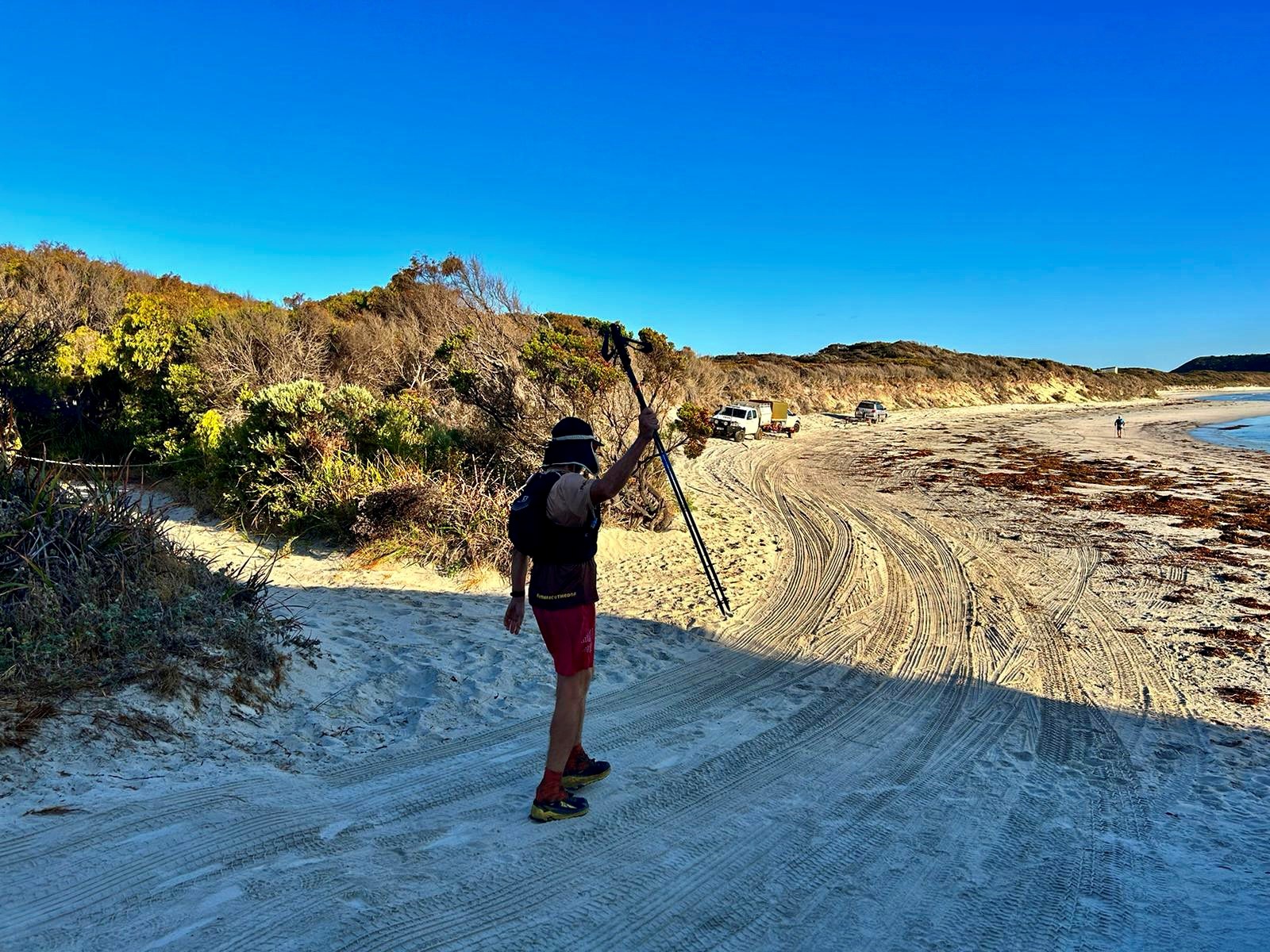
Marathons

The Montane Spine will test me, but that’s the point surely.

Next year I’m running the Montane Spine twice, once in the dead of winter and again in the height of summer. The post below is from Andy Glaze, a well known American Ultra runner and fireman. It’s bloody good so I’d thought I’d put it here for all to read. It came from Substack, which I’d never heard off. ( https://substack.com/ ) So if you like this post I’m sure Andy has written many more on this platform.

Like Andy I signed up for this event because it is another level of ‘hard‘ compared to normal 200 milers. Especially the winter version where you are battling freezing conditions, probably snow and eighteen hours of darkness.  I’ve raced seven two hundred milers and the distance now doesn’t faze me anymore, but the winter spine is another one hundred kilometres in brutal conditions with no support and very few aid stations. I am scared and that’s the point I suppose, do hard shit while you still can.  


They call the Pennine Way the backbone of England. 268 miles from Edale in the Peak District to Kirk Yetholm, just over the Scottish border. Bogs that swallow legs. Wind that holds you up when you lean into it. A 156-hour time limit and five checkpoints scattered across some of the wildest country in Britain.


I signed up because it scared me. That’s the honest answer. After many races of 100 miles and a couple of races between 200 and 300 miles, I’ve learned that the races that scare you are the ones that change you. Comfort doesn’t build anything. Comfort maintains. Growth lives on the other side of the thing you’re not sure you can do.

This is the story of six days on the Spine. But really it’s a story about what happens when you deliberately choose hard. Spoiler: you find out who you are.


Getting There

I arrived into Manchester on the afternoon of June 12th, 2026, jet lagged and carrying more gear than I’d ever brought to a race. A friend picked me up and drove me through the English countryside to Rushup Hall, a stunning stone farmhouse bed and breakfast nestled near the race start in the Peak District. Ancient stone walls bordered narrow winding roads. Sheep dotted the hillsides. The building looked like it had been standing there for centuries, which it probably had.


It felt genuinely remote. Quiet in a way that California never really is.

I took an Uber into Castleton that evening. Yes, Uber works in the English countryside, which surprised me. Castleton is a small medieval market town sitting at the mouth of the Hope Valley, flanked by dramatic limestone ridges and the ruins of Peveril Castle perched impossibly high on the hill above. Stone cottages line the narrow streets. The whole place feels preserved, like time slowed down and never quite caught back up. Most things close early here. This is not a late night town. But I found a pub still serving food and ate a proper meal, trying to carbo-load without overthinking it.

The strangest thing was the light. It doesn’t get dark until nearly 11pm in June at this latitude. I sat outside and watched the sky glow golden long past when it should have been night. Beautiful and deeply disorienting at the same time.


A Trail Worth Fighting For

Before I tell you about the race, you need to understand something about this trail. The Pennine Way exists because ordinary people decided it should.

Before 1965, these moorlands were locked up. Private grouse-shooting estates, guarded by gamekeepers, off limits to the working people who lived in the industrial towns below. On April 24, 1932, about 400 ramblers from Manchester and Sheffield walked up onto Kinder Scout anyway. Factory workers. Mill hands. They scuffled with gamekeepers on the way up. Five of them went to prison for it, some for up to six months.

The sentences backfired. Public outrage swelled. A rally at Winnats Pass drew 10,000 supporters. Three years later a journalist named Tom Stephenson, inspired by America’s Appalachian Trail, published an article calling for a “Long Green Trail” up the spine of the country. He described it as a faint line on the maps that the feet of grateful pilgrims would engrave on the face of the land over the years.

It took 30 more years of fighting. The Pennine Way finally opened on April 24, 1965. The exact anniversary of the trespass.

I think about that a lot. Every mile of this trail was won by people who did a hard thing when it would have been easier to stay home. The trail itself is a monument to the idea that discomfort in service of something bigger is always worth it. I’d be running on ground that ordinary people went to prison to open.

That’s not lost on me. It shouldn’t be lost on you either.


Race Registration Day

Morning at Rushup Hall. I unpacked everything, repacked everything, then second-guessed the packing and repacked again. Got my giant resupply drop bag organized and confirmed my running pack was exactly right. This race has one of the most extensive mandatory kit lists of any race I’ve ever entered. Everything had to be perfect.

Mandatory kit I was required to carry at all times:

  • Backpack/running vest capable of holding all compulsory kit
  • Physical baseplate magnetic compass (no electronic compasses allowed)
  • Custom Harvey’s race maps (provided at registration)
  • Emergency whistle
  • Clear lens eye protection with rubber seal and head strap
  • Headtorch (minimum 100 lumens) with spare batteries or second torch
  • Waterproof jacket with hood, minimum 10,000mm hydrostatic head, fully taped seams
  • Waterproof trousers, minimum 10,000mm hydrostatic head, fully taped seams
  • Warm insulated hat covering ears (no thin beanies)
  • Waterproof gloves with fingers
  • Spare socks
  • Neck warmer
  • Spare base layer top (long sleeved)
  • Spare base layer bottom (long legged)
  • Spare insulated down jacket with zip
  • Appropriate footwear
  • Waterproof bivvy bag (not the emergency foil type)
  • 3 liters of water carrying capacity
  • Minimum 1,000 calories of food (750 must be ready to eat)
  • Working mobile phone on a UK network
  • Rear red LED light
  • Toilet kit (trowel, tissues, poo bags)
  • Metal mug (the race is cupless)
  • Personal first aid kit including antiseptic wipes, hypodermic needles, kinesiology tape, safety scissors, paracetamol, rehydration salts, foil emergency blanket, waterproof plasters, and nitrile gloves

Mandatory drop bag kit transported between checkpoints:

  • Lightweight sleeping bag
  • CP footwear (kanes or flip flops)
  • Towel
  • Sun cream and a peaked sun hat

With all of that mandatory gear, plus enough food to cover up to 65 miles between some aid stations, my pack weighed approximately 25 pounds. Around 11.3 kg. I knew immediately that my back and shoulders were going to pay for this before my legs did.

Another racer staying at the hotel drove me to Edale for check-in, a quick ten minute drive into the village. The weather was sunny with scattered clouds, which was shocking after weeks of forecasts promising relentless rain. I started to feel cautiously optimistic.

The check-in process at Edale Village Hall was impressively organized. They assigned staggered time slots and the system moved efficiently. My advice for anyone doing this race: go toward the end of your time slot. Everyone floods in at the beginning and the queue gets long.

I was randomly selected for a full kit inspection. Of course the American would get the complete check, I laughed. They went through every single item methodically and thoroughly. I’d spent significant time and energy making sure everything met spec and it paid off. Everything passed. No issues.

Then came the navigation test. I had to demonstrate how to read true north using my physical compass, locate a six-figure grid reference on the race map, and then reverse it. Given a location, identify the grid coordinates. The Pennine Way is a National Trail and reasonably well-marked, but skilled navigators have gotten lost out here in bad weather and sleep deprivation. Navigation matters here in a way it doesn’t at most races I’ve done.

I also had to confirm my Garmin was configured for the British National Grid system rather than standard GPS coordinates. Position format set to British Grid, map datum to ORD SRVY GB. A detail that matters when you’re trying to find yourself in the dark somewhere in the North Pennines at 3am.


I got my bib, had my photo taken for the tracker system, and attended the mandatory race briefing. Well organized, thorough, no-nonsense. These people have been running this race for years and it shows.


Back at the hotel, I reassembled everything from scratch after having it all spread out for inspection. Filled all three liters of water capacity. Clipped everything into its designated pocket. Then put the pack on and went for a short shakedown run. Checked for chafing, bounce, hydration tube access, pack stability. When you’re carrying 25 pounds for potentially six or more days, every small irritation becomes a major problem. I needed to know everything worked before the gun went off.


It did. The pack was heavy but settled well.

One sleep until the start.


The Race

268 miles. Edale, Derbyshire to Kirk Yetholm, Scotland.

The Pennine Way traces the backbone of England from the Peak District north through the Yorkshire Dales, across the North Pennines and Hadrian’s Wall, through the remote Cheviot Hills, and finally over the Scottish border. It is one of the great wilderness routes of Britain. Exposed, technical, and completely unforgiving in bad weather. Summer temperatures can hit 77 degrees during the day and drop to freezing overnight.

Five mandatory checkpoints. A 156-hour time limit. No crew, no pacers. Whatever you carried was what you had.

That last part matters. In a world where we outsource everything, there’s something clarifying about a race that says: you, your pack, your decisions. Self-reliance isn’t a buzzword out here. It’s the entire format.


Day One – Edale to Hebden Bridge (CP1): 46 miles, 6,600 feet of ascent


Race start: 8:00am, Edale Village Hall. The village sits at the southern end of the Hope Valley in the Peak District, surrounded by moorland that rises sharply in every direction. Dark gritstone edges cut the skyline. The air was cool and clear with sunshine.

We arrived early and checked in. We were each assigned a GPS tracker to wear on our shoulder, which would let race staff and anyone with an internet connection follow us dot by dot across England. We also dropped off our one drop bag that would be moved from CP to CP. It could only weigh 20kg, and they were weighing them to make sure. I used a 110L Ortlieb dry bag. For 50 pounds I also had the option to drop off an international bag they would transport straight to the finish line. Basically my luggage for the trip. Clean clothes for the version of me that would exist on the other side of this thing.

A big group of people gathered to cheer us on as we started. The course wound up through Edale on the road for a bit before jumping onto the Pennine Way. The day was beautiful and the hills were impossibly green. Within the first couple miles I got my first taste of opening and closing gates. I’d been warned this would be a theme. The route crosses a lot of private farmland and every lot has a gate to keep sheep secured. I wish I had counted how many we went through, but honestly it would have been in the hundreds. By day three, opening a gate latch with wrecked hands becomes its own small skill.

The first significant challenge comes almost immediately. Jacob’s Ladder at mile 3 is a steep, rocky staircase of a climb rising brutally out of the valley floor onto the high moors of Kinder Scout, the highest point in the Peak District at 2,087 feet. The stone steps were actually built to repair the erosion caused by decades of boots, a reminder that this trail gets loved hard. At the foot of the climb sits a simple wooden bench with a poem carved into it: “Office bustle for leaves rustle. Mobiles ringing for birds singing.” I get it. That’s exactly why we were all there.

Kinder Scout is also holy ground if you care about how this trail came to exist. This is the plateau where those 400 ramblers trespassed in 1932. Climbing Jacob’s Ladder with 25 pounds on my back, I thought about mill workers climbing the same slopes in work boots, risking prison just to stand up here. Perspective is free if you’re willing to look for it.

The race sets its tone immediately. This is not a course that eases you in. The slabs and boulders demand attention from the very start, and with 25 pounds on your back, each step requires real effort. Once at the top we followed rocky ridgelines. Not small rocks. Very large stone slabs. It’s not technical but it requires concentration. The difficulty is that you want to look around at the beauty but also not trip.

I did trip. On a buffed out non-technical section, naturally. Cut my knee deep, blood running down into my sock. Rookie juice, I like to call it. A 268 mile race and I donate blood in the first ten. Forward is a pace, even when you’re bleeding.

I was introduced to the flagstone trails through boggy fields for the first time. Large flagstones around 3 feet by 2 feet form a path that keeps you somewhat dry through the wet fields. Many of these stones were recycled from the floors of demolished textile mills in the valleys below, flown in by helicopter and laid across the peat. The bones of the industrial north, repurposed to carry runners across the moors. Occasionally a stone would be loose and a step would rock it back and forth, creating a wet hazard. Occasionally they were fully submerged. A good system, but not a perfect system.

Then we entered our first truly boggy area. Deep mud and water that threatened to steal a shoe. I slowed down and used my poles to find the shallowest line, methodically working my way through. I did not yet have the confidence of the UK runners, who charged right through like it was nothing. I learned fast that sometimes there is no dry option. The only question is ankle deep wet feet or knee deep wet feet. That’s the whole menu.

There’s a lesson in the bogs, and I kept coming back to it all week. You cannot avoid the hard section. You can only choose how you move through it. Fight it and you exhaust yourself. Accept it and you keep moving. That’s true of peat bogs and it’s true of most things in life.

Around mile 20 we came upon a little food stand on the side of the road selling bacon sandwiches. I got 2 cokes and 2 waters. Refilled my bottles and drank the cokes. They hit the spot.

After this we had easy dirt road for a while before climbing again onto more flagstone, crossing Blackstone Edge with its medieval guidepost, the Aiggin Stone, that has been pointing travelers across this ridge for roughly 600 years. Everything out here is old. The trail doesn’t let you forget it.

Eventually we dropped down to a large parking lot where we found Nicki’s burgers. A shipping container converted into a restaurant for travelers. I got a burger and chips. It was heaven. I should have gotten two. I needed the calories and it would have been worth it. Write that down: at the Spine, when food appears, order double.

Continuing on, we crossed over the M62, the massive motorway cutting east to west across England, runners on a footbridge suspended over six lanes of traffic. In the distance we could see Manchester, its multistory buildings towering. The last bit of real civilization for a while. A lot of gates in our future.

On the final moors before Hebden Bridge we passed below Stoodley Pike, a 121 foot stone obelisk on the ridgeline that was originally built to celebrate the defeat of Napoleon. The first tower collapsed in 1854, on the exact day the Russian ambassador left London before the Crimean War. Local legend says if it ever falls again, war with Russia follows. It was still standing when I went by. Good news for everyone.

We started going through more private farmland and the trail became narrow and overgrown. Eventually we made our way into town. I ran down the road, excited to be there, but wait. One last technical descent to the CP. Down, down, down through singletrack. And the midges were coming out. I ducked into the CP building right as they started biting.

Hebden Bridge is an old textile mill town nestled in a steep wooded valley where two streams meet. The River Calder runs through its center, flanked by Victorian stone buildings that once housed the workers of the industrial north. It’s a striking arrival point after the raw exposure of the moors above.

Checkpoint 1: Hebden Hey Scout Centre. 46 miles in. Cut-off: 24 hours.

It was still light when I got there, which isn’t saying much since it stays light until 11pm. This was my first introduction to how they do checkpoints at the Spine, and it’s quite different than the US. We were given our drop bag and a chair. Food was in a totally separate building and if we wanted it, we had to go get it.

I decided to take care of myself before getting food. Cleaned my feet, retaped, relubed, put on new socks. Plugged in all my devices, then headed to eat. Several hot options were available. I got pasta with red sauce. It was delicious and I had 3 bowls.

I noticed everyone was wearing their sandals and realized I had made a rookie mistake. I should have taken my shoes off immediately and let my feet dry out in my sandals, only putting the wet shoes back on at the very end. Next checkpoint I wouldn’t make that mistake. Six days of racing is really just a long series of small lessons, learned fast, applied faster.

I decided not to sleep. I wasn’t tired and I knew the night would be short. I figured I would push through and morning sunlight would carry me through day two.

I restocked my pack with calories. I had 5 food sources: Precision 90g carb gels, Precision 30g chews, Phun bars, Skittles (guilty pleasure), and cold soaked ramen noodles. It should be noted that before leaving all CPs you have to do a gear check. They make you seal and hand over your drop bag first, then you go through all your mandatory gear. So no reason to pack up properly until after that’s done. I waited to fill my water reservoir until after the check since all my gear would be out of the pack anyway.

I had 65 miles until the next checkpoint, so I needed to carry a lot of food. I put my midge net on and stepped into the cold dark night.

Time to navigate in the dark.


Day Two – Hebden Bridge to Hardraw (CP2): 64 miles, 8,900 feet of ascent

The longest and arguably hardest section of the race. 64 miles between checkpoints, with a monitoring point at Malham Tarn in between. No drop bag access there, 30 minute maximum stay. This is the stretch I had been mentally preparing for since the day I signed up.

Leaving Hebden Bridge, the route climbs back onto the moors and traverses into the Yorkshire Dales, one of the most beautiful and exposed landscapes in England. The terrain shifts from dark gritstone moorland to the pale limestone country of the Dales, and the views open up dramatically. Navigating wasn’t challenging at first. The trail is pretty defined.

Top Withens sits high on the moors above Haworth. A ruined farmhouse, exposed and solitary against the sky, with nothing but heather and wind in every direction. This is the place said to have inspired the Earnshaw home in Wuthering Heights. Emily Brontë walked these hills, and standing up there in any kind of weather, you understand exactly why her writing is what it is. The farm has its own hard history too. Built in the 1500s, farmed by families who supplemented thin sheep income with handloom weaving, its last resident was a war veteran named Ernest Roddy who left in 1926. Now it stands as a stabilized ruin, and the trail signs nearby are printed in English and Japanese for the literary pilgrims who come from around the world.

I ran past it in the dark and the cold and just kept moving. That’s the strange privilege of this race. You pass world-famous landmarks at 2am, nod at them, and grind on.

Before reaching a small village we hit a downhill boggy section that was not crossable without a lot of wet feet action. It went on for around a mile, surrounded by tall grasses. The trail was hard to find in the darkness, but we could occasionally see the Pennine Way signposts sticking out of the ground and knew to aim for them.

Eventually we made it to the village and were treated to a beautiful pink sunrise. A huge mood boost. I had survived the first night of cold and navigation. In hindsight I should have grabbed my long sleeved base layer and been a bit warmer. Lesson filed.

I was hallucinating at this point. Early for an ultra, but the combination of poor sleep before the race and the jet lag had me seeing all kinds of animals and weird objects in the half light. My brain was in California. My body was in Yorkshire. Neither was fully committed to the project.

Around 20 miles in we came upon our first honesty box. A small building with a refrigerator in it, plus a hot pot for making hot water. Tons of food and drinks available. There was a little card machine and you just added up what you bought and charged yourself. Nobody watching. Nobody checking. The whole system runs on trust, and it works. I got some crisps, a coke, and a dense high calorie bar. I sat and ate them, then realized my morning bowel movement was arriving on schedule. I left in a hurry, found a section of tall grass, dug a hole and filled it. Glamorous sport, ultrarunning.

We then made our way along a canal, man made and dotted with long flat narrowboats. This is the Leeds and Liverpool Canal, part of the network that once moved coal and cloth through the industrial north. We passed under beautiful stone bridges and eventually reached Gargrave, a town with a small grocery store. I bought a bunch of candy and bread. Ate the bread, shoved the candy into my pack, and headed down the trail toward Malham.

This is when I first started getting sleepy, and I couldn’t understand it. It was morning, the sun was shining, and normally I feel great on day two in sunshine. But I wasn’t accounting for the jet lag. 8am in England is midnight in California. My body wanted to sleep. So eventually I gave in and took a 10 minute nap.

When I woke, I found my watch had crashed. Garmin does this occasionally. The blue triangle of death. This was terrible because I use my watch as my map. I reset it around 25 times, and on the 26th it came back to life with no issues. It even resumed my activity. Dodged a bullet. Adaptability isn’t just a mindset out here. Sometimes it’s pressing a button 26 times and refusing to panic.

Malham Tarn is a glacial lake sitting impossibly in a limestone landscape at 1,230 feet, one of the highest naturally occurring lakes in England. The surrounding carboniferous limestone creates terrain that looks unlike anywhere else in Britain. The house on its shore inspired Charles Kingsley’s The Water Babies, and Malham Moor mattered so much to the founders of this trail that they held the official Pennine Way opening ceremony here in 1965. For us it was a monitoring point only. Maximum 30 minute stay, no drop bag. Fill water, check in, keep moving.

Pen-y-ghent is one of the famous Yorkshire Three Peaks, rising to 2,277 feet of dark millstone grit and limestone, its stepped profile visible for miles. The ascent involves hands-on scrambling. A bit of a class 3 scramble, honestly. Very steep rock steps, and I definitely used my hands to climb this beast. I couldn’t help but think, how do the winter Spine racers climb this in snow? It was hard enough in gusty wind. If you’re afraid of heights, this summit will test you. It was mercifully short, and the views from the top stretch across the entire Dales.

You then get on the Cam High Road and it feels like it goes on forever. I watched the sunset for the second time of the race climbing this road. It’s not that steep, but it’s steep enough that running it with 100 miles under your legs isn’t going to feel good. Eventually it turns left and you start dropping toward Hawes.

After what seemed like a while you break off the road into a steep downhill section on a trail that’s been eaten by bogs. My feet got wet, it was dark, it was hard to navigate. And of course you’re at the end of a 64 mile section, so you’re a bit tired. I was hallucinating a lot and had already decided I would be taking a real nap at the checkpoint.

Eventually I got down through the boggy descent and into the outskirts of town. I was really out of my mind at this point. I remember going through a gate into a large walled field and I could not figure out how to get out. Eventually I found a small gate in the far left corner, but I was stuck in there like a penned animal for longer than I’d like to admit. Somewhere in Yorkshire there is security camera footage of an American ultrarunner losing a chess match to a sheep field.

Coming into the village it only got worse. The Pennine Way snakes through town in the most precarious ways, through yards and between homes, and at night I could not find all the little gates and paths. I got quite lost, hit a few dead end roads, and finally found my way to the checkpoint. The last mile seemed to take forever.

Hawes is a tiny village in Wensleydale, home to England’s highest single-drop waterfall, Hardraw Force, which pours 100 feet behind the Green Dragon pub. The sound of it carries through the village. At this point in the race, it’s the sweetest sound imaginable.

Checkpoint 2: Hardraw. 64 miles from CP1, 110 miles total. Cut-off: 60 hours.

I was way ahead of cutoffs, so no worries there. I believe they were serving a chili and rice dish. Truly, I cannot fully remember. I was that far gone. I know I ate, and then went to a tent and slept for 90 minutes. This time I kept my shoes and socks off as long as possible and let my wet feet dry out. Or attempted to. I slept like a rock. Thankfully I had brought a sleeping pad, because the tents have no cots. You sleep on the ground. It wasn’t cold enough for my sleeping bag, so I used it as a pillow. Pants, two long sleeve layers, and a jacket. Warm enough.

After the nap I ate one of my ramen noodles. They had hot water, so I ate it hot, which felt like fine dining. I cleaned my feet, retaped what needed it, relubed everything, put on new socks and squeezed my feet back into wet muddy shoes. It was still dark, the midges were biting, and I started climbing another large hill out of the aid station.

Emotionally this was a huge victory. For months I had mentally prepared myself to reach this exact point. Mile 110. CP2. The two longest sections of the race were behind me, and I had arrived in one piece, feeling good. That’s the thing about breaking an impossible task into pieces. You don’t run 268 miles. You run to the next checkpoint, over and over, until there are no checkpoints left.

Onward to CP3.


Day Three – Hardraw to Middleton-in-Teesdale (CP3): 34 miles, 4,700 feet of ascent

Leaving Hawes, the route climbs Great Shunner Fell and crosses into the North Pennines, an Area of Outstanding Natural Beauty that feels genuinely wild and remote. The landscape becomes broader, emptier, more severe.

I had to take a 10 minute nap halfway to Tan Hill Inn. The midges were out in force. I put my midge net over my face as I slept, but my hands were exposed and they bit me all over. The only solution was shoving my hands into my armpits while I slept in the grass. Living the dream, warriors.

A side note on naps. If our stops were longer than 30 minutes we had to call HQ and let them know. Anywhere on course. The problem I kept running into was that jet lag hammered me every morning. 8am English sunshine, midnight California body. An intense case of the sleepies, on repeat.

We had 17 miles until Tan Hill Inn, and I was told they would have hot food I could buy. I was excited. It was nice trail for the most part. Definitely some climbing out of Hawes. A lot of sheep. Eventually you reach an area that feels truly remote. Rolling green hills as far as the eye can see. And then finally, Tan Hill in the distance.

Tan Hill Inn sits at 1,732 feet above sea level. The highest pub in Britain. It has been standing up here since the 17th century, originally serving the miners who dug coal from these moors from the 12th century all the way until the last pit closed in 1929, plus the drovers pushing livestock across the lonely upland passes. Local legend says the Viking king Eric Bloodaxe was slain in battle near here in 984 AD, and that the ghost of a formidable 20th century landlady named Susan Peacock still haunts the place. She reportedly kept a revolver behind the bar for unruly patrons. My kind of establishment.

Finding it in the middle of nothing is one of those moments that feels slightly unreal, like the moorland decided to produce a pub out of sheer mercy. In a multi-day ultra with sleep deprivation and mounting fatigue, the sight of it carries an emotional weight that’s hard to describe to anyone who hasn’t been out here.

There was a large group of people gathered in the parking lot, cheering racers in. And then, the bad news. The Inn had turned off its stove.

I couldn’t believe it. I went in and begged them to turn it back on. I offered 100 pounds. They sadly said no. So I bought some potato chips and walked out. Luckily there was a large box of food that locals had brought for Spine racers, and I grabbed a coke and a bagel. Sat down for a second. Ate them. Felt the disappointment fully.

And then let it go. This is the whole game. You will plan for a hot meal and get a cold bagel. You cannot control the stove. You can only control the next step. Grace over perfection, even when perfection was a hot plate of chips. Onward.

The next section I had been warned about. Around 6 miles of bog. Probably the boggiest terrain until Scotland. It did not disappoint. Several miles took 45+ minutes each. Just trying to navigate a very wet bog, mile after mile. You were going to get wet. How wet was the only question. If you weren’t careful, you’d be wet up to your nipples.

So I slowly poked and prodded my way through with my poles, stepping from grass tussock to grass tussock, the only place you don’t sink. It was exhausting, and I found myself taking another 10 minute nap. In waterproof pants and a jacket, I just laid down on the wet ground and slept deeply. There is no dignity left by day three. There is only forward.

Occasionally you’d find a little trail and dry out a bit. In the distance we started getting closer to a main road, and I could see the traffic moving. It hit me strangely. For two days I had existed in a world of bog and sheep and 17th century pubs, where progress was measured in tussocks and my biggest decision was ankle deep or knee deep. And there, half a mile away, was the other world. People doing 70 in warm dry cars, coffee in the cup holder, arriving somewhere in minutes that would take me hours. Two worlds moving at completely different speeds, fully visible to each other, and I realized I didn’t envy them at all. They were comfortable. I was alive. There’s a difference, and you only learn it out here.

Right before the tunnel under the road we crossed another intense bog. But the tunnel was mile 134, and that meant we were halfway done. I celebrated with cold ramen noodles, which tells you everything about my standards at this point.


I got lost in a giant field after that and couldn’t find the trail. A lot of jumping through bogs and getting wet trying to relocate it. Eventually I just found a road. Around mile 141 I came across another honesty box, though this one was an honesty barn. Around 10 other Spine racers were inside, in various states of repair. A giant table covered in food and drinks. I donated 10 pounds, grabbed some food and a water, sat down and ate.

Two miles down the road, a sweet elderly couple had set up a tea and coffee stand in a small hay barn. Of course I stopped and had a cup of hot tea. This is the thing about the Spine. The race is unsupported, but the Pennines themselves support you. Farmers, retirees, kids with cowbells. An entire landscape of strangers rooting for you. It rebuilds your faith in people, one honesty box at a time.

Then we climbed up and over a hill and dropped down toward Middleton-in-Teesdale. I was hallucinating badly, and at one point I saw someone waiting for me on the hill. From a distance I was convinced it was a naked man covered in tattoos. I wasn’t sure how to handle this situation, alone in the middle of a giant field. Luckily he was just a fan who wanted his book signed. Not naked. Not tattooed. I signed the book. Only at the Spine.

Middleton-in-Teesdale is a small market town on the River Tees, a stone-built settlement that served the lead mining industry for centuries. Arriving here, at the river, with solid ground and shelter ahead, is deeply welcome. But of course we got to town and then had to follow the river for what seemed like forever to find CP3. And to add insult to injury, more gates, more wall stiles, up and over, again and again. I just wanted to be there.

I arrived at dusk, hungry and tired. The food was incredible. Yellow curry, rice, and naan. I had several portions before asking for a bed. It was dark, cold, and starting to rain. Luckily this place had indoor sleeping. I did have to climb a flight of stairs to get there, but a thin mattress in a warm room beats a cold tent on the ground every time. I slept for 2 hours. Got up. Ate more curry. Retaped and relubed my feet, and continued into the dark and the rain.

Checkpoint 3: Low Way Farm, Middleton-in-Teesdale. 34 miles from CP2, 144 miles total. Cut-off: 84 hours.


Day Four – Middleton-in-Teesdale to Alston (CP4): 37 miles, 5,000 feet of ascent

The section out of Middleton follows the River Tees upstream through some of the most dramatic river scenery in England. The Tees gorge here is carved through resistant volcanic rock called the Whin Sill, a great sheet of dolerite that forced its way between rock layers 295 million years ago and now shapes everything dramatic in this part of the country. The waterfalls. The crags. Even, further north, the ridge that carries Hadrian’s Wall.

One thing about the first 20 miles: no cell service, which meant no tracking. We were told not to stop for longer than 30 minutes. Our trackers apparently rely on cell signal here, unlike in the States. Consequently, the trackers are giant orange boxes we had to wear on our shoulder, and they’re quite uncomfortable. Some people brought kitchen sponges to pad underneath and reduce the chafing. Genius level problem solving from broken people.

It was raining hard and I got sleepy again. I got out my bivy sack and took a 20 minute sleep in it. Dry and warm. Got up, kept moving. That bivy was mandatory kit I’d hoped never to use. It turned out to be one of my favorite pieces of gear. Funny how that works.

As the sun rose, the views going up the river were insanely beautiful. I felt so lucky to be there, doing this. The Tees passes High Force upstream, England’s largest waterfall by volume, and locals used to tell children about Peg Powler, a water spirit who dragged the unwary into the deep pools. The river’s foam is still called Peg Powler’s Suds. When you’re sleep deprived on the banks at dawn, you understand where legends like that come from.

Right before Cauldron Snout we had a quarter mile of large wet rocks to pick through. Not easy, but the rain had stopped.

Cauldron Snout is a roaring cascade of white water pouring 200 yards down a stepped face of basalt, more waterfall than rapid, the sound of it filling the valley long before you see it. It’s considered one of the longest waterfalls in England. After the exposed moors, the drama of the gorge feels almost theatrical. I looked at this giant waterfall and immediately thought, how am I getting up there?

The answer: climbing. Using my hands, I climbed up a rock cliff alongside the falls and followed smaller cascades upriver to a small bridge to cross over.

And then the wind started. Strong. A farmer’s windmill was spinning so fast I couldn’t see the blades. Straight into my face. We were on a road for a bit, then dropped back onto trail. A little wet and foggy. As we approached a large valley, the sun broke through for around 20 minutes. The fog and clouds lifted, and I was treated to one of the great sights of my running life.

High Cup Nick. A colossal U-shaped glacial valley, carved by ice and edged with cliffs of that same Whin Sill dolerite, forming a near perfect geometric horseshoe that drops away from your feet toward the Eden Valley. It looks engineered. It looks impossible. Ice sheets spent tens of thousands of years sculpting it, and the hard dolerite rim held its crisp edge while everything softer wore away. Geologists come from all over the world to see it. I got 20 minutes of sunshine and had it to myself.

I stood at the edge and soaked it in. Moments like this are the wages of hard things. You cannot drive to this view. You cannot shortcut your way to how it feels at mile 160 with a pack on your back and four days of weather on your skin. The mountain charges full price, and then it pays you back double. The clouds and fog rolled back in, and I followed the ridgeline down into Dufton.

Dufton is a small estate village arranged around a traditional green, a moment of civilization before the race’s highest and most exposed section. I was told there was a little café that opened at 10am, and I had timed my arrival for the doors opening. I got there at 10am to find it already full. They had opened at 7am for Spine racers. Tons of pastries and breakfast items. I got a burger and fries and sparkling water. I should have gotten two. Some lessons take a few repetitions. The Spine had another little check-in down the road with hot water, cold water, and real bathrooms. And then we started out of town, toward the roof of the race.

Cross Fell, at 2,930 feet, is the highest point in the Pennines and on the entire Pennine Way. For centuries it was known as Fiend’s Fell, because locals believed evil spirits lived on the summit. Supposedly it took a saint planting a cross up there to change the name. Having climbed it in a headwind, I’d suggest the fiends never fully left. The mountain is also home to the Helm Wind, the only named wind in the United Kingdom, a violent blast that pours down the western escarpment with a howl you can hear coming. In clear weather the summit is extraordinary, with views to the Lake District fells. In bad weather it is brutal.

I wouldn’t say my weather was bad. But the wind was pretty insane and it rained a bit. I had to take my hat off and pack it because the wind kept trying to steal it. Heading uphill in wet grass and rock with a strong headwind was next level. It was breathtaking though. You climb up and over a couple of smaller fells first, past the Knock Old Man cairn and the white radar dome on Great Dun Fell, and the overall theme is the same everywhere here: climb to the top, cross a plateau that goes on longer than seems fair, drop back down. Also, a public service announcement: bogs occur on steep uphills and downhills too. Not just flats. Gravity, it turns out, does not drain a peat bog.

At the top of Cross Fell there’s a large stone shelter with seats built to block the wind. I sat down and enjoyed some ramen at the highest point of the race before descending. The descent was very wet, boggy, and steep. I fell twice, sliding my body into weird contortions. Luckily nothing broke. No real trail at first, then eventually a wide road. And on that road you find Greg’s Hut.

Greg’s Hut is a remote mountain bothy sitting just below the Cross Fell summit plateau at over 2,300 feet, the highest bothy in England. It started life as a blacksmith’s shop and bunkhouse for the lead mine here, where miners lived all week before walking home on weekends. When a climber named John Gregory died in the Alps in 1968, his friends rebuilt the ruin in his memory and dedicated it as a free shelter for anyone who needs it. During the winter Spine it famously operates as a noodle bar for frozen racers. A tiny stone building with a fire, offering exactly what you need at exactly the right moment. That’s the spirit of these hills in one room.

I didn’t use it. The sun was out, the wind had eased, no rain. Instead I found a patch of grass and took a quick nap outside the highest shelter in England.

The road went on for quite a while after, and then through the fields and lanes above Alston. Back onto singletrack, doing the fun gate-and-wall climb every 100 yards until CP4.

Alston claims to be the highest market town in England, sitting at over 1,000 feet in the South Tyne Valley, its cobbled main street descending steeply to the river. The checkpoint is at the Alston YHA, one of the checkpoints with showers. A rare luxury at this stage.

I arrived and they took my poles and shoes at the door. They led me to a table with charging ports. I took off my socks, plugged in my equipment, and started eating the best lasagna of my life. After 4 servings I asked for a bed. They took me upstairs to a dark room with 4 bunk beds. I got a top bunk. Let me tell you, the logistics of climbing not just stairs but a ladder to a top bunk 181 miles into an ultra is its own event. They should hand out a second medal.

I slept for 2 hours. I didn’t shower. I ate 2 more servings of lasagna instead, did my feet, and at dusk headed back out on the course. Priorities.

Checkpoint 4: Alston YHA. 37 miles from CP3, 181 miles total. Cut-off: 110 hours.


Day Five – Alston to Bellingham (CP5): 40 miles, 4,800 feet of ascent

I left Alston at dusk. Crossing the river, I entered some giant fields and everything seemed fine at first. But in the darkness I got quite lost in this section. Lost the trail multiple times. Ended up in some very boggy areas.

Then I came across a local man standing in the darkness. He was ushering racers through a technical section with a steep drop to our right. He wasn’t part of the race. He just didn’t want anyone falling to their death, so he walked each of us through the section and then turned around for the next runner. Hours of his night, given to strangers. I’ve thought about him a lot since. Nobody asked him to be there. That’s exactly why it mattered.

We went through another small village and I got lost again as the trail threaded through people’s yards and between homes. At night it was hard for me to follow. Eventually I decided to bivy again for a 20 minute nap. It was a long night.

As the sun rose I found myself in more boggy fields. Not terrible, but not dry feet either. Then we met a road that took us to the visitor center for Hadrian’s Wall. Someone from the Spine had water and a couple of snacks waiting. I checked in and kept moving.

Hadrian’s Wall. Started by the Roman Emperor Hadrian in 122 AD, stretching 73 miles coast to coast across northern England to mark the northern edge of the Roman Empire. The most powerful civilization on Earth got to these hills, looked north into the wind and the moor, and said: this is far enough. Then they built a wall to make it official.

Running alongside and sometimes directly on the wall itself, this section of the Pennine Way is something else entirely. The wall undulates dramatically across the volcanic Whin Sill crags, the same rock formation that created Cauldron Snout and High Cup Nick, rising and falling over exposed ridgeline in a way that is simultaneously breathtaking and punishing on legs that have already covered 180+ miles. Two thousand years ago, Roman soldiers from Italy, Spain, and North Africa stood on these same stones, staring at the same view, probably just as cold. History isn’t in a book out here. You run on top of it.

The section was beautiful but rugged. The wall goes dramatically up, then down. Steep steps in both directions. At one point the wall seems to fade and you think, was that it? No. That was the warm up. Another parking lot appeared with a small food cart serving tourists. Crisps, candy, sparkling water. And then the real wall section started.

This stretch includes Steel Rigg, Housesteads Fort, and Sycamore Gap, the famous dip in the ridge where a lone sycamore stood for generations until it was cut down a few years ago by drunk locals. The stump remains, and new shoots are growing back. There’s something fitting about that. Even the most senseless damage doesn’t get the last word. Things regrow. Standing there, you can look north across the Northumbrian moors toward Scotland and understand exactly why the Romans stopped here. The landscape beyond the wall is vast and empty.

You will be getting some vert in this section. Very steep pitches, over and over. Then you take a left and head into an expansive field on a small farm road for quite a while. I took another nap and was awoken by some hikers who thought I was dead. I think I scared them worse by waking up. Sorry, friends. Just a Spine racer, recharging.

I knew we had another honesty box coming at Horneystead Farm, mile 222, but first came some very deep bog. I made a tactical error on a jump and went knee deep on my right leg. Didn’t lose a shoe though. In this sport, that counts as a win. The honesty box had a ton of food and cold refrigerated soda. It had turned warm that day and the cold Dr Pepper hit different. They had meat sandwiches. I had my standard crisps and candy. The owners were incredibly kind.

Then on to CP5. The last checkpoint. I couldn’t believe I had made it this far. I knew I needed to be truly put together before leaving, because ahead lay a long 47 miles with no shops, cafés, or honesty boxes. Just the Cheviots and me.

Bellingham is a small market town in the North Tyne Valley, the last significant settlement before the Cheviots. The checkpoint at Brown Rigg Lodges has showers, the last real comfort before the final wilderness section.

CP5 had bangers and mash, and they were so damn good. I ate many servings and then took a nap in a tent. I tried for 90 minutes but was restless and only got 60. Unfortunate, but I wasn’t going to force it. There would be naps on the final section regardless. I did the usual. Charged my electronics. Fixed my feet. Chatted with other Spine racers and volunteers. Passed my last gear check, packed up, and got out of there.

Checkpoint 5: Brown Rigg Lodges, Bellingham. 40 miles from CP4, 221 miles total. Cut-off: 130 hours.


The Final Push – Bellingham to Kirk Yetholm: 41 miles, 5,000 feet of ascent

The hardest section to finish. The Cheviots are a different landscape again. Ancient rounded hills of volcanic rock, the eroded roots of a 400 million year old volcano, covered in vast open moorland and some of the deepest, most leg-swallowing peat bog on the entire route. After 220+ miles, this is where the race finds out what you’re made of.

And honestly? That’s why I came. Anyone can be disciplined on day one. Day six is where the truth lives.

We left Bellingham, snaked through town and several farms, and got out into the wilderness. I was with a couple of other Spine racers for a while and we navigated together. It was challenging, especially in the dark, through wet boggy ground. Eventually I broke off and took a nap. I wish I could have stayed with them, since navigating at night is easier with company, but I was tired and needed a brain reset. Sometimes the best move forward is stopping for ten minutes. Discipline isn’t always grinding. Sometimes it’s knowing when to close your eyes in a bog.

I continued through boggy fields for what seemed like forever. The trail got so overgrown it was hard to move. A steep downhill came, with a steep climb waiting on the other side. I could see headlamps strung up the hillside ahead, which told me everything. The climb was very boggy, and at the top the sun started to rise. I found a small flat patch of grass and took another nap. When I woke, several other racers were scattered around me doing the same thing. A hillside of sleeping runners at dawn, halfway between England and Scotland. You had to laugh.

We then followed a broken stone road for several miles, then a wide dirt road through the edge of Kielder Forest, one of the largest man-made forests in Europe. If you had legs, you could crush this section. Rolling hills, easy surface, no bogs. CP 5.5 was coming and of course it’s all I could focus on. Not because I needed anything. Emotionally, it was a checkmark that meant the finish was getting real. I had a rough morning through here, taking 3 naps along the road and trail before Byrness. That early morning jet lag hit hard on day five, right on schedule. But eventually I got there. Made hot ramen. Ate more crisps.

Byrness is a tiny village at the edge of Kielder Forest. Monitoring point only, 30 minute maximum, no drop bag. A check-in and the road ahead.

Beyond Byrness, the route enters the Cheviot Hills proper and doesn’t come back down until Kirk Yetholm. This is the most remote section of the entire Pennine Way. Miles of exposed ridge walking, limited shelter, and navigation that demands your full attention even when your brain has been running on fumes for five days.

You leave CP 5.5 with a very steep climb straight out of the gate. Once on top, it’s rolling hills as far as you can see. Some climbs remain, but they’re gradual. I took my last nap at the top. Lots of hikers out on this section, doing the Pennine Way the sensible way, in three weeks instead of six days.

Much of the journey between Byrness and Kirk Yetholm follows a border fence, the actual line between England and Scotland. The path spends most of its time on the English side but occasionally decides it wants a change and hops over into Scotland. This ridge has been a frontier for a very long time. During the era of the Border Reivers, raiding families ruled these hills, and the wardens of England and Scotland would meet at passes like Hexpethgate to negotiate fragile truces. In 1585, an English warden named Lord Francis Russell was shot dead at one of those truce meetings. A Bronze Age burial mound on the summit of Windy Gyle now carries his name: Russell’s Cairn. People have been doing hard things on this ridge, and dying on it, for three thousand years. We were just the latest ones passing through, and the luckiest.

The Cheviot itself sits at 2,674 feet, a vast dome of peat and grass that feels endless in the dark or in poor visibility. Two refuge huts sit along this final ridge, and the race allows a maximum of two hours in each. Tiny wooden shelters in the middle of nowhere, the only real protection from the elements in the final wilderness.

I got to the first hut in good weather, warm even. I took off my wind pants and jacket. Only stayed about 5 minutes, then continued up the next hill. Up and down, up and down, as far as you could see. There were boggy sections, but most had flagstone, so no issues. I got off trail a few times. Pro tip: if you’re not on flagstone in a Cheviot bog, you’re probably off trail.

Then the weather shifted. The wind picked up. Then came the rain, sideways. I ducked behind some large rocks on a hilltop and put on my rain jacket. It wasn’t freezing. Not warm either. But I stayed in my jorts, because at this point the jorts and I had been through too much together.

We reached the top of a large hill that seemed like the highest point. The GPS route had us going through a boggy field, but I think it was slightly off. Right across the fence was a nice flagstone trail where we probably belonged. The wind and rain did not let up, and then we reached the section called Windy Gyle. It did not disappoint. The wind was insane. You could lean forward and it would hold you up. The Cheviots were not going to let anyone coast to the finish, and honestly, it felt right. A race like this should make you earn the last chapter.

We took a sharp left and headed up another peak. Is this where hut 2 would be? No. Steep descent first. Spoiler alert: we had about 8 miles of very, very intense wind that beat me up. I got windburn on my face. But as I descended I could see Hut 2 in the distance, always much further away than I wanted it to be. At Hut 2, I ate another ramen and tried to collect myself. At least it was a break from the wind.

One more climb after hut 2. First a ridgeline traverse, then the last hill of the race. Descended down, jumped on a dirt road. Smooth sailing. Snaking through a couple of farms. A little civilization at last. Lots of sheep again, my constant companions of the week. Then onto a road. You can taste the finish.

But wait. They throw in one last steep climb before the half mile descent into town. Of course they do.

The final miles drop from the Cheviot ridge down through the Halterburn valley into Kirk Yetholm, a small village just over the Scottish border. For 300 years this little place was the headquarters of the Romani travelers of Scotland and the north, complete with a Gypsy Palace on the green where their kings and queens were crowned, the last coronation drawing thousands in 1898. And on that same green sits the Border Hotel, the official end of the Pennine Way. The legendary guidebook author Alfred Wainwright once promised to buy a pint for every walker who finished the whole trail. So many people finished that it nearly bankrupted him, and in 1979 he downgraded the offer to a half pint. The tradition survives to this day, sponsored by a local brewery. There are worse legacies than accidentally buying beer for fifty years of finishers.

I ran through the finish line and up to the hotel. There was a finish sign. I kissed the wall.


I was done. That was hard.


What the Spine Taught Me


268 miles. Six days. Two sunrises watched from bogs, a dozen naps in fields, hundreds of gates, one deep knee cut, one broken watch resurrected on the 26th reset, one cold stove at the highest pub in Britain, and one stranger standing in the dark to make sure nobody fell off a cliff.

Most of the race, I said I’ll never do this again. One and done. Then I crossed the line, and within minutes I found myself wanting to come back. That’s not a contradiction. That’s the whole point.

Here’s what I know. The race was magical, and I learned things about myself that you cannot learn without pushing past what you think is possible. Not what is actually possible. What you think is possible. Those are two very different lines, and the entire value of a race like this is discovering how much space exists between them.

We are built for hard things. Every system in your body and mind gets stronger under load and weaker in comfort. But somewhere along the way we started organizing our whole lives around avoiding difficulty, and then wondering why we feel restless, anxious, and small. The bogs don’t care about your excuses. The Helm Wind doesn’t check your follower count. Out there, the only currency is the next step, and it turns out the next step is always available. Forward is a pace.

The Pennine Way exists because 400 working people walked up a hill they were told they couldn’t climb. Ninety-four years later, I got to run all 268 miles of what their hard thing built. Someday, somebody will benefit from your hard thing too. Probably somebody you’ll never meet.

So find your Spine. It doesn’t have to be 268 miles across England. It has to be yours, and it has to scare you a little. Sign up. Show up. Get wet to your nipples if that’s what it takes.

And when the wind hits you sideways at Windy Gyle, lean into it. It will hold you up. I promise.

Smile, or you’re doing it wrong.

Thanks for reading Andy’s Substack! Subscribe for free to receive new posts and support my work.

Feel free to follow me on Strava.


Follow me on

or follow me on Instagram https://www.instagram.com/runbkrun/

or facebook  RUNBKRUNOZ

Tribe and Trail Running shop, Perth WA. (  https://www.tribeandtrail.com.au/ ) Your one stop shop for all things trail in WA.

Big shout out to fisiocrem , this product is just incredible for tired and aching legs. I use it daily and have noticed a vast improvement in recovery.

Bix hydration is just ace, a product brought to life by Vlad Ixel a professional ultra runner who knows a thing or two about hydration. ( https://www.bixvitamins.com/ )  The best thing about Bix is it tastes good with many different flavours and you never get sick of drinking it, this is a big plus as Maurten and Tailwind (both great products)  can be difficult to digest later in the event.  From the website :-

As an Australian elite multiple trail running champion, with wins in over 40 ultra-marathon races across Asia, recovery from training and races has always been my top priority. 

In searching for a solid recovery and hydration supplement, I recognized that critical vitamins and minerals – both in diversity and quantity – were missing from almost all supplements on the market. I had the feeling that in an effort to maximize their bottom-lines, companies in the hydration space, failed to deliver a product that could meaningfully assist athlete performance. 

In order to address this, I began the development of a hydration product. After two and a half years of development alongside a leading German sports scientist, BIX Recovery, an advanced, high-quality recovery drink was born. 

BIX boosts 12 active ingredients scientifically balanced to replace lost electrolytes and assist in immune function. It’s designed with quality vitamins and minerals, in quantities that work! 

BIX is a recovery solution for everyone, that will get you to the top of your game!

Great hydration.

What can I say about HumanTecar,  ( https://athleticus.com.au/ ) it looks great, smells great and is awesome for recovery or even pre-run/workout. Read about the science behind it first and then try the products. The compression bandages are just magical after a long event. Put these on and the next day you are recovered, I have used them on a number of occasions and they never fail to astound me albeit the family poke fun at me as I look like a ‘mummy and smell funny’ !

Fractelhttps://fractel.com.au/ ) have your performance headgear covered. I love the colours and the functionality of these hats, I guarantee there is one model you’ll fall in love with.

Fractel headgear, just ace.

Shokz headphones, let you keep in touch with the world around while losing yourself in quality tunes or podcasts. ( https://shokz.com.au/ )

Best running headphones EVER !

T8 running apparel is the best you can get, second to none. Designed for the ultra humid Hong Kong conditions the owners live in.  It is light and does away with any chaffing worries. T8 is the name given to the highest typhoon warning in Honk Kong,  storms and typhoons with gusts exceeding 180kph, which explains the branding. ( https://t8.run/)

Altra supply the best trail shoes on the planet, in my opinion, and none better than the Olympus five. Do yourself a favour and buy a pair. ( https://www.altrarunning.com.au/ )
https://www.osprey.com/au/en/category/hydration/trail-running/ Osprey Australia have come onboard and are supplying me with two running backpacks and travelling luggage for the Run Britannia adventure. I particularly like their running backpacks and am excited to test them over the event. I’ll be using the Duro 6 and the Duro 1.5 backpacks.
Excited to have Coros onboard who have supplied me with the new Apex 2 Pro GPS watch. I already owned the Apex 2 and was stoked when Coros reached out and offered me an upgrade. Even more battery life, can you believe 75 hours using GPS, wow! The watch itself is awesome, so light and well made. The watch is paired with a incredible application to keep track of all your stats, and runners love stats! .  ( https://coros.net.au/ )
Feel free to follow me on Strava.


Follow me on

or follow me on Instagram https://www.instagram.com/runbkrun/

or facebook  RUNBKRUNOZ

After 50 marathons does it get any easier ?

Looking good on the outside.

Yesterday I ran my 50th marathon at Bibra Lake. I finished in three hours and twenty-two minutes which was the best time I could have hoped for after zero marathon training all year, in fact for many years.  These days I run ultra marathons where to complete you just need to be able to get out of your comfortable chair and keep moving forward. The ratio of mental to physical fitness is certainly more mental than physical. In a marathon it is the opposite; to do well you need to have put in the work and this, together with a strong mental attitude, gives you the best results.  I had no right to really be at the starting lineup with my complete lack of marathon specific training.  No speed work and certainly not enough distance with no long runs at all bar the three ultras I had completed this year.  The only reason I entered was after one fourteen run, at marathon pace, had filled me with confidence and after a coffee or three, I hit the enter button.

Last three weeks post a 100 miler race.

Even driving down to the event I was second guessing myself and thinking of ways I could DNS (did not start) without losing any face, I couldn’t think of any? So, I got ready and did a two kilometre warm up where I felt horrible. This did not help my mood at the start of the race. When the gun went off, I settled behind the three-hour fifteen-minute pacer but struggled to hang on, my legs just left so heavy. There’s a six kilometre out and back at the start and by the time we returned to the start line I had to duck into the toilets, I came out and my three-hour fifteen bus was gone. The next few kilometres were hard, really hard. Again I just wasn’t in the game and now my shoes, Saucony Elites, were taking the blame. They didn’t have the bounce in them I was hoping for and I decided to swap shoes at the end of the lap. (For context Bibra lake is a short out and back and then six lap of around six kilometres)  Luckily I had parked my car just off the course so swapping shoes wouldn’t cost me more than a minute.

So after around thirteen kilometres I swapped into a pair of Nike Alphafly 3’s and boy what a difference. As you can see from the splits below I started to steadily improve and consistently run in the four forty’s a kilometre or high three thirties for rest of the race.  The slighty slower kilometre every six  is the one drink station where I would take a Bix 30 Gel – salted strawberry  ( https://www.bixvitamins.com/en-au/products/bix-gel-strawberryand a cup of elctrolytes or water.  The Bix gel is a game changer and I’m putting my performance down to this as much as my stubbornness to finish.

After a slow start I was Mr. Consistent.

The half marathon started five minutes after us but had a smaller out and back which meant we caught the back of the half runners on the first lap, this was a good confidence booster as I was running past people constantly, albeit they were in a different event. I would catch and pass the odd marathon runner and after lap one no one passed me in the main event. Lap two was better than lap one and mentally if I could run one more lap, I was over halfway and could start to see a finish.  Head down and just keep hitting the kilometre pace, metronome style. This is what I did bar a small blowout at the aid station where I fumbled for my gel and poured water all over my face, as is the marathon way.

I was feeling better and better every lap and started to believe I was going to finish my fiftieth marathon after being so close to pulling out hours earlier. I normally finish a marathon strong and when I get to the wall-stage (thirty two kilometres for us Southern hemisphere runners) I actually run better as for me the warmup is over with and its’ a ten kilometre sprint to the finish.  This marathon was no different and my last lap was my fastest although I was glad to see the finish line.

Johannes, Damo, Jon and I.

So, what have I learnt from this one?  Maybe don’t enter a marathon on a whim with no real training, as I’ve always said running is the most honest sport in the world and you will get found out.  The only thing that got me to the finish line was experience and a high level of general fitness, a combination of running, gym and pilates every day.  It wasn’t enough to get me a seat on the three-hour fifteen bus, but this run has given me fresh enthusiasm for the Perth marathon in October.  Maybe I’ll train for this one, maybe.

The look of a marathon runner who may have ‘gotten away with one. ‘
Feel free to follow me on Strava.


Follow me on

or follow me on Instagram https://www.instagram.com/runbkrun/

or facebook  RUNBKRUNOZ

Tribe and Trail Running shop, Perth WA. (  https://www.tribeandtrail.com.au/ ) Your one stop shop for all things trail in WA.

Big shout out to fisiocrem , this product is just incredible for tired and aching legs. I use it daily and have noticed a vast improvement in recovery.

Bix hydration is just ace, a product brought to life by Vlad Ixel a professional ultra runner who knows a thing or two about hydration. ( https://www.bixvitamins.com/ )  The best thing about Bix is it tastes good with many different flavours and you never get sick of drinking it, this is a big plus as Maurten and Tailwind (both great products)  can be difficult to digest later in the event.  From the website :-

As an Australian elite multiple trail running champion, with wins in over 40 ultra-marathon races across Asia, recovery from training and races has always been my top priority. 

In searching for a solid recovery and hydration supplement, I recognized that critical vitamins and minerals – both in diversity and quantity – were missing from almost all supplements on the market. I had the feeling that in an effort to maximize their bottom-lines, companies in the hydration space, failed to deliver a product that could meaningfully assist athlete performance. 

In order to address this, I began the development of a hydration product. After two and a half years of development alongside a leading German sports scientist, BIX Recovery, an advanced, high-quality recovery drink was born. 

BIX boosts 12 active ingredients scientifically balanced to replace lost electrolytes and assist in immune function. It’s designed with quality vitamins and minerals, in quantities that work! 

BIX is a recovery solution for everyone, that will get you to the top of your game!

Great hydration.

What can I say about HumanTecar,  ( https://athleticus.com.au/ ) it looks great, smells great and is awesome for recovery or even pre-run/workout. Read about the science behind it first and then try the products. The compression bandages are just magical after a long event. Put these on and the next day you are recovered, I have used them on a number of occasions and they never fail to astound me albeit the family poke fun at me as I look like a ‘mummy and smell funny’ !

Fractelhttps://fractel.com.au/ ) have your performance headgear covered. I love the colours and the functionality of these hats, I guarantee there is one model you’ll fall in love with.

Fractel headgear, just ace.

Shokz headphones, let you keep in touch with the world around while losing yourself in quality tunes or podcasts. ( https://shokz.com.au/ )

Best running headphones EVER !

T8 running apparel is the best you can get, second to none. Designed for the ultra humid Hong Kong conditions the owners live in.  It is light and does away with any chaffing worries. T8 is the name given to the highest typhoon warning in Honk Kong,  storms and typhoons with gusts exceeding 180kph, which explains the branding. ( https://t8.run/)

Altra supply the best trail shoes on the planet, in my opinion, and none better than the Olympus five. Do yourself a favour and buy a pair. ( https://www.altrarunning.com.au/ )
https://www.osprey.com/au/en/category/hydration/trail-running/ Osprey Australia have come onboard and are supplying me with two running backpacks and travelling luggage for the Run Britannia adventure. I particularly like their running backpacks and am excited to test them over the event. I’ll be using the Duro 6 and the Duro 1.5 backpacks.
Excited to have Coros onboard who have supplied me with the new Apex 2 Pro GPS watch. I already owned the Apex 2 and was stoked when Coros reached out and offered me an upgrade. Even more battery life, can you believe 75 hours using GPS, wow! The watch itself is awesome, so light and well made. The watch is paired with a incredible application to keep track of all your stats, and runners love stats! .  ( https://coros.net.au/ )
Feel free to follow me on Strava.


Follow me on

or follow me on Instagram https://www.instagram.com/runbkrun/

or facebook  RUNBKRUNOZ

How to run the perfect marathon.

My first sub-3, City to Surf 2009.

A week Sunday I will be lacing up for my 50th marathon. A journey I started in Perth 2002 when I ran my first on a whim, entering on the day which you could do back in the day, these days you have to be online the minute entries open, normally a year before the event, and for any World Majors it also requires a kidney or two.  If you look on Ausrunning.net website you can see all my marathons bar my New York race in 2012 where I ran a sub three.  ( https://ausrunning.net/ )

I managed thirty-two sub3 marathons including twenty-nine in a row until my Melbourne 3:17 in 2022 after too many years running ultra marathons.  Add in sixty-five ultra marathons and it’ll be marathon and ultra number one hundred and fifteen next Sunday.  Funny thing is it seems like yesterday I was setting my alarm for my first marathon and would decide on the morning of the event if I would run or not. I actually used the same logic for marathon number forty-nine last year, funnily enough also the Perth marathon, my fourteenth, I had done little or no running for many weeks and was nursing an ankle injury. With a free entry from the Race Director, I wasn’t financial invested in racing. In the end I ran but had a shocker with my ankle giving way at around the thirty kilometre mark due to the camber of the road. I hobbled home, and I mean hobbled, in three hours forty-five minutes, ouch. Since then I’ve shied away from the marathon distance but feel I’ve ran into some form over the last few months and am confident I can run sub three hours thirty minutes, my original goal back in 2002. Back then I blew up and hit the wall at thirty-two kilometer’s, funny that, due to not specific marathon training, surfing twice the day before and not eating anything on the course.

I would not run my first sub3 until 2009, my tenth marathon, after bringing down my time in increments. My sub three streak started in 2011 and lasted until 2019, twenty-nine in total. Next Sunday there are no sub3 dreams it will be all about setting a pace and trying to hold it for as long as possible and then coming home around three hours and ten minutes or quicker. Can I run this time ? Probably not but I’m sure I can run quicker than my last marathon time, three hours forty-five minutes, and that’s the main objective, to try and start bringing down my marathon time to a more respectable time.

Later in the year I have entered the Perth Running Festival for my fifteenth Perth marathon, (October) and it would be good to give one more sub3 a nudge. ( https://perthrunningfestival.com.au/ )   Racing wise I have the Transcend Ultra in August ( https://transcendtrails.com/ ) and then the Lighthorse 24 hour ultra in September before the Perth marathon in October. If I just concentrate on the marathon the other two races will take care of themselves, I always believe if you have the general fitness, you can finish any ultra it just won’t be as good a time compared to focusing on ultra specific longer training runs.

Since February this year I’ve been running very consistently and have also done better than the previous years in the three events I’ve entered so far, Herdys backyard ultra, Delirious West 200 miler and the Cape to Cape miler.  Add in the regular visits to the gym concentrating on Pilates and a five kilometre treadmill run, as well as some weights, and I feel I’m in pretty good shape. The only possible fly in my marathon running ointment is I haven’t been doing any real marathon specific runs. No midweek long runs at marathon pace, not racing shorter events often and no real tempo or threshold runs.  Truth be told I’ve no right targeting a three-hour ten-minute finish time but I’m hoping I just have a ‘very good day’. This coming from the man that says marathon running is an honest sport, you get out what you put in, there’s no ‘having a really good day’.  I guess we’ll find out next Sunday whether consistency and Pilates can get you a reasonable marathon time.

I’ve added some posts I’ve written over the years on all the reasons I probably won’t have a really good day below for your amusement.

I post I wrote on the three staple runs for marathon success. 

Before I begin this post, I must stress that the most important thing for marathon improvement is distance and consistency, plain and simple. Marathon success is built on consistency and adding as much distance to your weekly total week in, week out.  Consistent training over a long period of time will trump pure talent, with no work ethic, all day long.  This is why I love running, there are no short cuts, it rewards hard work with results. In other sports, say football for example, you may have a talented player who doesn’t put in the hard yards but shines on match day and is able to paper over the cracks with pure talent alone, think Maradona in his party hey-days but still guiding Nepali to a league title.  In marathon running you will never see a race won by a ‘party boy’, even with the special drugs that seem to the be the norm in African runners these days. Taking these two factors out of the equation what else is a staple diet of a marathon runner improving their finishing times.  I’m going to talk about three runs every marathon runner needs to add to their weekly arsenal to run quicker.

Hamming it up for the crowd. You’d be mad not to. City to Surf marathon 2016 2:41:44

First what I believe the most important run is the medium to long run in the middle of the week at as close to marathon pace as possible.  Back in the day when I was a marathon show pony we use to run home twice a week from the city to the suburbs giving us anything from sixteen kilometres up to twenty-five, depending on the route home.  At the time I was running around the two hours forty-five, or quicker, marathon time so would set the dial around the four minute to four minute fifteen seconds a kilometre pace.  It was testing but do-able after a long day at work. There’d be a small group of us, and we’d start slow increasing pace as we neared our destination, isn’t this the way with all run’s truth be told.  My good friend Paul Mitchell was training for his first sub3 marathon and he would be right on his marathon pace, or even quicker, while I’d happily skip along chatting most of the way. Paul would eventually just miss out on a sub3 at the Melbourne marathon by less than two minutes, so these runs proved their worth.  For me it was a twice weekly run close to marathon pace over a good distance, sandwiched between smaller runs at lunchtime with the usual suspects.  I’m convinced these runs allowed me to get use to running at marathon pace and gave me the confidence that adding ten to twenty kilometres on race day wouldn’t be an issue.

2024 Bibra Lake 3:04. I knew I was in trouble weeks prior.

When I ran a three hour four-minute marathon at Bibra Lake in 2024 I knew beforehand I would struggle to go sub3 when in a training run weeks prior to the event, I struggled to hold marathon pace for a thirty-minute block within a long run. I hadn’t done enough medium to long runs at marathon pace and as I said earlier running is an honest sport, you can’t hide from lack of proper training in the event.  I did manage to get to twenty-six kilometres before I was ejected off the back of the sub3 bus but I failed to build on that for another crack in October of the same year in Perth, sacrificing my sub3 for a back yard ultra in August. I regret running the BYU now as my heart wasn’t in it and this torpedoed my chances of a sub3 at Perth, in the end coming home ten minutes slower than my Bibra Lake marathon time in three hours and fourteen minutes.

50th b-day run with the boys. 14k progressive with muffin and good coffee as a reward. What more can I ask for ?

The next run is the most obvious, the long run on the weekend, although whatever day you run it is fine. It just needs to be longer than your ‘normal’ run and slower and this is the crunch point here, the slower point. Most people run longer once a week but they stick to their shorter pace bracket and end up doing more harm than good. The Sunday long run (most people run long Sunday for some reasons?) needs to be at a much reduced pace, one that allows you to put the world to rights with your fellow runners.  Of course, what happens is somebody will eventually start to step up the pace and I’ve been involved in hundreds of sprint finishes at the end of an east long run.  Back in the day it was expected that there would be a progressive ramp up, kilometre by kilometre , for the last ten kilometres or so resulting in a near sprint situation as the coffee shop came into view.

The Sunday long runs use to be all about running then somebody suggested we have a coffee post run. This escalated to food, usually pancakes on the pretext they were running healthy replacing carbohydrates (and sugar!), and before long we would spend more time post run talking about running, than actually running. That’s the same these days, natural progression when there is less running to talk about and more life stories, putting the world to rights I suppose.  The Sunday long run has morphed into more social bonding , over good coffee, than actual running but back in the day it was all running.

The final must-do run for marathon improvement is racing, any distance but often.  As you can see from an extract from my running spreadsheet, just in case Strava is ever destroyed, in 2013 I ran a lot, run medium long runs a lot and raced a lot. The result speak for themselves backing up my post. I also did a free circuit class twice a week which I loved. (highlighted in purple.)  So cross training is also a good thing to do for marathon improvements, again we all know this but in 2013 I was actually doing it.  The last twelve months I’ve been hitting the Pilates reformer machine four to five times a week and loving it, albeit I’m still as flexible as the tin man in Wizard of Oz.

2013 and I ran a lot and raced a lot, resulting in a few wins and lots of PB’s

2013 was probably my best year overall with fourteen top ten finishes and a few wins sprinkled with many personal bests. I feel this was the year I really stepped up my training albeit I did raise it to another level in 2016 with many more double days. Double days are a good way to increase mileage without the risk of injuries, or less chance of injuries, because you’re taking a break between runs and thus recovering, rather than a single long run where the fatigue can build up.  I also enjoy two shorter runs compared to one long run, it’s a personal thing.

In 2016 I experienced a second-coming after Raf Baugh coached me for six months in 2015 and encouraged me to step up the mileage, which I did using double days. Again, I raced often, ran a lot but did let the long medium run home in the week disappear, I had moved jobs by this time.  The stella run for the year was the Fremantle half where I ran a 1:14:59 and another 2:41 at the Perth City to Surf together with personal bests on most outings.  Unfortunately, a calf tear in 2017 put an end to my personal best journey and a bad case of Plantar Fasciitis in 2018 took away my top end pace.  No worries, what a journey and I turned my attention to Ultra running in 2020 onwards.

2016 was my biggest year for distance and some stella performances.

So to summarize as I do tend to digress, the three most important runs for marathon improvement are the mid-week long to medium run at marathon pace, the weekend long run and racing as often as possible, basically any run with a bib on your chest. Add in as much distance, weekly, as you can stand and cross train often and there you go. Sometimes marathon running is so simple, right ?

I ran my first sub 3 marathon at the Perth City to Surf in 2009, and my last at the same event ten years later. In that time I ran sub three hours thirty-three times and was on a 32-in-a-row streak before blowing out in the Melbourne marathon of 2022, three years after my last marathon.  Once every few years I like to repost some  posts from that time when I was running twice a day and over 160 kilometres a week and knocking out sub3 marathons like they were training runs, and truth be told they were.  I ran sub two hour fifty minutes seventeen times and between 2011 and 2017 this was my target, always sub four-minute kilometre average.  Funnily enough I was running with my good friend Georges Hombert today, him of Georges cafe in City Beach, and my last kilometre , the fastest, was around four minutes and ten seconds and I was deep in the pain box with the head gasket just about to blow. How did I ever run forty-two of these, and faster?

The reason I do this post once every few years is to remind myself, and you the reader, that there is some substance to my ramblings. I have achieved what I set out to achieve or at least come close enough that I am happy with my marathon career. Could I have ran sub two forty maybe, with carbon plates, probably, truth be told easily. I didn’t though and my three two forty one’s are as close as I got but man I was fast, and I adored the adulation of the crowd as I raced ahead of the pack towards the finish line. A show pony marathon runner was me all day long, I was built for it.  Add in the shorter distances and I loved the feeling of racing my fellow competitors with a bib on my chest.  I still love competing but back in the day it was everything and I breathed it all in.

So what changed ? I was on top of my game in 2016 with wins in the Perth 32k (10k) , Peninsula 10k and the Founders 10 Miler. Also ran a half PB of seventy-five minutes at the Fremantle half, good enough for third place, a second place at the Rottnest marathon and a second place, age group, at the World Masters marathon held in Perth. Throw in a 5th at the Perth half marathon, 5th at the Chevron City to Surf marathon, 2nd at the Point Walter ten miler, third at the Christ Church 12k, 3rd at the John Gilmour track 10k, 6th at the Perth Marathon, 2nd at the City Beach 4k and a second at the Lake Monger 10k and I was a medal chasing machine.  I started 2017 in similar form taking home a second at my first hundred kilometre race and then a 3rd at Point Walter.  Unfortunately a few weeks later I tore my calf and did a pretty good job, a 5cm tear.  I was out for six months but then did manage a few second and third places towards the end of the year before a win at the City Beach 4k.  2018 started well enough with a win at the Australia day ultra and an Australian age group record followed  up by another win at the Peninsula 10k.

The nail in my marathon career came later that year after the Australian Masters event in Perth. I picked up eight age group medals but in the process tore my plantar fascia and that was it for my top speed, it evaporated. I was still able to compete but my days of chasing pb’s for anything shorter than marathon distances were over.  I did manage two more sub 3 marathons in 2019 but both were in the two hour fifty-five plus range.

My last 2:41 in 2016.

Post 2019 I turned into an ultra-runner and found I could still compete over the longer distances and this is where I am today.  Do I miss the shorter distances? Hell yeah, nothing beats running at the front of the field with the crowd going banana’s, maybe that was more in my mind?  So many great memories running and racing good friends over the years and managing to snag a few wins makes it even more special.  It was the right decision to move in ultra marathons when I did and I’m as excited about the run tomorrow as I was about my first run decades ago, and that’s the point I suppose, keep the fire burning.  This is one of the reasons I have never got into coaching, I run because I love running but sometimes I don’t love running , we all have times when we question our love of our sport.  As it’s just me, I can do that without having to pretend or motivate somebody else, I just couldn’t do it.

So let’s get into it, I have copied a few posts I have written over the years focused on the marathon distance, I hope you find something in there that may help you achieve your marathon goal. One final word before I leave you to it. Maybe one more golden rule would be buy the best pair of carbon plated shoes you can afford.  They don’t even have to be top brands; you can get them on AliExpress these days and they are certainly fit for purpose. Search on YouTube for runners who have compared the AliExpress carbon plate trainers to the named brands, there doesn’t seem to be enough difference to justify the extra few hundred dollars.  Albeit it’s probably better to buy a pair with good reviews and also maybe try them on first.

Mostly ultra running post 2019.

I have said many times on my blog running is an honest sport, put in the time in training and you will see results. The longer you can spend running the bigger the results and if you start to run tailored sessions, i.e. tempos, thresholds, fartleks etc, the quicker the results , as long as you also keep the distance high.  Ralf Baugh, the owner of the Running Centre   ( https://therunningcentre.com.au/ ) and former professional duathlete, has been keeping data on his 90+ sub 3 marathon runners training habits. It makes for interesting but predictable reading.

Ashley Phelps, a finely tuned sub 3 machine. !

Marathon Training & Performance: Sub 3h Dataset

Since commencing personalised training programs in 2009, the Front Runner coaching team has been primarily focused on assisting both recreational and competitive runners competing in events ranging from 800m to the Marathon, as well as Full and Half Ironman Triathlon.

Over time, the tracking of data (through GPS and online training software) and personalised exercise prescription based on the runner’s individual goals and training history, has allowed for empirical data to be compiled from our ever-growing database of motivated and goal-driven runners. As our database grows, we continue to observe certain trends in the data that help guide our coaching team towards more accurate and effective exercise prescription.

As well as a strong scientific element to data tracking, working with a team of nine engaged coaches all with individual experiences and qualifications has enabled an excellent structure to develop hypotheses on further improving exercise prescription. With the popularity of the Marathon continuing to increase in recent years, we have updated our dataset from 2018, focusing on those runners who have broken the magical 3h barrier.


3 of our Sub 3h Marathoners: Toni (2.43), Miki (2.55) & Yi-Jin (2.59) during the 2017 Perth C2S HM

As of March 2020, 91 Front Runner athletes on an individual exercise prescription have bettered the 3hr marathon. The aggregation of this many athletes at a high recreational marathon standard, in combination with monitored training prescription, has allowed us to identify some strong data trends. We hope that awareness and knowledge of this data will continue to help our Front Runner community progress towards their individual goals, as well as educated fellow runners and coaches interested in enhancing performance in recreational Marathon populations.

Through Training Peaks software, we analysed the data based on what we believe are two key principles for successful distance running and how they related to Marathon performance (goal time):

  1. Anaerobic Threshold: Measured as their best 10k race time within 12 months of their goal Marathon
  2. Volume: Peak 4 week mean volume within the final 3 months of their goal Marathon

A 10km race is a practical estimate of the anaerobic threshold (the upper limit of how well the body can sustainably use oxygen for energy – read more HERE). The lower the 10km time, the higher the anaerobic threshold and the more effectively the runner can utilise oxygen for aerobic metabolism.

The peak mean volume the runners were able to sustain for four consecutive weeks in the lead up to their Marathon is a practical indication of their muscular endurance. As running is a weight-bearing activity, covering 42.2km’s requires significant muscular endurance. Four consecutive weeks were chosen to ensure the volume was a sustainable peak and not a once-off.

Of the 91 Front Runner athletes to have officially broken 3h for the Marathon, objective data was available and collated from 65* of these athlete’s performances. *multiple sub 3h Marathon’s from the same athlete have been included.

Figure 1: Each runners 10km pace & Marathon pace was plotted against their weekly volume (n = 65)


Figure 2: As training volume increased, the difference between 10km and Marathon race pace decreased.


Full Data Set 

n = 65
Volume (km/week) 10km time Marathon time
Min = 66 Slowest = 40.30 Slowest = 2.59
Max = 170 Fastest = 29.26 Fastest = 2.14
Mean = 120 Mean = 35.01 Mean = 2.43


Males Only

n = 58
Volume (km/week) 10km time Marathon time
Min = 66 Slowest = 40.30 Slowest = 2.59
Max = 170 Fastest = 29.26 Fastest = 2.14
Mean = 120 Mean = 34.51 Mean = 2.43


Females Only

n = 7
Volume (km/week) 10km time Marathon time
Min = 77 Slowest = 38.30 Slowest = 2.57
Max = 145 Fastest = 34.40 Fastest = 2.34
Mean = 119 Mean = 36.29 Mean = 2.47


Sub 2h 20min

n = 2
Volume (km/week) 10km time Marathon time
Min = 150 Slowest = 30.32 Slowest = 2.19
Max = 170 Fastest = 29.36 Fastest = 2.14
Mean = 160 Mean = 30.04 Mean = 2.16

2h 20min = 2h 29min 

n = 6
Volume (km/week) 10km time Marathon time
Min = 140 Slowest = 32.30 Slowest = 2.29
Max = 170 Fastest = 29.26 Fastest = 2.22
Mean = 159 Mean = 31.23 Mean = 2.26


2h 30min – 2h 39min

n = 13
Volume (km/week) 10km time Marathon time
Min = 90 Slowest = 35.54 Slowest = 2.39
Max = 160 Fastest = 31.12 Fastest = 2.32
Mean = 136 Mean = 33.52 Mean = 2.35


2h 40min – 2h 49min

n = 22
Volume (km/week) 10km time Marathon time
Min = 90 Slowest = 37.15 Slowest = 2.48
Max = 165 Fastest = 33.20 Fastest = 2.40
Mean = 121 Mean = 35.11 Mean = 2.44


2h 50min – 2h 59min

n = 22
Volume (km/week) 10km time Marathon time
Min = 66 Slowest = 40.30 Slowest = 2.59
Max = 140 Fastest = 34.50 Fastest = 2.50
Mean = 94 Mean = 36.59 Mean = 2.55

Breaking the Sub 3h Marathon (2h 55min – 2h 59min)

n = 15
Volume (km/week) 10km time Marathon time
Min = 72 Slowest = 40.30 Slowest = 2.59
Max = 140 Fastest = 35.36 Fastest = 2.55
Mean = 97 Mean = 37.14 Mean = 2.57


Primary Observation

The clearest trend from the graphs on figure’s 1 & 2 is the reduced vertical gap between the trend lines for 10km and Marathon pace as you move to the right – i.e. the MORE volume you run, the LESS difference between your 10km and Marathon pace. We therefore conclude the following: for recreational runners chasing a sub 3h Marathon, your anaerobic threshold will determine the ceiling of your Marathon (i.e. the faster you can get over 10km, the faster your potential Marathon time) and your peak volume will determine how close you can get to that ceiling.

This presents a trade-off as such where runners who spend a lot of time increasing their 10km time at the expense of their weekly volume may find their Marathon may not improve. Alternatively, runners who chase the highest volume possible at the expense of specific training that will improve their 10km time, may also limit their Marathon performance.

Each runner will be different, bringing their own strength & weaknesses to the table. Therefore, to achieve your Marathon goals, we recommend consulting a qualified and educated coach who can provide you with an individualised program that contains an optimal distribution of training load across the week, that is periodised towards your end goal.


Additional Thoughts

  • Specificity: Sustainable volume appears to correlate more closely with predicting Marathon performance than 10k time. This reflects the conditioning and the fatigue resistance of the musculoskeletal system, in addition to the fuelling changes in the cell that may relate to low intensity running specifically.
  • The Complete Runner: The 10km & Marathon have similar attributes but different limiting factors, meaning relative success in one event doesn’t directly translate to the other event. To best enhance your Marathon performance, it is our belief that focussing on both volume and threshold increases is crucial to successful Marathon performance.
  • VO2 Max: Training repetitions at VO2 max (i.e. above threshold – see HERE) appear to increase the relative risk of injury in recreational Marathon runners due to their fatigued training status. The perceived exception to this is if the athlete had track running experience from their youth.
  • Strength Training: Resistance training that is targeted to the individual is the best asset for Marathon runners to remain consistent with their training. This is achieved by reducing injury risk under the high training loads associated with the Marathon as well as increasing their running economy (reducing energy cost @ Marathon pace). Adherence to strength training programs is most common post injury, however should be maintained where possible when in Marathon training (2x per week to improve strength, 1 x per week to maintain current strength).
  • Biomechanics: Functional running drills and strides (see our YouTube channel HERE) that are performed 2-3x per week (as a W/U pre workout OR post easy runs) appear to be effective strategies for improving running economy in Marathon runners.
  • The Group Effect: Group runs for easy aerobic volume sessions correlated with significantly greater adherence to their training program than prescribed but self-directed easy volume sessions. This advocates the role of “jogging groups” as an integral part of a balanced training program for recreational and advanced Marathon runners and not just group training for interval sessions.


We trust you enjoyed our insight into Marathon training and performance. If you wish to know more about this topic, or anything to do with your running training, please get in touch with our expert coaching team who are ready to assist you towards your next running goal! Please email us HERE or see our website HERE

Looking at my training over the years I peaked naturally around 2013 , without a coach,  setting many PB’s , virtually every race, for a period of 12-18 months before a bad Bunbury Marathon result in 2014 propelled me into a  slump for over 6 months before I teamed up with Raf in early 2015. Over the next 12 weeks I started to run a lot more and added double days,  as well as more tailored sessions concentrating on hitting a quicker pace.  A possible stress fracture meant I didn’t achieve the result I was after,  albeit still ran a top 10 finish at the Perth Marathon , but the lessons Raf taught me allowed to me run a stellar 2016 achieving many PB’s , times I thought beyond me after 2015. I continued this form in 2017 until I picked up a nasty case of plantar fasciitis, this unfortunately was the death knell for my days of PB’s at the shorter distances, upto marathon pace.
The main take away from training with Raf was distance is king but also a tailored approach to training  building each week and with every run a building block towards the final goal. The best part of being coached is you don’t have to think about your next run, it is there in black and white infront of you (or these days in Training Peaks), there is also nowhere to hide, so you are accountable. Initially this can be confronting because, in my case, I always felt my training didn’t reflect my racing times, i.e. my times were quicker than my training would suggest I was capable of, this meant Raf would give me targets I would fail to reach.  Over time though I improved, weekly really, and my pace started to quicken, I even began to enjoy the quicker sessions, my improvement was measurable and there for all to see.  A favourite of Raf is the 3 * 5k with a 3 minute rest between laps. Initially I was running over 18 minutes for each repetition but after 6 months all my times were sub 18 minutes, a massive improvement, as I said earlier,  accountable and measurable.
Father time has put an end to my Marathon and quicker PB’s , probably, and I am ok with this, I have achieved so much more than I ever thought possible. These days I enjoy the challenge of the Ultra marathon , trail running and backyard ultra’s , races where mentally you can still be competitive with the field. This does not mean I have given away the shorter distances and I have plans to run sub 3 marathons for many more years but my wiggle room is certainly getting less and less each time I put on the bib and toe the start line, wouldn’t have it any other way….

I wrote this post four years ago in 2016 so thought it would be a good opportunity to recycle as I’m on another training block heading towards another sub 3 at the Running Works Marathon at Bibra Lake, Perth August 30th. My Golden Rules are unchanged over this period and still ring true, follow them and I guarantee success.

The extract from Strava (you are on Strava right ? http://www.strava.com shows the last 5 weeks training I have put myself through as I prepare for the Running Works marathon in 6 weeks time. I will have given myself a good 12 week training block by the time I start my taper a week before race. This should be enough to sneak under three hours. (Rule 8 : Consistency)  (The grey circles indicate when I commute on my Bionic (stand up bike) to work as well as run. )


It’s been a busy few weeks.


Funnily enough my ramp up started as soon as I started working from home , middle of March. The extra time allowed me to start to look at my training regime and slowly add distance , consistently. (Rule 1 : Run Further) I started at 40k a week and moved up through the gears to 162k last week which also included a trial half marathon on Saturday and a trial full marathon Sunday. When you can look at these graphics it gives you the confidence to lock in your marathon pace.  (Rule 9: It’s all in the mind)


Build week on week …


As I mentioned earlier I commute to work on a stand up bike. My stand up bike of choice is the Bionic B-Runner but unfortunately  the company went broke due to substandard Chinese manufacturing (funny that?),  so if you need a stand up bike go to the Elliptical website and get yourself the next best thing. I have had an Elliptigo and they are ace, they are truly running without the impact, and they are also so much fun.  ( http://www.elliptigo.com )  I sold mine to my good friend Mark Conway and regret it daily, just got to find a way to buy another one and sneak it into the garage without No1 Wife finding out ? These stand up bikes are perfect for extra training without the risk of injury (Rule 3 : Don’t get injured) I have used one when I had a calf tear a few years ago and was able to come straight back to racing with times duplicated before the injury, this would have been impossible without the training I was able to undergo on the Elliptigo.

Meb (Boston Winner and Olympic Marathon runner) on the ‘Go’.


Anyhow here is the post from 2016, worth a read.. 

This weekend I made a bold decision and stopped running at 29.5k when I got back to the City Beach car park after our long run into the Bold Park hills. It was a conscious effort to take control of my running from the evil that is Strava ( http://www.strava.com ) that has taken hold of many a good runner and turned them into a run recording web junkies. Truth be told I already had 121k banked for the week and knew I was over the 150k weekly total with another 10k planned in the evening to take me over the 161k (100 mile) threshold. So really who was I kidding stopping at 29.5k? It did impress the rest of my running group who ran in ever decreasing circles around the car park to get the extra 500m needed for 30k.

How did this happen ? Social media has a large part to play and these days every run is accompanied by a Strava upload as a minimum and a social media post if the run justifies it. Compare this to when I started running before the Internet and GPS watches (Yep such a time did exist and to tell you the truth it wasn’t that bad. ) when a runner who have to record all their information using a thing called a pen and paper. (To the young followers of my post these things are now defunct and serve no purpose bar to be used a weapons in disposing of zombies and other evil creatures in the mindless video games you spend hours playing. Note. That is the pen, the paper would be used as fuel to set fire to said zombies if the pen failed to do it’s job.)  I’ll put my hand up with most of the running population as an avid Strava addict who has 4 Garmin watches and an iphone to make sure that every kilometre I run is documented and shared. I did try and run without a watch once, on the advice of a ‘friend’ (?) to try and recapture the feeling of that bygone age. I hated it and all the time kept thinking how I was going to record this and document my findings to the world. It is like if a tree falls in a forest does it make a sound, if you run without recording it on Strava did it happen ? Not sure about the tree and forest scenario but for the Stava question the answer is ‘no’, if it ain’t on Strava it didn’t happen.!

This brings me to the point of this post this morning. We do live in a digital world (this may or may not be a good thing?) but you still need , as backup, a non Strava recording of all your totals. I have attached mine below for the last 8 years and with the table as backup will use these totals to complement my golden rules of running.

7 years of recoding running fun...
8 years of recording running fun…
  1. Run Further. Add distance, not speed.  As you can see from the table my weekly average has steadily increased year on year with this year being the first I will break the 100k a week average for the year. In 2012 I was injured with a nasty calf knot, that I didn’t treat, which explains the delta compared to the previous year.  2014 my training had plateaued which is why I turned to Raf ( http://www.therunningcentre.com.au ) to train me in 2105 where my distance increased by 10%. I have taken this training forward and will probably increase another 10% this year.  Distance first, everything else comes once the ‘foundation of distance’ has been achieved.
  2. Run Faster. This is about adding pace after you have got your foundation after rule 1. 2011 was a break out year for me after 3-4 years of building a good running base. I had ran 3 Comrades campaigns in 2008-2010 ( http://www.comrades.com ) so my distance foundation was well and truly complete. In 2011 every time I put on a bib I was confident of a pb.  It was a wonderful year. Unfortunately in 2012 I had a nasty injury which set me back but towards the end of the year I was able to train consistently again and in 2013 I was again rewarded with a magical year of running.  
  3. Don’t get injuredThis is the hardest rule to obey as you always want to do more of rule 1 and 2 which can result in an injury. (I even hate typing the word!) In 2012 I succumbed to a calf knot which took me out for over a month. I struggled to recover from this and as you can see from the table I only ran 3 pb’s for the year compared to 13 the previous year and 10 the following year when I recovered. If this doesn’t back up this rule nothing does.! Don’t get injured, so easy to type but in reality one of the hardest thing for a runner to do, period.
  4. Nutrition, nutrition and nutrition… Did I mention nutrition. It’s all about the proper fuel. So underestimated by so many runners. The number of times I hear the old ‘I run xxx kilometres a week so I can eat what I want’ . Not true, imagine putting low grade fuel in a Porsche, eventually the head gasket blows and you are faced with a serious bill, not to mention a misfiring engine. The human body is a finely tuned machine and should be treated as such, we all know what is good food and what is bad (normally the nice tasting stuff!), avoid the bad and put in the good, easy really. (bar the odd Yelo muffin of course, we are after all only human.)  I’ll be exploring nutrition more next year when I have one more go at a sub 2hr 40minutes marathon.
  5. Weight. So important, use to believe because I ran 100k+ a week I could eat what I wanted. Not true. This is another golden rule so often ignored. Runners can run so much faster is they hit their racing weight rather than a running weight. My go to man , Matt Fitzgerald, when it comes to everything running even has a website dedicated to this. ( http://www.racingweight.com/ ) If Matt has a website dedicated to this subject it must be important.
  6. Baseline, document and evaluate everything. If it isn’t on www.strava.com it didn’t happen. Once you set a goal you have to be able to know how far you have come to achieving this, small steps but constant feedback. So buy a Garmin and start recording , everything !!! Contentious subject here. I’m a Strava addict and I know it but the purest will be horrified. You need a baseline to see improvement, set new goals and realize your goals. Buy a Garmin and to quote a small clothing company ‘just do it’.
  7. Sleep. So underestimated but the bodies way of refuelling and preparing for the next day of running. Common sense but so often ignored. Sometimes the most obvious, common sense tips are the ones ignored. Sleep is when your body repairs itself, the more sleep the more repairs can be completed. It really is that easy, go to bed and dream about running.
  8. Consistency. No point running 100k one week and then nothing. Marathon fitness is built up over time and this works hand in hand with rule number 1. I feel the figures from my running log back this up. I’ve steadily increased the duration consistently year in, year out (bar injury) and have reaped the rewards with 2016 being my fastest year yet as I move towards my fifth sixth decade. (Thanks Dave Kennedy) Running is all about getting out there on a regular basis again and again and again. Time on feet initially and then add pace before targeting certain distance with different run types, most important thinkg to note though is always consistently putting on the trainers and just running. ‘If you build it they will come’ type approach, keep running, build the foundation and the personal records will come. (This also works for baseball pitches apparently.)
  9. It’s all in the mind. After 32k a marathon is down to mental strength and the ability to persuade your body you can still perform at your desired pace without falling to fatigue, which is the minds way of protecting itself. Never underestimate the power of the mind in long distance racing. Finally another massive part of running, the Noakes ‘central governor’. I’ve talked about this at length in various posts on this site. With experience I believe I can mentally finish a marathon stronger now then when I first started. I know what to expect and to this end can persuade my old friend fatigue to stay away for longer allowing me to achieve better finishing times. The mind is such an important part of running and needs to be trained as much as the body. When you race a marathon you will spend time in the ‘pain box’, the runner who can spend the most time in this little box of joy, before opening the door and embracing the old enemy fatigue, will run the fastest. I spoke to Steve Moneghetti after the Perth Marathon this year after he ran the 3hr30min bus and asked him how the professional athletes are so much faster than us recreational runners. His answer surprised me as he replied that a professional runner can stand more pain and this gives them the advantage need to push through and achieve the faster times. Again turning off the ‘central governor’  and spending more time in the ‘pain box’ avoiding fatigue and thus not slowing down. Common sense really, thanks Steve.


Steve Moneghetti enjoying time out of the 'pain box'.
Steve Moneghetti enjoying time out of the ‘pain box’.

Consistency is the key to unlocking pace and improvement

As runners we are creatures of habit and nothing confirmed this more than the Strava heat map attached below.  ( http://www.strava.com ) What Strava does (if you pay for premium membership) is take all your recorded runs (in my case well over 1,000 and rising 2 a day !) and map them onto a map with the different colours indicating the runs you run the most. The bright red lines show where I spend all my time.

I am a creature of habit.

As you can see I spend all my time running around Kings Park and the Bridges on my lunch time runs and then up and down the coast on the weekends.  You can also see my go-to run of choice, a 10k loop from my house to Star Swamp and back through Carine Park that I run 4-5 times a week minimum. This run is normally my recovery run and I can just about give you a breakdown of kilometer times to the second of each one of the 10k’s. For example the first kilometer is always between 4:40 – 4:50 min/k and I run k2 at 4:37min/k (this one is normally within 1-2 seconds) etc. etc….  These runs are built for time on feet and as I discussed yesterday recovery runs. A run you can run in your sleep but one where sometimes an autopilot is just what you need to rack up the kilometers without the need for mental engagement.

Golden rule number 8 is about consistency and this heat map shows me that I am Mr. Consistent. As well as establishing your go-to runs consistency is also about maintaining a good foundation, even on the off-season. (not really sure what an off-season is in my case?)  The biggest threat to this is of course rule no.3, injury. Once injured consistency is no longer an option and it’s back to rule no1 , distance, to rebuild.

No one said this running was easy..

Sub 3 no1 2009.

End of the ‘distance’ phase, now onto pace.

So after the City to Surf marathon I gave myself one day off before launching into a 100k recovery week , followed by three 100 Mile weeks (160k+) including the biggest ever week of my running career this week , 190k and 14 runs. Today I managed a 30k long run this morning, wolfed down a few pancakes, took the dog for a walk and then snuck out for a 12.3k run to give me the 190k and 42.3k for the day. So here I am typing this happy to know that it’s time to turn the distance foundation into pace pre-racing.
Biggest week of my running career.

The Running Centre did a survey of a number of athletes recently who had trained with them and broke the 3hr marathon mark. They examined their 10k times, half times and marathon times in-conjunction with the number of kilometres trained over a set period. While looking at different training methods, different zones i.e. did they train mostly at tempo pace or more recovery runs, or thresholds etc. After all this analysis the end result was basically distance was the most over riding dominant factor. He who runs the longest will normally run fastest. Running is an honest sport and basically the more you do the better you get. It’s ain’t rocket science. (I wonder what people who study Rocket Science say when they’re talking about complicated matters… like Rocket Science, they have to say ‘well you know, it is Rocket Science’  or maybe ‘it’s ain’t Quantum Physics’.. ?)

Over the next 6 weeks I have 5 races planned starting next Sunday with a 10k, then the following weekend the Fremantle half, ( https://www.wamc.org.au/major-events/fremantle-half-marathon/ )a week off and then the Rottnest half.  ( https://www.wamc.org.au/major-events/rottnest-marathon-fun-run/ ) Then it’s straight into the World Masters Games ( www.perth2016.com ) for a 5k starter on the 29th October before the reason behind all this high distance training, the World Masters Marathon on November 6th. I’m hoping for a podium in my age category (45-50). As I have home advantage (the course is the same one as the Perth Marathon which I have run the last 3 years ) and will be acclimatised, maybe it’ll be enough.

This will be a good test of the distance Golden Rule no.1 morphing into pace, Golden Rule no. 2. Maybe 5 races in 6 weeks is a tad testing but i wouldn’t have it any other way.

Baseline everything, how do you know you’re improving with proof?

Golden rule number 6 is baseline everything. This involves a Garmin  ( http://www.garmin.com.au ) or any other device that records distance, pace, heart rate, steps, temperature etc. I have mentioned before that over the last few years I have become a Strava tragic ( http://www.strava.com ) . I cannot run without the resulting data being uploaded as soon as possible afterwards. Strava, although predominately still cycling software, has been embraced by the running community and has turned itself into the Facebook of running. Over time it has added the ability to add photos, comments and now you can even tag fellow runners and add groups. I envisage soon the interface will start to morph more and more into a social media type look. In Australia it has been taken the place of CoolRunning which use to be the go-to site of choice for runners, which is a pity as I use to love that site. ( http://www.coolrunning.com.au ) i did manage to get to a 1000 posts before it really stopped being the place to go. I’m hoping it can reinvent itself but Stava has become so widely accepted it will be hard to dislodge.

So baseline, what does that mean and what is the benefit ? In the ‘good old days’ before GPS watches and the Internet (Yes, once there was no internet !) a runner would keep a diary of distance (normally estimated) but pace and heart rate or cadence was unmeasurable. Once GPS watches and the internet came along all this changed. Now the data you produce from the GPS watch can be uploaded to a variety of software tools in the internet and all sorts of reports produced. Training peaks ( https://www.trainingpeaks.com ) is a good example of whats available.

So what is the benefit ? If you don’t baseline how do you know when you improve ? All this data is useful to show how week on week, month on month, you are improving. That may be running the same pace at a lower heart rate, or average pace increasing for known runs or just keeping tracks of your PB’s and race times. Software takes out all the guess work and the watches themselves give you so much information, real time, there is no hiding from a bad run or instant gratification from a good one.

I remember back in the day running marathons with a stop watch and the mental arithmetic needed to work out splits and target times as you reached a K marker, which was normally in the wrong position anyway. Not knowing what pace you had just run or were running at the time and always leaving it late due to either bad maths or optimistic finishing pace. Happy days. Always made the last 10k of a marathon a surprise. These days you can set your watch for a certain pace and even ‘virtual partners’ to race against. No surprises, instant feedback. Sometimes I miss the challenge of that last 10k when you can finally work out what you need to run and still have no real idea if you are going to make it until you round the last corner and see the finish line…. maybe one day I’ll dust down the stop watch and go ‘old school’….. who am I kidding ?

From https://readysetmarathon.com/hitting-the-wall-in-a-marathon-why-it-happens-and-8-tips-to-prevent-it/

Hitting the Wall in a Marathon: Why It Happens and 8 Tips to Prevent It

One of my non-marathon running friends recently asked about “hitting the wall” in the marathon wondering if it’s a real thing. (Where you feel the sudden onset of fatigue.) I told him that unfortunately, it is very real. I’ve spent time strategizing the best ways to avoid this from happening, and want to share it with all of you. Because hitting the wall is not fun! So let’s find out why hitting the wall in a marathon happens and what steps to take to prevent it.

Hitting the wall in the marathon happens because the body can only store 2,000 calories of glycogen (the fuel you use to run) which is usually used within 20 miles. Being that the marathon is 26.2 miles long, for 6+ miles your body has to use fat for fuel which is a much less efficient process.

Luckily there are ways to train your body to push through the “wall” or even so you never feel it at all. Here you’ll learn more about what hitting the wall (also known as bonking) in a marathon feels like, why it happens, and this good stuff:

8 tips to implement to avoid hitting the wall from happening including:

  1. Run higher mileage in training.
  2. Incorporate at least 3 long runs of 20+ miles during your training.
  3. Put medium-long runs into your training.
  4. Try running “carb-free” on your easy runs.
  5. Practice your mental game.
  6. Carbo-load before your marathon.
  7. Don’t go out too fast.
  8. Follow a proper fueling/hydration strategy during the marathon that includes carbs.

Hitting the wall can be overcome!

Hitting the Wall in a Marathon: Symptoms and What it Feels Like

Though you can certainly feel exhausted in lots of sports or after a hard workout, it’s not the same as the wall that endurance athletes refer to. So it’s not to be confused with being tired and it isn’t something you’re most likely going to experience in shorter races. It COULD happen in a long training run, but isn’t likely to happen for most people in the 16 and below mileage range.

So, if it’s not just about getting tired when you run, what does hitting the wall feel like exactly?

Here’s how you know you’ve “hit the wall” or “bonked” in your race or long run:

  • You’re in the 18-22 mile range
  • You’ve been feeling good or great up until that point and suddenly you don’t anymore.
  • You have a strong urge to walk
  • a feeling of “dead legs”
  • dizziness
  • Negative thoughts and doubt creep in
  • Both your mind and your body want to quit
  • You feel completely depleted (and that’s because you are! Read on…)

This is different from being ready to quit after an intense speed session when you feel like your heart might explode. Rather, this is a pace you’ve been able to carry for maybe 20 miles or more when, with almost no warning, you feel like you can’t run anymore. And it sucks. Yet, it’s completely normal.

Why Marathon Runners Hit the Wall

Though “the wall” or “bonking” are just coined terms for this feeling, there’s actually a scientific reason behind it all.

Fortunately, it’s actually pretty easy to understand.

Your body needs energy and for most people that comes from tapping into glycogen stores. It’s essentially our fuel reserve found in our liver and muscles. Your body can also metabolize fat, but unless you’ve trained your body to do this, it’s a much slower process than using glycogen stores.

The problem is that, in general, a body can only hold about 2,000 calories worth of glycogen. Perfectly fine in everyday life, not so much for a marathon runner. Once that glycogen’s used up, your body has to start the much less efficient process of burning fat. This quick math shows where the problem lies:

2,000 calories stored up divided by (an average of) 100 calories burned per mile = hitting the wall at mile 20

If only our body stored 2,620 calories that would be so much better, right?! Darn. And some people store closer to 1,800 or so, making the bonk come that much sooner.

So many people wonder what the hardest mile of a marathon is, which I discuss in this article, and for most, it’s wherever hitting the wall decides to show up. But does it show up for everyone, or is there a way to avoid it?

Is it Possible to Avoid Hitting the Wall in a Marathon?

As a marathon runner, if you’ve ever hit the wall, then you’re in good company. According to this study of over 300 marathon runners, 43% of them reported common symptoms of hitting the wall. But common or not, it’s an encounter we’d prefer to skip if at all possible.

Top 8 Tips to Avoid Hitting the Wall in a Marathon

    1. Run higher mileage in training. Being able to run farther, longer, and faster is the name of the game when it comes to marathons. High mileage is a large contributing factor in how well your body can maintain your goal pace for the duration of the marathon since its purpose is to build your body’s aerobic engine. Getting in goal pace miles is important, but note that optimal long-run pace is generally about 55 – 75% of your 5k pace (as stated by Coach Jeff here on Runners Connect.)I love using the Mcmillan calculator to figure out what paces I should be running, by the way!
    2. Incorporate at least 3 long runs of 20+ miles during your training. The long run is probably the single best indicator of how you’ll fare in your marathon. That’s not to say that quality workouts and the rest of the mileage through your week isn’t important, but safely building those long runs week to week is what really prepares you for the main event of 26.2 miles. Though long runs should be run at much slower pace, these 20+ miler runs are like a dress rehearsal.
    3. Put medium-long runs into your training. I just started a new marathon training group, and my coach has a medium-long run planned each week. This will be new for me and I can’t wait to see how it helps! Even Greg Mcmillan of McMillan Running agrees that the mid-long run is an important part of building resistance against hitting the wall.
    4. Try running “carb-free” on your easy runs. Training without consuming carbs before or during an easy run will help your body adapt to utilizing more fat for fuel. I personally would never try this on a quality/speed workout or long run, but I do it pretty often for those easy runs of 7 miles or less.
    5. Practice your mental game. Yes, the physiological component of hitting the wall comes from a depletion of glycogen in your body. But, you CAN overcome it with sheer will and grit. Remember that your mind will try to give up long before your body actually would need to. The trick is to learn how to just.keep.going. Practice your positive mental strategies in your long runs and these will pay dividends in your marathon. Promise.
    6. Carbo-load before your marathon. You should be getting as much glycogen stored in your body (without overdoing it) in the week before your marathon. This is not the time to feel guilty about consuming those extra carbs! Your body will rely on it more than you can know. Need more info about how to go about the carbo-load? Read: The Carbo-Load: Why do marathon runners do this?
    7. Don’t go out too fast. This is one of the top mistakes of new marathon runners. It’s even tough to do when you know better – I’ve been there and it’s hard to pull the reigns in when you feel so good. But this will matter big time later in your race. Don’t go any faster than your goal pace in the beginning, and staying on the conservative side for the first 10k or more is a smart racing strategy. “Banking time” won’t be your friend, and you can read more about that here.
    8. Follow a proper fueling/hydration strategy during the marathon that includes carbs. A simple electrolyte isn’t going to cut it. You have to make sure you’re ingesting approximately 30 – 60 grams of carbohydrates every 45 minutes to 1 hour in a marathon. This can come in the form of gels, liquids, or solids – depending on what you prefer. But it needs to be easily digestible, so be sure you practice your fueling strategy during long runs before the big day. My go-to is the Sword Endurance drink. And start this early on in your marathon – do not wait!
Make sure you do at least 2-3 long runs of 20 miles or more to prepare for your marathon to avoid the “wall.”

Overcoming the Dreaded Wall Even When You Can’t Avoid It

Ultimately, there will be times when you hit the wall even when you’ve tried to do everything you could to keep it from showing up. Here’s the thing – just because it rears its ugly head, doesn’t mean you have to succumb to it. And a lot of that comes from how you choose to mentally cope with it.

In this Runner’s World Q & A with sports scientist Tim Noakes, he states that he believes the brain directs exercise performance as a way to save ourselves from overexertion by strenuous exercise. What this means is that though you may feel like you’re going to die, you’re actually not. You have to train your brain to be able to overcome the physical pain that comes with hitting the wall. You can go so much farther than you could ever imagine.

So what should you do if you’ve hit the wall? Is it possible to push through?

Unless you’re feeling dizzy or disoriented (in which case you’ll want to assess if you’re in danger with a possible visit the medic tent), you can absolutely get through bonking.

The best thing to do at this point is distract yourself in any way that you can and stay positive. Tap into your mental training that you utilized during all of your long runs. I highly recommend choosing a mantra or two you can run through your head over and over when the going gets tough. “The body achieves what the mind believes,” was mine in my last race. I probably said it to myself at least 100 times. It works!

And if you have to slow the pace down, then do so! But if you never intended to walk in your marathon, I would strongly urge you to just keep running for as long as you possibly are able.

Feel free to follow me on Strava.


Follow me on

or follow me on Instagram https://www.instagram.com/runbkrun/

or facebook  RUNBKRUNOZ

Tribe and Trail Running shop, Perth WA. (  https://www.tribeandtrail.com.au/ ) Your one stop shop for all things trail in WA.

Big shout out to fisiocrem , this product is just incredible for tired and aching legs. I use it daily and have noticed a vast improvement in recovery.

Bix hydration is just ace, a product brought to life by Vlad Ixel a professional ultra runner who knows a thing or two about hydration. ( https://www.bixvitamins.com/ )  The best thing about Bix is it tastes good with many different flavours and you never get sick of drinking it, this is a big plus as Maurten and Tailwind (both great products)  can be difficult to digest later in the event.  From the website :-

As an Australian elite multiple trail running champion, with wins in over 40 ultra-marathon races across Asia, recovery from training and races has always been my top priority. 

In searching for a solid recovery and hydration supplement, I recognized that critical vitamins and minerals – both in diversity and quantity – were missing from almost all supplements on the market. I had the feeling that in an effort to maximize their bottom-lines, companies in the hydration space, failed to deliver a product that could meaningfully assist athlete performance. 

In order to address this, I began the development of a hydration product. After two and a half years of development alongside a leading German sports scientist, BIX Recovery, an advanced, high-quality recovery drink was born. 

BIX boosts 12 active ingredients scientifically balanced to replace lost electrolytes and assist in immune function. It’s designed with quality vitamins and minerals, in quantities that work! 

BIX is a recovery solution for everyone, that will get you to the top of your game!

Great hydration.

What can I say about HumanTecar,  ( https://athleticus.com.au/ ) it looks great, smells great and is awesome for recovery or even pre-run/workout. Read about the science behind it first and then try the products. The compression bandages are just magical after a long event. Put these on and the next day you are recovered, I have used them on a number of occasions and they never fail to astound me albeit the family poke fun at me as I look like a ‘mummy and smell funny’ !

Fractelhttps://fractel.com.au/ ) have your performance headgear covered. I love the colours and the functionality of these hats, I guarantee there is one model you’ll fall in love with.

Fractel headgear, just ace.

Shokz headphones, let you keep in touch with the world around while losing yourself in quality tunes or podcasts. ( https://shokz.com.au/ )

Best running headphones EVER !

T8 running apparel is the best you can get, second to none. Designed for the ultra humid Hong Kong conditions the owners live in.  It is light and does away with any chaffing worries. T8 is the name given to the highest typhoon warning in Honk Kong,  storms and typhoons with gusts exceeding 180kph, which explains the branding. ( https://t8.run/)

Altra supply the best trail shoes on the planet, in my opinion, and none better than the Olympus five. Do yourself a favour and buy a pair. ( https://www.altrarunning.com.au/ )
https://www.osprey.com/au/en/category/hydration/trail-running/ Osprey Australia have come onboard and are supplying me with two running backpacks and travelling luggage for the Run Britannia adventure. I particularly like their running backpacks and am excited to test them over the event. I’ll be using the Duro 6 and the Duro 1.5 backpacks.
Excited to have Coros onboard who have supplied me with the new Apex 2 Pro GPS watch. I already owned the Apex 2 and was stoked when Coros reached out and offered me an upgrade. Even more battery life, can you believe 75 hours using GPS, wow! The watch itself is awesome, so light and well made. The watch is paired with a incredible application to keep track of all your stats, and runners love stats! .  ( https://coros.net.au/ )
Feel free to follow me on Strava.


Follow me on

or follow me on Instagram https://www.instagram.com/runbkrun/

or facebook  RUNBKRUNOZ

Want to feel alive.. simple, run a 100 miler.

The start line of the Cape to Cape 100 miler 2026

The Cape to Cape 100 miler follows the Cape to Cape track (funnily enough) in Western Australia, from the lighthouse at Augusta to the lighthouse at Cape Naturaliste and adds another forty or so kilometres (with a nasty loop) to get the full miler distance. I ran this event last year in a ‘complex storm‘ (a technical term for a big bloody storm!) and it was brilliant as the conditions were so bad, think horizontal rain and powerful winds, it made the whole thing special. Please note the wind was for the most part a tailwind and this certainly helped push you along the beaches, this year all we got was heat so had to work so much harder on softer sand.

Coming off the back of a good Herdys BYU total (30 laps/hours for a equal tenth place) and a second place at the Delirious West 200 miler, I was hoping for a quicker time than last year, anything with a 26 at the start (hours that is) was the goal. I got my wingman dialed in, Andy Thompson, and gave him the finish time leaving the pacing to him as is tradition with 100-mile races.

The start line in Augusta is about a three-to-four-hour drive from Perth and I had Karen, no1 Wife, and Jasmin, my first born, along for the ride. After a very relaxing drive down we arrived in Augusta in time for compulsory gear check and race briefing before the early night where you spend hours tossing and turning and doing anything but sleep. I often wonder if a good sleeping pill would help the situation but have never had the courage to try, yet?

The conditions for this year’s event were absolutely perfect albeit it did get a tad warm later in the day but I’m a big fan of the heat so was more than happy. The trail runs mainly along the coast and the scenery is spectacular, perfect beaches coupled with beautiful single trail, a trail runners paradise. There was even a section through prestige forest which was very runnable. Yep, 2026 really did deliver.

headtorches at sunrise.

I started with the lead group but quickly realised they were running way to hot so dropped back looking for my wingman Andy. I think Andy must have decided to start really conservatively as even moving back through the field I couldn’t see him? I worked my way back stopping to chew the fat with runners as I did. I ran to the first aid station with Max Batten and Elleisha Parish and tried to convince both of them Delirious West 200 miler was much more fun that these 100 mile ‘races‘, not sure I convinced them?

Elleisha dropped off just before the first aid station, but Max and I stayed together until much later in the race, until Gracetown aid station at around the ninety-three kilomtre mark. I had to let him go then while I waited for confirmation that I could continue after making a wrong turn and dropping three kilometres of the total race total. In the end the Race Director gave me an hour penalty, and I continued on alone into the night.

The hang glider that cost me a hour penalty.

Coming out of the first aid station, Foul Bay, I bumped into Andy who was probably about twenty minutes behind me. I urged him to speed up but had Max for company, and also navigation, so was happy enough to continue along at the pace set by Max. This was Max’s first miler and he was killing it. He would eventually finish four overall which is pretty special for your first attempt, uncrewed.

As I said earlier the conditions were perfect, weather wise, but the sand was not so accommodating. There had been a nasty storm the previous weekend and I feel the beaches suffered. The sand was certainly softer than last year and add in the heat factor it made the going tough. Sometimes you’d get lucky if a 4WD had driven down the beach and flattened the sand, this was certainly true for the beaches just before the second aid station at Boranup. There was a section of four to five kilometres of runnable sand which made such a difference, without this this section would have been so much harder. Soft sand beach running and heat are not good partners for long distance runners.


Showing off for the camera.

Max and I picked up another runner, Will Jackson, heading into the third aid station at Conto’s where we stopped for our first proper food, a chicken pot noodle and a few glasses of coke with oranges and pineapples chunks. This was early afternoon before setting off towards the fourth aid station at Prevelley where I had my one drop bag with some food and a change of clothes.

Coming out of Conto’s I lost Max as I stopped for some photos of a hang glider and although I often caught sight of Max we never joined back up. This was to cost me dearly as I missed a deviation off the Cape-to-Cape track and ended up coming into Prevelley aid station ahead of him, confused?

Sunset at Prevelley Beach.

We both set off from Prevelley towards the next aid station at Gracetown but I was very downhearted knowing I had cut the course short by three kilometres, I was devastated as I was running the best race and was confident I could knock out a good course PB. Chatting to Max I tried to think of ways I could keep competing otherwise I was just ‘running’ 100 miles. I decided to ask the Race Director if I could do an out and back loop somewhere along the course so I could make up the distance. In the end I was given an hour penalty for the three kilomtres I missed, which was fair. This allowed me to continue racing and in the end it made no difference to my overall final position. The only downside was while I was waiting for the decision at Gracetown aid station Max left so I had to continue alone. Max had been setting a good pace and I was devastated to lose his company but also his drive as he chased a podium position.  Leaving Gracetown it was good to be racing again but the legs felt heavy, I needed a partner in crime, and I would find him soon after the next aid station at Moses Rocks.

Beach running at night.

Leaving Moses Rocks after a great cup of tea, with three sugars, brewed by Jamie ‘Chemie Banger‘ Beck  I was caught by a 50-mile runner Ben Gardiner. who had come over from Sydney with his Wife and friends. His Wife was running the 100 miler but Ben, who was new to this ultra game, had decided to run the 50.  He caught me knocking back a few tablets from my goody bag of BK’s little helpers. (all legal, in some countries anyway?) Initially he ran over the top of me, but I managed to latch back onto his head torch and found we were running the same pace. We ran together to the Yallingup aid station and then to the turnaround at the furthest aid station, Cape Naturaliste lighthouse. It was great having company in the witching hours, or the DNF hours, between two am and sunrise. As Ben was from Sydney we had a lot to talk about and this made this section of the course disappear quickly albeit we were told it was a ten kilometre hop from Yallingup to Cape Nautraliste when it was thirteen, so the last three kilometres was challenging.  Glen Smetherham, one of the race directors, also try to convince Ben he had to run the three kilometre loop when he didn’t, luckily we asked some fifty kilometre runners coming back to confirm, never trust anything Glenn says.

Cape Nauraliste lighthouse

I was at my lowest at the Cape Naturaliste aid station as I knew I would have to run the loop alone and this would be the last aid station for over twenty two kilometres, the next stop being the finish.  Luckily Jacki Catania was there to wipe my tears and send me on my way. As it was the three kilometre loop was ok and post loop there was a four kilometre downhill section on concrete, and then the sun rise; all of a sudden, I could smell the finish, and all was good with the world. It’s amazing how a race can change in a matter of minutes, one minute you’re tearing up in an aid station, the next you’re trucking along with a massive smile on your face thinking I could run forever!

Sun rise on Sunday morning, heading home.

Because Ben didn’t have to run the three kilometre loop we said our goodbyes at the Cape Naturaliste aid station. Unbeknown to me Ben was about to leave the aid station but decided to charge his head torch, he then got a mild case of hyperthermia and ended up waiting at the aid station for three hours. If I’d had known I would have picked him up on the way back. As it was I’d run the last twenty or so kilometres alone but at least the sun rose and I was heading home.

Mentally after the Cape Naturaliste loop I was in a better headspace and opened up the legs for a few fast kilometres (I say fast in the broadest sense of the word) heading back towards the finish line. As I said earlier there was a few kilometres of downhill concrete and with the sun rise ahead of me I was starting to enjoy myself after a testing night. I bumped into Max coming back from the Cape Naturaliste and it seemed he was in fourth place, meaning I was fifth.  Knowing I had an hour penalty I reckoned I needed at least a five to six  kilometre buffer from the next one hundred mile runner.  The first hundred-mile runner I passed running back, Mark Timoney, was about five kilometres behind me so I was confident I could hold fifth place, even with the hour penalty.  In the end Mark must have put on a push for the finish but I was good for fifth by abut ten minutes.

After Mark passed me, I bumped into the first female runner, my good friend and one-hundred-mile debutant Nancy Shaw. We stopped for a selfie but not for too long as she had the second female right behind her and these two would fight it out to the finish with Nancy eventually grabbing the win, outstanding debut.

Bumping into the first female, my good friend Nancy, as we cross with me going home and Nancy heading out to the Naturaliste lighthouse.

The last ten or so kilometres were pretty uneventful really. My legs felt as good as they could after running for over twenty-seven hours and I was able to plod along quite happily enjoying another great day of gorgeous weather. After a nasty climb the final ten kilometres are mainly downhill, on good terrain, and a small beach section before you run over the headland and into the finish chute.  I crossed the line in twenty-seven hours and thirty two minutes, with a distance of 161km, but then had to add an hour so no PB this year.  Very happy with the event, I dug deep when I had to and spent less time in aid stations compared to previous 100-mile events.  Looking back I enjoyed the solitude of some of the nighttime running but also the heat and beaches. There are no real climbs so you do spend more time actually running in this event, which is good and bad of course. I still prefer the two-hundred-mile distance as it’s an adventure and you have crew and it’s just a bigger deal, the one hundred miler still seems to be more about a finishing time and less about the journey, the opposite to a two hundred miler.  Will I go again next year? Probably, I mean what else is there?

So finally, back to the title of this post. After the miler as you return to the hustle and bustle of normal life you find your mind wandering back to the witching hours, during the event, between two am and sunrise, when you’re totally destroyed, normally alone and pushing to get to the next aid station for some well-earned rest. These are the moments when you are most alive, I suppose, when you are so physically and mentally spent. At the time you can’t wait for this period to pass but afterwards you long to be back there, alone with your thoughts, finding out how far you can push yourself. Only ultra’s, and long ones, let you get to the point where you are so close to breaking but that’s where you feel most alive, pushing your boundaries. It’s hard to express but to quote Robbie Willams ‘you gotta’ get high before you taste the lows’ 
Feel free to follow me on Strava.


Follow me on

or follow me on Instagram https://www.instagram.com/runbkrun/

or facebook  RUNBKRUNOZ

Tribe and Trail Running shop, Perth WA. (  https://www.tribeandtrail.com.au/ ) Your one stop shop for all things trail in WA.

Big shout out to fisiocrem , this product is just incredible for tired and aching legs. I use it daily and have noticed a vast improvement in recovery.

Bix hydration is just ace, a product brought to life by Vlad Ixel a professional ultra runner who knows a thing or two about hydration. ( https://www.bixvitamins.com/ )  The best thing about Bix is it tastes good with many different flavours and you never get sick of drinking it, this is a big plus as Maurten and Tailwind (both great products)  can be difficult to digest later in the event.  From the website :-

As an Australian elite multiple trail running champion, with wins in over 40 ultra-marathon races across Asia, recovery from training and races has always been my top priority. 

In searching for a solid recovery and hydration supplement, I recognized that critical vitamins and minerals – both in diversity and quantity – were missing from almost all supplements on the market. I had the feeling that in an effort to maximize their bottom-lines, companies in the hydration space, failed to deliver a product that could meaningfully assist athlete performance. 

In order to address this, I began the development of a hydration product. After two and a half years of development alongside a leading German sports scientist, BIX Recovery, an advanced, high-quality recovery drink was born. 

BIX boosts 12 active ingredients scientifically balanced to replace lost electrolytes and assist in immune function. It’s designed with quality vitamins and minerals, in quantities that work! 

BIX is a recovery solution for everyone, that will get you to the top of your game!

Great hydration.

What can I say about HumanTecar,  ( https://athleticus.com.au/ ) it looks great, smells great and is awesome for recovery or even pre-run/workout. Read about the science behind it first and then try the products. The compression bandages are just magical after a long event. Put these on and the next day you are recovered, I have used them on a number of occasions and they never fail to astound me albeit the family poke fun at me as I look like a ‘mummy and smell funny’ !

Fractelhttps://fractel.com.au/ ) have your performance headgear covered. I love the colours and the functionality of these hats, I guarantee there is one model you’ll fall in love with.

Fractel headgear, just ace.

Shokz headphones, let you keep in touch with the world around while losing yourself in quality tunes or podcasts. ( https://shokz.com.au/ )

Best running headphones EVER !

T8 running apparel is the best you can get, second to none. Designed for the ultra humid Hong Kong conditions the owners live in.  It is light and does away with any chaffing worries. T8 is the name given to the highest typhoon warning in Honk Kong,  storms and typhoons with gusts exceeding 180kph, which explains the branding. ( https://t8.run/)

Altra supply the best trail shoes on the planet, in my opinion, and none better than the Olympus five. Do yourself a favour and buy a pair. ( https://www.altrarunning.com.au/ )
https://www.osprey.com/au/en/category/hydration/trail-running/ Osprey Australia have come onboard and are supplying me with two running backpacks and travelling luggage for the Run Britannia adventure. I particularly like their running backpacks and am excited to test them over the event. I’ll be using the Duro 6 and the Duro 1.5 backpacks.
Excited to have Coros onboard who have supplied me with the new Apex 2 Pro GPS watch. I already owned the Apex 2 and was stoked when Coros reached out and offered me an upgrade. Even more battery life, can you believe 75 hours using GPS, wow! The watch itself is awesome, so light and well made. The watch is paired with a incredible application to keep track of all your stats, and runners love stats! .  ( https://coros.net.au/ )
Feel free to follow me on Strava.


Follow me on

or follow me on Instagram https://www.instagram.com/runbkrun/

or facebook  RUNBKRUNOZ


Cape to Cape miler, more fun in the sand and probably a complex storm.

Last year’s inaugural Cape to Cape miler was just brilliant but its brilliance was a mixture of the scenery and the weather.  ( https://www.cape2capeultra.com.au/ ) The scenery was stunning, as we all knew it would be, but the weather was so bad it was good, as weird as that sounds. We were treated to a complex storm, which is like a normal storm but on steroids in layman’s terms.  On the bright side we had a tail wind and it’s really a point-to-point race, so we were pushed to the finish. If it had been a head wind it would have been brutal.

Reads all about here , ( https://www.runbkrun.com/2025/06/26/perth-marathon-sub3-mission-week-three/ ) at the time it was week three in my Perth marathon training block, but this went out the window after running the Cape to Cape after I finished and just stagnated for about three months before injuring my ankle running the Transcend Ultra in August. When Perth came around in October, I think I had run five times in three months, not ideal. Anyhow I digress, another reason the Cape to Cape was so good was the company. I ran with my good mates Andy, Glen and Matty virtually the whole way and we just had such a great laugh. Great company just makes the miles disappear; it truly does. Andy would set the pace and we all hung on, of course any sign of weakness and you were ejected out of the back of the bus with the assumption you’d get back on sometime down the line. There was no slowing, Andy sets the pace and just grinds it out like a metronome, he is the white diesel van of ultra running.

This year Glen is one of the Race Directors as he hasn’t fully recovered from a nasty man-cold/chest infection that skuttled his 2026 Delirious race, I’ve not heard from Matty so hope he just turns up like last year as the pre-event dinner.  We’ll pick up a few more runners along the way I’m sure.

Andy, myself, Shaun, the RD, Glen and Matty.

Unlike the Feral Pig Ultra ran later in the year, ( https://www.feralpigultra.com.au/ ) with a midnight start and serious elevation and heat, the Cape to Cape is virtually flat with ideal running conditions. You don’t worry about finishing as you’re having so much fun exploring the beaches, as you move along the course, and then just as you think you’ve seen enough beaches the course snakes its way through pristine forest, again pretty flat. Then of course more beaches. I don’t remember any time last year when I didn’t enjoy my surroundings and I feel it will be the same next Saturday when I tackle the event for the second time.

Fitness wise I’m in better condition than last year running an extra eleven laps at Herdy’s backyard Ultra in March (top ten finish from a world record field) and finishing the Delirious West 200 miler four hours quicker a few weeks ago.  (good for a second place overall) I never really race 100 miler’s as I feel I’m more competitive over the longer distances, i.e. 200 milers. A 100 mile is more suited to the younger runner who actually sets a time and get their head down, missing all the beautiful trails. At my stage in my running career, i.e. at the end, I enjoy breathing in the course and taking loads of photos and just spending times with my mates on the trails.

I’ve only ran two 100 milers, the Feral Pig, which I’ve finished four times, and inaugural Cape to Cape 100 miler last year.  The contrast in these two events is massive. Feral has some serious elevation and is held on the Bibbulmun track in November, ( https://www.bibbulmuntrack.org.au/ ) when it’s seriously hot (usually). This race really does test you and although there is excitement, it’s what we do right? ,   there is also some trepidation. A finish is never guaranteed when you race the Feral Pig, you just do the best you can and hope you’ve done enough. Last year racing the Cape to Cape I never even thought about finishing, I was having too much fun with the boys and the conditions. I’m hoping for more of the same in a few days and the weather report seems to indicate we’ll get some rain and that normally means there’ll be wind, let’s just hope it’s another strong tail wind.

Post Cape to Cape miler I have a completely free schedule bar the Montane Winter Spine in January 2017. This is a race that I am very, very nervous about but at the same time incredibly excited. It will be my longest race ever coming in at two hundred and sixty-eight miles, over one hundred kilometres further than the Delirious West 200 miler. ( https://www.nationaltrail.co.uk/en_GB/trails/pennine-way/ ) Add in more than double the elevation of Delirious and the extreme conditions, extremely cold conditions after training in a Perth Summer, and this will be an incredibly hard challenge. It is rated as the hardest race in the UK and the UK has its fair share of hard ultras. Training wise all I can do is try and get as ultra fit as possible and then hope that the proper clothing will protect me from the extreme cold, albeit a lot will depend on the conditions at the time of the race. I’ve watched videos of horizontal snow, wind that was blowing runners off their feet and visibility so poor you couldn’t see the hand in front of your face. This is daunting but at the same time why I’ve chosen this event, to test myself, go deep into the pain cave , curl up into the fetal position and just stay hard. Can I dig myself out or will I fold in a heap. Looking at the DNF rate it’s normally over 50% and I’m sure a lot higher if conditions go against you.  This one really is me against the elements. Add in no support, severe sleep deprivation, possible -15c temperatures on the higher areas, limited aid stations and unforgiving terrain and you have a real test of your ability to finish, forget chasing a time.

Of course there are options for other event before the Winter Spine. Probably Transcend Ultra in August ( https://transcendtrails.com/ ) to make up for my incredibly slow time last year after spraining my ankle in the first two kilometers. Then the last Lighthorse 24-hour event in September where I’m hoping to add to my five in a row podium finishes. ( https://lighthorseultra.com.au/ ) November of course if the Feral Pig miler for the sixth time and looking for my fifth finish. ( https://www.feralpigultra.com.au/ ) I’m also tempted to try shorter distances but am always wary about possible injuries given my vintage. I ran a 39.55 last year and it would be good to keep the sub 40 streak going. There is also Bibra Lake running festival first week in July but not sure how the legs will have recovered post Cape to Cape? ( https://raceroster.com/events/2026/108936/bibra-lake-runningworks-festival ) I feel the last few months I have neglected any speed work, even selecting the easier 10k option at Yelo every Thursday morning when back in the day it was a gut busting fourteen progressive. It’s a balancing act switching between ultra events and quicker, shorter distances.  Training and running ultras, generally, can keep you injury free for longer. As soon as you add pace, you’re rolling the dice, for us mature runners. Maybe target the Bibra lake half, the course is flat and three loops so it would be a good chance to break 90 minutes, maybe? I could always step up for the marathon and just try and get as close to three hours fifteen minutes as possible, make up for my disaster of a Perth marathon last year when I really did fall into a big heap, albeit I’m blaming the Puma Nitro shoes, and my Transcend Ultra injury. We’ll see, let’s get the Cape to Cape miler put to bed first before starting my next training block. Tally ho.

Enjoying myself eight hours into the Transcend when the painkillers started to kick in.


Feel free to follow me on Strava.


Follow me on

or follow me on Instagram https://www.instagram.com/runbkrun/

or facebook  RUNBKRUNOZ

Tribe and Trail Running shop, Perth WA. (  https://www.tribeandtrail.com.au/ ) Your one stop shop for all things trail in WA.

Big shout out to fisiocrem , this product is just incredible for tired and aching legs. I use it daily and have noticed a vast improvement in recovery.

Bix hydration is just ace, a product brought to life by Vlad Ixel a professional ultra runner who knows a thing or two about hydration. ( https://www.bixvitamins.com/ )  The best thing about Bix is it tastes good with many different flavours and you never get sick of drinking it, this is a big plus as Maurten and Tailwind (both great products)  can be difficult to digest later in the event.  From the website :-

As an Australian elite multiple trail running champion, with wins in over 40 ultra-marathon races across Asia, recovery from training and races has always been my top priority. 

In searching for a solid recovery and hydration supplement, I recognized that critical vitamins and minerals – both in diversity and quantity – were missing from almost all supplements on the market. I had the feeling that in an effort to maximize their bottom-lines, companies in the hydration space, failed to deliver a product that could meaningfully assist athlete performance. 

In order to address this, I began the development of a hydration product. After two and a half years of development alongside a leading German sports scientist, BIX Recovery, an advanced, high-quality recovery drink was born. 

BIX boosts 12 active ingredients scientifically balanced to replace lost electrolytes and assist in immune function. It’s designed with quality vitamins and minerals, in quantities that work! 

BIX is a recovery solution for everyone, that will get you to the top of your game!

Great hydration.

What can I say about HumanTecar,  ( https://athleticus.com.au/ ) it looks great, smells great and is awesome for recovery or even pre-run/workout. Read about the science behind it first and then try the products. The compression bandages are just magical after a long event. Put these on and the next day you are recovered, I have used them on a number of occasions and they never fail to astound me albeit the family poke fun at me as I look like a ‘mummy and smell funny’ !

Fractelhttps://fractel.com.au/ ) have your performance headgear covered. I love the colours and the functionality of these hats, I guarantee there is one model you’ll fall in love with.

Fractel headgear, just ace.

Shokz headphones, let you keep in touch with the world around while losing yourself in quality tunes or podcasts. ( https://shokz.com.au/ )

Best running headphones EVER !

T8 running apparel is the best you can get, second to none. Designed for the ultra humid Hong Kong conditions the owners live in.  It is light and does away with any chaffing worries. T8 is the name given to the highest typhoon warning in Honk Kong,  storms and typhoons with gusts exceeding 180kph, which explains the branding. ( https://t8.run/)

Altra supply the best trail shoes on the planet, in my opinion, and none better than the Olympus five. Do yourself a favour and buy a pair. ( https://www.altrarunning.com.au/ )
https://www.osprey.com/au/en/category/hydration/trail-running/ Osprey Australia have come onboard and are supplying me with two running backpacks and travelling luggage for the Run Britannia adventure. I particularly like their running backpacks and am excited to test them over the event. I’ll be using the Duro 6 and the Duro 1.5 backpacks.
Excited to have Coros onboard who have supplied me with the new Apex 2 Pro GPS watch. I already owned the Apex 2 and was stoked when Coros reached out and offered me an upgrade. Even more battery life, can you believe 75 hours using GPS, wow! The watch itself is awesome, so light and well made. The watch is paired with a incredible application to keep track of all your stats, and runners love stats! .  ( https://coros.net.au/ )
Feel free to follow me on Strava.


Follow me on

or follow me on Instagram https://www.instagram.com/runbkrun/

or facebook  RUNBKRUNOZ


How to run a Backyard Ultra.

The biggest backyard Ultra field EVER! A world record 488 starters.

I was talking to my running buddy’s in my gazebo after finishing the Herdys backyard ultra for the sixth time and explaining to them why this type of event allows you to go so much further than any normal race, without a defined finish line. Because the finish is determined by you, either by tapping out or timing out, you decide how deep and for how long you want to put yourself deep in the runner’s pain cave.  It is the only event where you decide when you finish, you alone. Your crew will always attempt to push you out for one more lap, it’s normally what you told then to do at the start , and the volunteers will encourage one more but in the end you make the decision about getting out of the comfy chair and staggering to the start line to go again, one more lap.

I always liken day two of any backyard ultra to a scene from the walking dead, there is a lot of carnage on the course and a lot of suffering. Competitors have been stripped bare and are in autopilot mode moving forward one step at a time towards the finish before they are lifted by their crew and deposited back at the start and left to their own devices for another lap.  This continues until the runner can’t make it back in the hour time limit (timeout) or the legs and mind just give way, and they stay slumped in the chair as the field leaves the corral. (tap out)

What keeps competitors coming back for more is the opportunity to better their previous best, one lap at a time, as that nagging thought in the back of the mind convinces them they can do better, a tweak here, a tweak there. No one ever has the perfect race because if you did, you’d never stop, right? Be it nutrition, hydration, fitness, planning, conditions, crew the list of possible areas to improve on is endless. I don’t know any runner who has said ‘I ran the prefect race, I can retire as I know I will never go further.’, it never happens. This is why a backyard ultra is so dangerous, it’s like crystal meth for runners, always hunting for their next fix and in this case it’s the bigger total of laps completed, highly addictive.  It would also be similar to any addiction as once you finish a backyard ultra you normally vow to never ever do another one as your body and mind are destroyed, in that moment the thought of going again is the last thing you would ever think of doing.  This feeling passes pretty quickly and normally within 24 hours you have a new plan, another tweak that will make a difference, more lesson learned material to add to the backyard ultra running database.  Then when entries open, and there’s an early bird discount,  before you know it you’re emailing your friends asking for crew again, who reply astonished, convinced you had actually retired this time.

The traditional waffles pre-event at Georges in City Beach, with Georges.

So, let’s get to it, Herdy’s 2026. I’d had a very quiet start to the year after my first ever DNF at the 6 inch ultra at the end of 2025 due to illness. I’d mentally never recovered and only ran one ten kilometre run for the whole of January, not ideal preparation for a backyard ultra in March and a 200 miler in early April. I was determined I would start a training block in February and at least give me a chance of beating last year’s total of 19 laps but also be ready for the Delirious West 200 miler a few weeks post Herdy’s. ( https://www.deliriouswest200miler.com.au/ )  Happy to report I ran virtually every day in February and also hit the gym and the Pilates Reformer at least three times a week for some extra strength training, apparently an athlete of my vintage needs to keep hitting the weights surrounded by twenty somethings glued to their phones? Either way I got myself into reasonable shape and for the first time in a few years felt I could give Herdy’s a good tilt.  (for long term followers of my blog, i.e. Mum, you will remember I strained my calf a week out from Herdy’s last year and the previous year I ruined my race by overdosing on electrolytes early on and losing my appetite) This year I was confident I would halt my downward spiral of finishing distances for the event. (47, 34, 28, 24 and 19)

My tent partner Simon Bennet, another runner who had competed all previous five Herdy’s and a bloody talented BYU runner.

As is tradition I had my morning waffles with Georges and then spent the rest of the day running around like a headless chook getting all the provisions that I knew in the end I wouldn’t eat. After dropping over two hundred dollars at the local Coles I was ready. Karen gave me a lift to the start and my gazebo, which I had set up the night before, paying a $50 premium for the privilege, thanks Si. Last year there was a competition for the best gazebo which we won thanks to Simon’s talented Wife Sophie. Last year it was a Roman theme, this year we were more frozen as you can see from the image below.

With a world record field I skipped to the front of the event and made sure I ran ahead of my fellow competitors as the path is certainly not built for nearly five hundred stampeding runners. I found myself at the front of the pack and decided to stretch the legs finishing the first loop in just over thirty-five minutes.  Funnily enough on the second day, when I was struggling, a spectator noted that I was a lot quicker on lap one, I blamed my quick start for the drop off in pace twenty-four hours or so later, this gave us both a chuckle.

The first few laps were uneventful, and I made sure I was always near the front at the start, unfortunately I was a tad late on the first headtorch lap and paid the price, surrounded by runners at a crawl with trip hazards everywhere.  I made my way through the crowd, but this required so much more energy, and I was spent by the time I slumped into my chair.  Lap four is the first head torch lap (7pm – 8pm lap) and the lake was lit up with hundreds of headtorches as well as boom boxes blasting out tunes, a real party atmosphere. I tried my best to enjoy it, but I was starting to spiral knowing what was ahead. This is one of the big problems with running so many of these backyard ultra events, you know how painful the race is, both mentally and physically. Basically, you know what’s coming and you know you have the power to avoid it but instead plough on. I suppose this is why most runners retire from the format after finishing but after a few days (hours?) change their mind.  (I always think this would be like childbirth, ask a woman straight after giving birth if she’ll go again and you’ll probably get lynched but once they’re recovered it’s a different story, mostly)

My BYU career, 1 win, 2 assists to Phil Gore and a few podiums.

As you can see from my BYU career above (thanks to https://backyardultra.com.au/ , a website which has every Australian backyard ultra result) I have struggled in the last few years to match my earlier results. I think a lot of this is down to understanding what it takes to go over thirty hours, and beyond, and asking your mind and body to go to places that basically they have been before on many occasions and now just doesn’t want to go, self-preservation I suppose. When Shaun Kaesler first invited me to a backyard ultra back in 2019 it was a brand-new concept and although I missed the first one, (due to illness or injury I honestly can’t remember now?) when I did run one it was just the most fun and I was hooked. I remember I had to leave at twenty-four hours to be home for family stuff and on lap twenty-four I felt great and finished in under forty minutes, fresh as a daisy. I knew then this was a format I was suited to. This was backed up when early 2021 Phil Gore and I set a new Australian record for the format at the first Herdy’s event.  Phil has gone on to become world champion and word record holder since that event, while I’ve gone downhill gradually and never got close to that distance again. Such is life.

Worth revisiting this post on that event if you’re bored. ? https://www.runbkrun.com/2021/04/04/herdys-backyard-ultra-probably-the-run-of-my-life-so-far/

With a backyard ultra I always feel the first fifteen laps/hours are the worst. Once you get to fifteen laps you’ve hit one hundred kilometres and that’s a reasonable distance. Looking down on your watch and seeing three figures is reassuring, sort of makes the suffering worthwhile. I find post fifteen you can start to see lap twenty two (the tu-tu lap, where are runners wear tu-tu’s ) , and then of course lap twenty four ( one hundred miles) is soon after. Very few people DNF on lap 23 but loads do on lap 24 and 25. It’s hard to see what’s next but if you get past 26 all of a sudden thirty is within touching distance and then of course 36 for 150 miles. You see how setting these achievable goals can help you leapfrog to a big total, one lap at a time.

LAP TU-TU (22) Apparently there was 22 runners in tu-tu’s ?

Right the nighttime laps were pretty uneventful and before I knew it the sunrise was imminent. Was I enjoying myself?  Probably not truth be told but I was lapping around fifty minutes and in no discomfort, so no excuse to stop. I was impressed with the field as it didn’t seem to thin out much during the night and even after the big drop out at fifteen laps (remember, 100 kilometers) there was still a decent number. I think from memory there was 26 out on lap 26, in 2026.

Sunset day two.

I’m trying to remember how I felt at sunrise but for the life of me I can’t. I know I was running in the middle of the pack, and I had a strategy of running the first section, then a couple of small walk breaks to the water fountain (at around two kilometres) and then running for another section before one small break just before the trail which I would always run.  This was enough to get me in with just over ten minutes to spare, five minutes to sit down and then three minutes to get ready before heading to the corral with two minutes to spare.  As I fatigued I lost most of my sitting down time, but I managed to get six to eight laps without the chair and eating on the course, after finding a bench at around four hundred metres in, just over the first bridge. This turned into a picnic each lap but would mean I was last at around the one kilometre mark. This actually worked in my favour as I would run people down, always good to chase rabbits. I lost my Gazebo buddy Simon Bennet around lap twenty-three, taken out by the ultra-runners curse, the bad stomach issues (and a bad case of gastro coming into the event) being unable to take in food which basically results in a death spiral. He’ll be back in May to take on the reverse course and probably win it, he’s funny like that!

Lap 23 and excited to see 100 miles come into my line of sight, lap 24.

Getting to lap 24 I knew I had more to give and watching and listening to runners ringing the dreaded DNF bell and tapping out would encourage me to go again and move up the leaderboard. I also had my Australia age record for 59 in the back of my mind and post 24 laps this was now the main goal; I needed thirty laps to match it and 31 to beat it.  My Yelo running buddies Vici (lap 25, massive PB) and Andy (lap 26, brilliant effort by a true champion) left me and I was alone for the last push as Saturday day turned into night and I donned my head torch for the second time.

Vico, Andy and I on the second day, late in the afternoon.

I always enjoy the second night as you have the solitude you craved during the first night and you have achieved so much to get to this point, anything more now is a bonus, well for me anyway.  I feel the pressure of reaching a respectable distance, once you get there, is relieved and you can start to enjoy the event, I say ‘enjoy’ of course in the broadest sense of the word, trust me.  Laps twenty-seven and twenty-eight and I was losing time on the limestone section of the course, which was also into a head wind. I couldn’t move quicker than nine-minute kilometre pace, which meant I would need to run seven-minute pace for the second half, on the trail section.  I was able to do this for three laps but in the end on lap thirty my legs gave up on me and I finished in fifty-nine minutes, not enough time to make the starting corral for lap thirty-one, and the outright Australian age record for fifty-nine. Typing this now you always think ‘what if’ I had made it, why didn’t I try? Easy to think that a few days later but I knew I was done.

Finished with Georges and Rob. (I think Georges is holding me up)

Herdy’s 2026 was a big success, as always, I battled through self-doubt early, got to twenty-four and then held on to equal the age record for Australia, 59 years young. All boxes ticked.  Will I go again a few months at the reverse version of Herdys ? Not sure, I really would like to take out the age record and then maybe nudge forty laps, with cooler conditions it may be possible ? I’ll decide post Delirious West 200 miler in two weeks. ( https://www.deliriouswest200miler.com.au/ )  It would fit in quite nicely in May , two weeks before the Cape-to-Cape miler in June, tempting. ( https://www.cape2capeultra.com.au/ )

I’m now top of the leaderboard for total laps for the six events only because Simon Bennett and I are the only runners who had completed all six. Over one thousand two hundred kilometers and one hundred and eight two laps and counting.  Can I hold off Michael and Phil next year, even with a hundred kilometres head start the answer is no, albeit they have to enter first of course. Until then I am officially the King of Herdy’s , self-titled.  (Please note this is humour )

Big shout out to Tribe and Trail for supplying me my T8 clothing ( https://t8.run/ ) for the event. ( https://www.tribeandtrail.com.au/ ) If you live in the Perth area please go and pay Wayne and his team a visit. They are all things trail.  


Feel free to follow me on Strava.


Follow me on

or follow me on Instagram https://www.instagram.com/runbkrun/

or facebook  RUNBKRUNOZ


Big shout out to fisiocrem , this product is just incredible for tired and aching legs. I use it daily and have noticed a vast improvement in recovery.

Bix hydration is just ace, a product brought to life by Vlad Ixel a professional ultra runner who knows a thing or two about hydration. ( https://www.bixvitamins.com/ )  The best thing about Bix is it tastes good with many different flavours and you never get sick of drinking it, this is a big plus as Maurten and Tailwind (both great products)  can be difficult to digest later in the event.  From the website :-

As an Australian elite multiple trail running champion, with wins in over 40 ultra-marathon races across Asia, recovery from training and races has always been my top priority. 

In searching for a solid recovery and hydration supplement, I recognized that critical vitamins and minerals – both in diversity and quantity – were missing from almost all supplements on the market. I had the feeling that in an effort to maximize their bottom-lines, companies in the hydration space, failed to deliver a product that could meaningfully assist athlete performance. 

In order to address this, I began the development of a hydration product. After two and a half years of development alongside a leading German sports scientist, BIX Recovery, an advanced, high-quality recovery drink was born. 

BIX boosts 12 active ingredients scientifically balanced to replace lost electrolytes and assist in immune function. It’s designed with quality vitamins and minerals, in quantities that work! 

BIX is a recovery solution for everyone, that will get you to the top of your game!

Great hydration.

What can I say about HumanTecar,  ( https://athleticus.com.au/ ) it looks great, smells great and is awesome for recovery or even pre-run/workout. Read about the science behind it first and then try the products. The compression bandages are just magical after a long event. Put these on and the next day you are recovered, I have used them on a number of occasions and they never fail to astound me albeit the family poke fun at me as I look like a ‘mummy and smell funny’ !

Fractelhttps://fractel.com.au/ ) have your performance headgear covered. I love the colours and the functionality of these hats, I guarantee there is one model you’ll fall in love with.

Fractel headgear, just ace.

Shokz headphones, let you keep in touch with the world around while losing yourself in quality tunes or podcasts. ( https://shokz.com.au/ )

Best running headphones EVER !

T8 running apparel is the best you can get, second to none. Designed for the ultra humid Hong Kong conditions the owners live in.  It is light and does away with any chaffing worries. T8 is the name given to the highest typhoon warning in Honk Kong,  storms and typhoons with gusts exceeding 180kph, which explains the branding. ( https://t8.run/)

Altra supply the best trail shoes on the planet, in my opinion, and none better than the Olympus five. Do yourself a favour and buy a pair. ( https://www.altrarunning.com.au/ )
https://www.osprey.com/au/en/category/hydration/trail-running/ Osprey Australia have come onboard and are supplying me with two running backpacks and travelling luggage for the Run Britannia adventure. I particularly like their running backpacks and am excited to test them over the event. I’ll be using the Duro 6 and the Duro 1.5 backpacks.
Excited to have Coros onboard who have supplied me with the new Apex 2 Pro GPS watch. I already owned the Apex 2 and was stoked when Coros reached out and offered me an upgrade. Even more battery life, can you believe 75 hours using GPS, wow! The watch itself is awesome, so light and well made. The watch is paired with a incredible application to keep track of all your stats, and runners love stats ! .  ( https://coros.net.au/ )
Feel free to follow me on Strava.


Follow me on

or follow me on Instagram https://www.instagram.com/runbkrun/

or facebook  RUNBKRUNOZ


The only race where the last to finish wins.

Next Friday I take on Herdy’s Frontyard Utra for the sixth time. ( https://www.herdysfrontyard.com.au/ ) . I ran an assist to the great Phile Gore (current World Champion and record holder) and at the time set an Australian record of 48 laps (I was the assist and ran 47 laps) Since then I’ve ran 33, 28, 24 and 19 laps.  I’d like to at least reverse this descending total, and I’ve put in a good six-week block of constant training to give myself half a chance.

I’ve written posts on each backyard ultra I’ve ran, twelve as of writing this post, so feel free to search on the term backyard ultra in the search bar to read a couple. The one below has links to a YouTube video on the 2021 event where Phil and I set an Australian record. Certainly worth a visit.

https://www.runbkrun.com/2024/10/27/backyard-ultra-satellite-championship-the-hardest-race-youve-never-heard-of/

Below is a post I wrote on Birdys Backyard Ultra in 2024 where I staggered to lap 22, the tu-tu lap. It explains the backyard ultra concept in more details. ( https://www.birdysbackyardultra.com.au/ )

So, what are my plans for Herdys in a weeks’ time. Truth be told going into a BYU is really the only time when you shouldn’t set yourself any goals because when you hit them the urge to continue disappears. To run long in a BYU you just need to keep going one lap at a time until you either time out or the urge to get up out of your comfortable chair isn’t there. Most people don’t time out, I’d say about 90% just stop and then regret it ten minutes later after the field has left and they’re sitting there in their chair. This is what keeps runners coming back for more because they always think they could have gone further, and they probably could have.  It’s similar to a marathon when you think I can go quicker but in a BYU it’s just a deeper regret post event that draws you back.

The format is another positive as everybody starts together on the hour, every hour.  So much more sociable than traditional races where you see everybody at the start and then that’s it until the coffee van post event.  In a BYU you could stand next to the World Champion every hour and have a chat, it’s that type of event. Everybody is pulling together, similar to an Ultra, it’s a ‘we’re all in this together’ feeling, unique in running.

Of course there is a downside to a backyard ultra. The nature of the event means it goes on for a long time, day rather than hours and it has the ability to make you push yourself further than you thought possible. This could be a positive as well as a negative I suppose.?

Birdy’s backyard Ultra would be my fourth time running this iconic BYU and my eleventh BYU event. A description of a BYU below for those who haven’t come across this format before , or alternatively read my last post which has the links to my previous ten events.  https://www.runbkrun.com/2024/07/24/backyard-ultra-number-11-why-wouldnt-you/

What is a Backyard Ultra?

A backyard ultra is a type of ultramarathon where runners must complete a 4.167-mile (6.7 km) loop every hour, on the hour, until only one runner remains.

This seemingly arbitrary distance is derived from the need to complete 100 miles in 24 hours. The race continues until only one runner is left who can complete a loop within the allotted time. This format, popularized by Lazarus Lake (also known as Gary Cantrell) of the Barkley Marathons fame, has a deceptively simple structure but requires immense physical and mental resilience.

The details of the race:

  • Hourly Start: Every hour, runners start a new loop. If a runner fails to complete the loop within the hour, they are out of the race.
  • Rest Periods: Any time remaining after a runner finishes a loop is their rest period. For example, if a runner completes a loop in 50 minutes, they have 10 minutes to rest, eat, or tend to any needs before starting again.
  • No End in Sight: The race continues indefinitely until only one runner completes a loop within the hour. The last runner standing must complete one more loop than the second-to-last runner to be declared the winner.

The Appeal: Backyard ultras attract a wide range of participants, from seasoned ultramarathoners to those looking for a new kind of challenge. The format levels the playing field, as it’s not necessarily about who can run the fastest, but who can manage their time, energy, and strategy the best.

I had entered Birdy’s after running a disappointing total at Herdy’s Frontyard Ultra in March this year. (Herdy’s is called a Frontyard Ultra as it is the sister event of the Birdy’s backyard Ultra, it’s actually a BYU but Shaun Kaesler, the Race Director,  likes the unique naming convention for the country and the city BYU’s ?) Herdy’s was hot and humid and I overdosed on electrolytes effectively killing my appetite and in a BYU you need to keep on top of hydration and nutrition, as in any ultra. I managed 24 hours but it was a struggle early on and,  as is the norm with these events , I retired from the format immediately.  As brutal as a BYU is it is also addictive in its ability to push you to places normal racing events can’t. As the race with no finish it really is up to you when you decide to stop (unless you win of course?) . No other format gives you this ability as the finish is either determined by distance or time before hand. This is what makes a BYU so alluring but then also so brutal because, post event, every single runner, bar the winner, I guarantee sits down and  thinks to themselves I could have gone further. This is why it is so addictive, you are competing with yourself and after every event you know you can improve. With experience you tweak things and go further but you will always think there’s more in the tank, just one more lap.

The campsite . image Astrid Volzke

Birdy’s backyard Ultra is held on a campsite beside Lake Towerrining and the Ultra Series WA ( https://ultraserieswa.com.au/ ) takes over the site for the weekend. This is a major appeal of the event, it is a weekend away with like minded people all doing what they love and all encouraging others to do the same, one lap at a time. Birdy’s is unique.

Must have been early, I’m smiling. image Astrid Volzke

Mentally I wasn’t 100% for this one. I had run the Bibra Lake Marathon four weeks prior and the legs hadn’t recovered. Post marathon I ran a two week recovery straight into a two week taper, not ideal. Basically a month of very little running coming into an event involving lots of running. As my good friend Dave Kennedy says ‘You don’t need to taper for an Ultra’. Not sure if there is any science to Dave’s quote but I believe the more distance you have in your training the better prepared, for an ultra anyway. Different story for a marathon or a faster event but for an ultra you can get away with competing on tired legs and doing well. I put this down to an ultra relying on mental preparation as well as good hydration and nutrition; less so pure cardio fitness.

For the first five or so laps I ran quick to the three kilometre mark and then walked a kilometre , over the grass meadow section, before running the last kilometres to the finish, bar any large inclines of course, it is an ultra. Looking at my splits on Strava (You are on Strava right ? http://www.strava.com ) I managed to hold this up to around the 100km mark. I was lapping between forty and forty five minutes , giving me good time in my chair to relax before the next lap.

Post 100km my splits tell a different story as my time in the chair became more and more limited before it was hard to see on my splits where my ‘chair time’ was.  I was lapping in the late fifty minutes now and coming in with no time to rest, just enough time to grab a snack or hydration.  This is the BYU death spiral and it is hard to get out of, fatigue just eventually grinds you down until you can’t make the hour and you time out. Gotta’ love a BYU.

The bridge, with a filter.

One of the major draws of Birdy’s is the course itself. The Lake is stunning at sunrise and sunset and also pretty good during the rest of the day as well. Highlight though is the bridge installed for the event. You’re never sure if it is going to survive and in past years it has had some critical maintenance during the event. This year there was no issue albeit the water did seem to rise in the evening, or maybe that was my mind playing tricks on me ? In the evening it was good to take a few moments on the bridge and just appreciate your surroundings, the serenity setting was high.

The course can be divided into three sections and I do this with every BYU I enter.  At Birdy’s the first three kilometres to the bridge is good for running and banking time. The next two kilometres or so from the bridge to the ‘swamp area’ is green paddocks and the hardest section so I would normally walk large chunks of this. From swamp area, past the beach,  to the finish is again good for running.  Once I got to the swamp I was starting to think about what I needed to achieve back at camp, I would know by then what was required to get me onto the next lap.  If you take nothing from this post but this paragraph it’s worth the read. Don’t think of a lap as one start and one finish, break it down into smaller manageable and achievable smaller sections.  This is the way to run any race truth be told, this way you are achieving goals quicker and then onto the next one rather than waiting for the finish.

Another great photo. image Astrid Volzke

Running a BYU is as much mental as physical and as I mentioned earlier I was not where I needed to be mentally for this event. My lowest ever BYU result was 24 hours , my first ever BYU and my last (10th), but I was struggling after seven or eight laps and started to set increasingly lower goals. It started at 24 laps, then 22 laps (tutu lap) , 120km for AURA points, then 15 laps for 100km and even ten laps for double figures. I started to work my way though the list hoping to reach 24 as minimum.

Best part of the course at night through the swamp. image : Astrid Volzke.

Birdy’s starts at 10am so you have seven laps before it gets dark. You then have ten or eleven hours running in the dark and at Birdy’s its very dark bar the event village, which is very loud and light. For the first few hours there is a procession of headtorches but as the night wears on this number gradually falls each lap as runners DNF.  At each major milestone a number of runners leave the event for the warmth of their van or a hot shower. These milestones would be an ultra (lap 7), double figures (lap 10), 50 miles (12 laps) ,  100km, (lap 15) , tutu lap (lap 22) and then 100 miles (24 laps).


Saturday morning fog. image Astrid Volzke

There was nearly 200 starters at 10am Friday morning but by sunrise Saturday  we were down to around thirty runners. A mixture of fatigue and freezing weather conditions made surviving the night challenging. Things got even harder with a morning mist that gave us virtually zero visibility. At one point I was totally lost as the head torch reflected off the mist and blinded me. I had ran the course nineteen times before but was very close to going  completely in the wrong direction. Funnily enough I could see a headtorch in the distance, way of course, and the runner called my name. I grunted back and carried on ‘swimming in a pea soup’. The runner eventually caught me up but if I’d been a few minutes earlier or later there’s no knowing where he would have ended up, certainly out of the race as I was lapping last at that point.

Sunrise Saturday morning

Once the mist cleared it turned into another sharp, crisp, beautiful morning.  The photos , as always don’t do it justice but  it was just so quiet and peaceful bar the odd frog calling for their mates. I was now heading towards the 22 lap target, the tutu lap. I was cutting it very close now , lapping around 55-58 minutes, straight from the finish line to the start line. I’d learnt from Herdy’s earlier in the year you can rack up quite a few laps doing this and sometimes its better to keep moving.  I know Harvey Lewis, the current World Champion with a 108 laps to his name, laps in the middle fifties and spends little time sitting in his chair.  It’s all about not expending too many energy, keeping in the low gears and just continually moving through the laps.

Lake Towerrining , glorious.

I was lapping last now and bar a miracle was never going to recover from my running fatigue and mental hole I had been digging myself the last few hours. I made it in on lap 21 by a minute and was handed a tutu and pushed back out again. Making the tutu lap was my second last goal but it was to be my last one. Luckily Astrid was there to get the photo which summed up the event really, hands on knees totally beaten. I had been feeling that way for many hours and the urge to continue to lap 24 was gone.  Could I have gone on and made 24 laps ? 100% yes, did I want to, 100% no. That’s a BYU.

Done on lap 22 . even the tutu couldn’t save me.  image Astrid Volzke

One thing that is guaranteed after a BYU is you double guess yourself on why you finished and convince yourself you can go further next time. That’s the addictive nature of the event. It’s similar to chasing a time in shorter events. During the event I retired so many times and even until the following day I convinced myself I would never run another BYU, eleven was enough,  but then you start to remember the good things about the race itself and block out all the negatives.  Similar to never asking a Woman straight after child birth if she wants another child, you need time to digest what has just happened albeit for a BYU 24 hours is probably enough (not sure that is long enough for post child birth?)  Also I have already entered Herdy’s 2025 so it’d be a shame to give the entry away and it would be closure if I could finally find lap 48 at the event where really it all started with a 47 assist to Phil Gore.

Lap 22 is tutu lap. image Astrid Volzke Luckily I’m just out of sight.

I think the tutu lap was a tradition started by Phil Gore and is now taking off around the world in BYU’s. It was certainly ‘a thing‘ at the World Championships last year and would have been adopted since then. I wonder when we’ll see a 122 tutu lap ? Next year, the following year ? Soon I think.

Charles on his way to an assist for the event, finishing on 36 laps. image Astrid Volzke

The race for top honours came down to three runners by lap 36. Charles , Chris and a Japanese import with a very good racing pedigree, Kyohei Yoshizawa. Unfortunately Kyohei  could not complete lap 36 and was taken to hospital, which is a pretty good excuse not to go on. He is fine now. Chris had been nursing a foot injury the whole event and had let Charles know. Charles had to stop at lap 38 due to religious reasons (no exercising on a Sunday) and did the right thing by allowing Chris to take the win a lap or two early to save any further discomfort.  So on lap 37 Chris ran alone for the win and a silver ticket , which is entry into the Australian team for the satellite Championship’s to be held in October in Perth, actually at the Herdy’s loop.

Best feeling in a BYU is finishing a BYU. image Astrid Volzke

I love the image above of me and one of the race directors, Felix, after he presented me with my DNF spoon and the Birdy’s five year anniversary medallion, that look on my face is pure joy at finishing the event. These are the moments you run these events for, the roar emotions, BYU’S only really the only event where you decide how deep into the pain cave you go and how long you stay there. The ability to push yourself harder and longer than you think you can possibly go. As brutal as they are beautiful.  This is why runners come back for more.

Steely look from Chris Martin, the winner completing 37 laps. image Astrid Volzke
So what did I learn form BYU number eleven. I learnt I can do better and need to be more mentally switched on.  My goal is still 48 laps at Herdy’s in 2025 which would be a great way to complete my BYU career, coming full circle from my 47 laps in 2021 when I was so, so close. To do this I need to make Herdy’s one of my A races and get physically and mentally ready. I have the experience now and understand what it takes, it will happen.
Heating the DNF image to brand the wooden spoon presented to each competitor.


Feel free to follow me on Strava.


Follow me on

or follow me on Instagram https://www.instagram.com/runbkrun/

or facebook  RUNBKRUNOZ


Big shout out to fisiocrem , this product is just incredible for tired and aching legs. I use it daily and have noticed a vast improvement in recovery.

Bix hydration is just ace, a product brought to life by Vlad Ixel a professional ultra runner who knows a thing or two about hydration. ( https://www.bixvitamins.com/ )  The best thing about Bix is it tastes good with many different flavours and you never get sick of drinking it, this is a big plus as Maurten and Tailwind (both great products)  can be difficult to digest later in the event.  From the website :-

As an Australian elite multiple trail running champion, with wins in over 40 ultra-marathon races across Asia, recovery from training and races has always been my top priority. 

In searching for a solid recovery and hydration supplement, I recognized that critical vitamins and minerals – both in diversity and quantity – were missing from almost all supplements on the market. I had the feeling that in an effort to maximize their bottom-lines, companies in the hydration space, failed to deliver a product that could meaningfully assist athlete performance. 

In order to address this, I began the development of a hydration product. After two and a half years of development alongside a leading German sports scientist, BIX Recovery, an advanced, high-quality recovery drink was born. 

BIX boosts 12 active ingredients scientifically balanced to replace lost electrolytes and assist in immune function. It’s designed with quality vitamins and minerals, in quantities that work! 

BIX is a recovery solution for everyone, that will get you to the top of your game!

Great hydration.

What can I say about HumanTecar,  ( https://athleticus.com.au/ ) it looks great, smells great and is awesome for recovery or even pre-run/workout. Read about the science behind it first and then try the products. The compression bandages are just magical after a long event. Put these on and the next day you are recovered, I have used them on a number of occasions and they never fail to astound me albeit the family poke fun at me as I look like a ‘mummy and smell funny’ !

Fractelhttps://fractel.com.au/ ) have your performance headgear covered. I love the colours and the functionality of these hats, I guarantee there is one model you’ll fall in love with.

Fractel headgear, just ace.

Shokz headphones, let you keep in touch with the world around while losing yourself in quality tunes or podcasts. ( https://shokz.com.au/ )

Best running headphones EVER !

T8 running apparel is the best you can get, second to none. Designed for the ultra humid Hong Kong conditions the owners live in.  It is light and does away with any chaffing worries. T8 is the name given to the highest typhoon warning in Honk Kong,  storms and typhoons with gusts exceeding 180kph, which explains the branding. ( https://t8.run/)

Altra supply the best trail shoes on the planet, in my opinion, and none better than the Olympus five. Do yourself a favour and buy a pair. ( https://www.altrarunning.com.au/ )
https://www.osprey.com/au/en/category/hydration/trail-running/ Osprey Australia have come onboard and are supplying me with two running backpacks and travelling luggage for the Run Britannia adventure. I particularly like their running backpacks and am excited to test them over the event. I’ll be using the Duro 6 and the Duro 1.5 backpacks.
Excited to have Coros onboard who have supplied me with the new Apex 2 Pro GPS watch. I already owned the Apex 2 and was stoked when Coros reached out and offered me an upgrade. Even more battery life, can you believe 75 hours using GPS, wow! The watch itself is awesome, so light and well made. The watch is paired with a incredible application to keep track of all your stats, and runners love stats ! .  ( https://coros.net.au/ )
Feel free to follow me on Strava.


Follow me on

or follow me on Instagram https://www.instagram.com/runbkrun/

or facebook  RUNBKRUNOZ


Marathon success on three staple runs

Before I begin this post, I must stress that the most important thing for marathon improvement is distance and consistency, plain and simple. Marathon success is built on consistency and adding as much distance to your weekly total week in, week out.  Consistent training over a long period of time will trump pure talent, with no work ethic, all day long.  This is why I love running, there are no short cuts, it rewards hard work with results. In other sports, say football for example, you may have a talented player who doesn’t put in the hard yards but shines on match day and is able to paper over the cracks with pure talent alone, think Maradona in his party hey-days but still guiding Nepali to a league title.  In marathon running you will never see a race won by a ‘party boy’, even with the special drugs that seem to the be the norm in African runners these days. Taking these two factors out of the equation what else is a staple diet of a marathon runner improving their finishing times.  I’m going to talk about three runs every marathon runner needs to add to their weekly arsenal to run quicker.

Hamming it up for the crowd. You’d be mad not to. City to Surf marathon 2016 2:41:44

First what I believe the most important run is the medium to long run in the middle of the week at as close to marathon pace as possible.  Back in the day when I was a marathon show pony we use to run home twice a week from the city to the suburbs giving us anything from sixteen kilometres up to twenty-five, depending on the route home.  At the time I was running around the two hours forty-five, or quicker, marathon time so would set the dial around the four minute to four minute fifteen seconds a kilometre pace.  It was testing but do-able after a long day at work. There’d be a small group of us, and we’d start slow increasing pace as we neared our destination, isn’t this the way with all run’s truth be told.  My good friend Paul Mitchell was training for his first sub3 marathon and he would be right on his marathon pace, or even quicker, while I’d happily skip along chatting most of the way. Paul would eventually just miss out on a sub3 at the Melbourne marathon by less than two minutes, so these runs proved their worth.  For me it was a twice weekly run close to marathon pace over a good distance, sandwiched between smaller runs at lunchtime with the usual suspects.  I’m convinced these runs allowed me to get use to running at marathon pace and gave me the confidence that adding ten to twenty kilometres on race day wouldn’t be an issue.

2024 Bibra Lake 3:04. I knew I was in trouble weeks prior.

When I ran a three hour four-minute marathon at Bibra Lake in 2024 I knew beforehand I would struggle to go sub3 when in a training run weeks prior to the event, I struggled to hold marathon pace for a thirty-minute block within a long run. I hadn’t done enough medium to long runs at marathon pace and as I said earlier running is an honest sport, you can’t hide from lack of proper training in the event.  I did manage to get to twenty-six kilometres before I was ejected off the back of the sub3 bus but I failed to build on that for another crack in October of the same year in Perth, sacrificing my sub3 for a back yard ultra in August. I regret running the BYU now as my heart wasn’t in it and this torpedoed my chances of a sub3 at Perth, in the end coming home ten minutes slower than my Bibra Lake marathon time in three hours and fourteen minutes.

50th b-day run with the boys. 14k progressive with muffin and good coffee as a reward. What more can I ask for ?

The next run is the most obvious, the long run on the weekend, although whatever day you run it is fine. It just needs to be longer than your ‘normal’ run and slower and this is the crunch point here, the slower point. Most people run longer once a week but they stick to their shorter pace bracket and end up doing more harm than good. The Sunday long run (most people run long Sunday for some reasons?) needs to be at a much reduced pace, one that allows you to put the world to rights with your fellow runners.  Of course, what happens is somebody will eventually start to step up the pace and I’ve been involved in hundreds of sprint finishes at the end of an east long run.  Back in the day it was expected that there would be a progressive ramp up, kilometre by kilometre , for the last ten kilometres or so resulting in a near sprint situation as the coffee shop came into view.

The Sunday long runs use to be all about running then somebody suggested we have a coffee post run. This escalated to food, usually pancakes on the pretext they were running healthy replacing carbohydrates (and sugar!), and before long we would spend more time post run talking about running, than actually running. That’s the same these days, natural progression when there is less running to talk about and more life stories, putting the world to rights I suppose.  The Sunday long run has morphed into more social bonding , over good coffee, than actual running but back in the day it was all running.

The final must-do run for marathon improvement is racing, any distance but often.  As you can see from an extract from my running spreadsheet, just in case Strava is ever destroyed, in 2013 I ran a lot, run medium long runs a lot and raced a lot. The result speak for themselves backing up my post. I also did a free circuit class twice a week which I loved. (highlighted in purple.)  So cross training is also a good thing to do for marathon improvements, again we all know this but in 2013 I was actually doing it.  The last twelve months I’ve been hitting the Pilates reformer machine four to five times a week and loving it, albeit I’m still as flexible as the tin man in Wizard of Oz.

2013 and I ran a lot and raced a lot, resulting in a few wins and lots of PB’s

2013 was probably my best year overall with fourteen top ten finishes and a few wins sprinkled with many personal bests. I feel this was the year I really stepped up my training albeit I did raise it to another level in 2016 with many more double days. Double days are a good way to increase mileage without the risk of injuries, or less chance of injuries, because you’re taking a break between runs and thus recovering, rather than a single long run where the fatigue can build up.  I also enjoy two shorter runs compared to one long run, it’s a personal thing.

In 2016 I experienced a second-coming after Raf Baugh coached me for six months in 2015 and encouraged me to step up the mileage, which I did using double days. Again, I raced often, ran a lot but did let the long medium run home in the week disappear, I had moved jobs by this time.  The stella run for the year was the Fremantle half where I ran a 1:14:59 and another 2:41 at the Perth City to Surf together with personal bests on most outings.  Unfortunately, a calf tear in 2017 put an end to my personal best journey and a bad case of Plantar Fasciitis in 2018 took away my top end pace.  No worries, what a journey and I turned my attention to Ultra running in 2020 onwards.

2016 was my biggest year for distance and some stella performances.

So to summarize as I do tend to digress, the three most important runs for marathon improvement are the mid-week long to medium run at marathon pace, the weekend long run and racing as often as possible, basically any run with a bib on your chest. Add in as much distance, weekly, as you can stand and cross train often and there you go. Sometimes marathon running is so simple, right ?


Feel free to follow me on Strava.


Follow me on

or follow me on Instagram https://www.instagram.com/runbkrun/

or facebook  RUNBKRUNOZ


Big shout out to fisiocrem , this product is just incredible for tired and aching legs. I use it daily and have noticed a vast improvement in recovery.

Bix hydration is just ace, a product brought to life by Vlad Ixel a professional ultra runner who knows a thing or two about hydration. ( https://www.bixvitamins.com/ )  The best thing about Bix is it tastes good with many different flavours and you never get sick of drinking it, this is a big plus as Maurten and Tailwind (both great products)  can be difficult to digest later in the event.  From the website :-

As an Australian elite multiple trail running champion, with wins in over 40 ultra-marathon races across Asia, recovery from training and races has always been my top priority. 

In searching for a solid recovery and hydration supplement, I recognized that critical vitamins and minerals – both in diversity and quantity – were missing from almost all supplements on the market. I had the feeling that in an effort to maximize their bottom-lines, companies in the hydration space, failed to deliver a product that could meaningfully assist athlete performance. 

In order to address this, I began the development of a hydration product. After two and a half years of development alongside a leading German sports scientist, BIX Recovery, an advanced, high-quality recovery drink was born. 

BIX boosts 12 active ingredients scientifically balanced to replace lost electrolytes and assist in immune function. It’s designed with quality vitamins and minerals, in quantities that work! 

BIX is a recovery solution for everyone, that will get you to the top of your game!

Great hydration.

What can I say about HumanTecar,  ( https://athleticus.com.au/ ) it looks great, smells great and is awesome for recovery or even pre-run/workout. Read about the science behind it first and then try the products. The compression bandages are just magical after a long event. Put these on and the next day you are recovered, I have used them on a number of occasions and they never fail to astound me albeit the family poke fun at me as I look like a ‘mummy and smell funny’ !

Fractelhttps://fractel.com.au/ ) have your performance headgear covered. I love the colours and the functionality of these hats, I guarantee there is one model you’ll fall in love with.

Fractel headgear, just ace.

Shokz headphones, let you keep in touch with the world around while losing yourself in quality tunes or podcasts. ( https://shokz.com.au/ )

Best running headphones EVER !

T8 running apparel is the best you can get, second to none. Designed for the ultra humid Hong Kong conditions the owners live in.  It is light and does away with any chaffing worries. T8 is the name given to the highest typhoon warning in Honk Kong,  storms and typhoons with gusts exceeding 180kph, which explains the branding. ( https://t8.run/)

Altra supply the best trail shoes on the planet, in my opinion, and none better than the Olympus five. Do yourself a favour and buy a pair. ( https://www.altrarunning.com.au/ )
https://www.osprey.com/au/en/category/hydration/trail-running/ Osprey Australia have come onboard and are supplying me with two running backpacks and travelling luggage for the Run Britannia adventure. I particularly like their running backpacks and am excited to test them over the event. I’ll be using the Duro 6 and the Duro 1.5 backpacks.
Excited to have Coros onboard who have supplied me with the new Apex 2 Pro GPS watch. I already owned the Apex 2 and was stoked when Coros reached out and offered me an upgrade. Even more battery life, can you believe 75 hours using GPS, wow! The watch itself is awesome, so light and well made. The watch is paired with a incredible application to keep track of all your stats, and runners love stats ! .  ( https://coros.net.au/ )
Feel free to follow me on Strava.


Follow me on

or follow me on Instagram https://www.instagram.com/runbkrun/

or facebook  RUNBKRUNOZ


Is a DNF better than a DNS ? 6 Inch trail ultra 2025.

Funnily enough I wrote a post on the subject title a few months ago , https://www.runbkrun.com/2025/08/27/how-much-is-too-much-or-is-a-dnf-better-than-a-dns-part-1/ . Little did I suspect I’d be asking myself the question as the start of the 6 inch trail ultra marathon yesterday morning.  ( https://www.6inchtrailmarathon.com/ )

First of all some background on the event. The 6 inch trail ultramarathon was started twenty years ago by Dave Kennedy, together with his bother-in-law Nathan Fawkes, as a fat-ass trail race (i.e. free entry) that would be staged just before the boys sat down for Xmas dinner and all that that entails. Their logic was if they ran an ultra, they could overindulge in the Xmas period without doing too much damage to their ‘trail running’ physiques.  Of course, their logic is flawed as we all know ultra runners always carry a bit of puppy fat , which they can then utilise when they run out of nutrition during the event, well that’s the theory anyhow.

This would be my 16th time racing the 6 inch and over the years there are many traditions that have started and strictly adhered to over the weekend. It use to be a family weekend away but as our kids have all grown up it has morphed into a boys weekend.

Tradition one is the photo of the boys before we set of on our adventure. In this case it’s me, Adam and Bartsy in the local IGA carpark, Saturday high noon.

The traditional photo pre-driving down to the 6 inch. Myself, Adam and Bartsy.

Next is the photo in the Truckers Lounge at the Baldivis service station where we were joined by Veronika, whose driving is so bad no one is prepared to drive with her, so she comes alone.  This, as the name suggests, is a private lounge reserved for ‘truckers‘ but I feel as Convoy is one of my all-time favourite films I’m allowed entry.

Love our time in the Truckers lounge, so posh.

Tradition number three is the photo outside the truckers lounge with the signage in view.  As you can see the signage, as with the whole service station, has been updated and looks very posh.  Unfortunately, the quality of the ‘tukka’ available within the establishment hasn’t changed and I was forced to take on an egg sandwich.  No worries, we were here for the two photos and we got them so time to move on to Goldmine hill.

Goldmine hill is where the event starts and it’s a two, or three kilometre , depending on who you talk to, nasty gradient that sets the tone for the rest of the day if you misjudge it.  Take it easy and you arrive at the top ready for a great day racing in the hills, get it wrong and you arrive at the top contemplating rolling back to the start and crawling home.

Tradition four is the drive-up Goldmine hill and taking photos along the way. We just did the drive bit this year for some reason although Bartsy did stop at the bottom and christened one of the porta-loos, this could now become a tradition for next year?

A refurbished sign for 2025 to go with the newly refurbished service station,

Tradition five is the shot of the boys in the water showing off their guns, this was added last year.  It’s good to know that even after so many years we can still find new traditions to add to the ever-expanding list. (We’re thinking of starting a calendar of us runners semi-naked, for charity ? What do you think? Answers in the comments section.)

Suns out, guns out ! Myself, Bartsy, Adam, Scott and Andy.

Tradition six is the pre-race photo, just after we tick ourselves off as arriving for the start in North Dandelup Village Hall.

Team Yelo at the start of the 6 inch trail ultra.

The final tradition is the finishers looking resplendent in their finisher’s shirts, showing off their medals but for the first time in over fifteen years I’m not in this one after pulling out at 18k into the event.  This brings me back to the title of the post, is it better to DNF or DNS?  It’s a double-edged sword me thinks. A DNS shows you realised you wouldn’t be able to complete the event and did the sensible thing by not starting. This protects your body and limits any damage that could, or would have been, taken on board if you had attempted to run an ultra, ill.  Unfortunately, runners are not sensible, and most would argue for a DNF being a batter option because at least you tried to finish.

Driving to the start line I knew there was a good chance I’d be in trouble if I started. I was feeling nauseous and had probably lost a few kilograms on the toilet a few hours earlier. I would have been dehydrated and weak from whatever bug had taken hold of me. (With hindsight probably the same one that had struck down my daughter and wife earlier in the week!)

The issue you face of course is if you DNS (did not start) you’ll always wonder if maybe you could have finished, albeit probably a tad slower than planned?  With a DNF at least you’ll know but you are then tarred with a DNF to your name, which for some is something they find hard to stomach.  Ultimately you are in a lose-lose situation as both options leave you open to criticism.

I decided to go with the ‘roll the dice’ option and hope I could still finish albeit towards the back of the pack, with a finishing time playing secondary to just finishing. Unfortunately, this seems to be my favourite word in my posts this year, I probably chose the wrong option and ended up pulling out at the first major road crossing at eighteen kilometres in.  Some of you may think that left only around thirty kilometres to the finish but at this stage I was probably just ahead of the sweeper and three hours into the event.  I would have been cutting it close to finish in the eight hours allotted time.  More importantly I wasn’t having fun, far from it, and five more hours of not having fun wasn’t that appealing.

Of course there is the finish at all costs mentality but after twenty odd years of racing, and this being my sixteenth time racing this event, I really wasn’t overly excited and couldn’t muster up enough enthusiasm to carry on. If I had continued there would then be a seven-to-eight-hour finish time against my name which I considered worse than a DNF. So many reasons to DNF , and this time, for the first time for many years, I decided to justify one of them and pull the pin.

Winners are grinners, the 6-inch finishers for 2025, Veronika, Adam, Scotty, Andy, Bartsy and Phoebe.

So was it the right thing to do? It’s a personal question that one. I could have probably finished just before the cut off, around eight hours, but what would that accomplish.  This was an end of year event more about spending times with the boys than the actual event, at this stage in my running career.  The days of top three finishes are well and truly over and it’s not as if I haven’t finished this event fifteen times before.  Some will say it could have been sixteen but at what cost , I need to justify suffering and in this case I just couldn’t, simple.

Of course Bartsy was unrelating in his ‘banter’ which bordered on just being plain nasty but that’s Bartsy, he is very competitive and in his defence we did pay out on him last year when his hammy prevented him from finishing.  The rest of the crew were very understanding, and social media also aired on comforting rather than confrontational.   No worries, typing this post I am happy I made the right decision albeit having another DNF to my name hurts but that’s just ego and I’ll take some learning from this moving forward,  which is a good thing, one of the most important ones avoid your Wife if she is sick and you have a race coming up !

Finally, a new tradition now is the DNF runners started last year when Bartsy pulled out with TB at aid one with a dodgy hammy. Unfortunately, there’s that word again, I joined TB this year.  I’m hoping Jon (TB) and I avoid this photo next year, actually I’m hoping no one is in this traditional photo next year!

The photo of shame, Jon and I. The DNF photo.
Feel free to follow me on Strava.


Follow me on

or follow me on Instagram https://www.instagram.com/runbkrun/

or facebook  RUNBKRUNOZ


Big shout out to fisiocrem , this product is just incredible for tired and aching legs. I use it daily and have noticed a vast improvement in recovery.

Bix hydration is just ace, a product brought to life by Vlad Ixel a professional ultra runner who knows a thing or two about hydration. ( https://www.bixvitamins.com/ )  The best thing about Bix is it tastes good with many different flavours and you never get sick of drinking it, this is a big plus as Maurten and Tailwind (both great products)  can be difficult to digest later in the event.  From the website :-

As an Australian elite multiple trail running champion, with wins in over 40 ultra-marathon races across Asia, recovery from training and races has always been my top priority. 

In searching for a solid recovery and hydration supplement, I recognized that critical vitamins and minerals – both in diversity and quantity – were missing from almost all supplements on the market. I had the feeling that in an effort to maximize their bottom-lines, companies in the hydration space, failed to deliver a product that could meaningfully assist athlete performance. 

In order to address this, I began the development of a hydration product. After two and a half years of development alongside a leading German sports scientist, BIX Recovery, an advanced, high-quality recovery drink was born. 

BIX boosts 12 active ingredients scientifically balanced to replace lost electrolytes and assist in immune function. It’s designed with quality vitamins and minerals, in quantities that work! 

BIX is a recovery solution for everyone, that will get you to the top of your game!

Great hydration.

What can I say about HumanTecar,  ( https://athleticus.com.au/ ) it looks great, smells great and is awesome for recovery or even pre-run/workout. Read about the science behind it first and then try the products. The compression bandages are just magical after a long event. Put these on and the next day you are recovered, I have used them on a number of occasions and they never fail to astound me albeit the family poke fun at me as I look like a ‘mummy and smell funny’ !

Fractelhttps://fractel.com.au/ ) have your performance headgear covered. I love the colours and the functionality of these hats, I guarantee there is one model you’ll fall in love with.

Fractel headgear, just ace.

Shokz headphones, let you keep in touch with the world around while losing yourself in quality tunes or podcasts. ( https://shokz.com.au/ )

Best running headphones EVER !

T8 running apparel is the best you can get, second to none. Designed for the ultra humid Hong Kong conditions the owners live in.  It is light and does away with any chaffing worries. T8 is the name given to the highest typhoon warning in Honk Kong,  storms and typhoons with gusts exceeding 180kph, which explains the branding. ( https://t8.run/)

Altra supply the best trail shoes on the planet, in my opinion, and none better than the Olympus five. Do yourself a favour and buy a pair. ( https://www.altrarunning.com.au/ )
https://www.osprey.com/au/en/category/hydration/trail-running/ Osprey Australia have come onboard and are supplying me with two running backpacks and travelling luggage for the Run Britannia adventure. I particularly like their running backpacks and am excited to test them over the event. I’ll be using the Duro 6 and the Duro 1.5 backpacks.
Excited to have Coros onboard who have supplied me with the new Apex 2 Pro GPS watch. I already owned the Apex 2 and was stoked when Coros reached out and offered me an upgrade. Even more battery life, can you believe 75 hours using GPS, wow! The watch itself is awesome, so light and well made. The watch is paired with a incredible application to keep track of all your stats, and runners love stats ! .  ( https://coros.net.au/ )
Feel free to follow me on Strava.


Follow me on

or follow me on Instagram https://www.instagram.com/runbkrun/

or facebook  RUNBKRUNOZ


Feral Pig 2025 Race Report.

What was I thinking ? Taking on the Feral Pig miler with no real training since June , madness pure madness but a bloody good post for the blog I suppose. As you can see from my Strava extract below there are a lot of dot days, albeit for a lot of these I did go to the gym and hit the Pilates reformer and stepper machine. The races in this period all went badly.  Starting with the Transcend Ultra ( https://www.runbkrun.com/2025/08/27/how-much-is-too-much-or-is-a-dnf-better-than-a-dns-part-1/ ) where I rolled my ankle in the second kilometre and hobbled to the finish with the aid of hard painkillers, this was then repeated for the Perth Marathon where my ankle gave way with ten kilometres to go and I stumbled to the finish feeling very sorry for myself.  ( https://www.runbkrun.com/2025/10/14/perth-marathon-2025-deja-vu-it-is/ ) , without the painkillers (it’s an ultra thing obviously) )

I had put in a massive six run training block in the weeks post Perth but in my defense my ankle was pretty cooked post-marathon. I sold the Puma Nitro R3’s post event, not for my weak ankles it seems.  I had also had a day running the Sterling ranges with the lads which gave me some confidence, just over twenty kilometres but over two thousand metres of vert.

Training since June , shameful.

So yet again I found myself driving to the start with a sick feeling in my stomach knowing what lay ahead. This would be my fifth time taking on the Feral Pig and each time I had to dig very deep to get to the finish , bar the first year when I DNF’d at the Perth Discovery Centre, after 132km, throwing in the towel at the thought of the death loop on exhausted legs. I was certainly way better prepared that time but had no experience of the midnight start and the brutal course.  With zero time on the actual course itself I had to run with slower runners as I wasn’t confident of not getting lost. This slowed me when I was able to run faster and in the end I just run out of ‘puff’. ( https://www.runbkrun.com/2020/11/13/another-lesson-learned-ultras-teach-you-stuff/

All aboard the Feral Pig ‘fun’ bus, to the start.

Once I got to  the Perth Discovery Centre I relaxed a bit. Surrounded by the nervous energy of like minded individuals and greeting old friends is always good for race nerves. We had to hang around an extra hour because the course had changed due to access restrictions so we would start at Sullivans Rocks, normally the first aid station at forty kilometres north of the start line. This year we would run south for nineteen kilometres, over Mount Cooke, to Nerang Campsite before turning around and returning , back over Mount Cooke to Sullivans Rocks, the course would then continue as previous years following the bibulumun track back to Perth Discovery Centre before finishing after completing the death loop.

On the bus I sat with Andy Thomson, a runner who I had shared many, many adventures with over the years including three Feral finishes and more recently the Cape to Cape Ultra . ( https://www.cape2capeultra.com.au/ ) Andy is like a white diesel van, he sets a pace and just keeps to it, slow and steady, no surprises and no change of pace, relentless.  He would be the bus driver for this event, with me as a passenger hanging on.  The ‘proper’ bus journey takes a few hours and I try and block out everything in that time and close my eyes , I don’t think I ever sleep but I certainly relax and leave the bus refreshed , which,  given the midnight start, is a bonus.

Hamming it up (I type that a lot these days!) to the camera, pre-start.

Once you leave the bus there are words of encouragement from Shaun Kaesler, the brains behind this silly race, and then you’re let loose, over Sullivans Rocks towards Mount Cooke running south.  I’d opted to try a pair of road running shoes with a carbon plate as I had used a pair of  Hoka Mach X’s for the 6 Inch trail ultramarathon and they worked well. This time I tried a pair of Saucony Endorphin Pro’s but it soon became apparent this was a big mistake. I felt like Bambi as I skipped down the first hill barely able to keep my feet.  I had mitigated for this situation by putting a pair of Altra Lone Peak’s in my drop bag but I would not see said drop bag for another thirty eight kilometres, I was in trouble.

My partner in crime, Andy ‘the while diesel van’ Thompson.

Sullivans Rocks to Nerang Campsite (0k – 19k). I managed to get to the front of the pack and led up to Sullivans Rock, about five hundred metres.  I  was very unstable on my feet for the first ten kilometres or so but eventually managed to get the hang of the road shoes and adjust accordingly. On the flat they weren’t a problem but any technical trails I’d be found out quickly. On the bright side I was concentrating so much on my footing I did avoid any falls and when I did encounter any runnable sections I really enjoyed the carbon plate as I bounced along.  Long term though they were not the answer and I did change them when we returned to Sullivans Rock early the next morning.

Managed to snatch the lead albeit only for a few meters.

After the first five kilometres or so I managed to start to get on top of the Saucony road shoes, they were actually ok on the flats but useless for downhill sections bordering on suicidal, and ok for the ascents as long as they weren’t too technical. Not good news with Mount  Cooke looming on the horizon. As the image below shows I was dumped like a bad rash on the descent and had to work very hard to catch my fellow competitors once we hit the flat trail, luckily for me it was a nice runnable section and the carbon plates came into their own.  By the turnaround point I was back with the  bus.

Another small issue I was having at this point was a tight calf. I had pulled up sore the week before the event and promised myself I’d take care of the calf with rest and plenty of massage gun action. Of course I did nothing and was now regretting my decision. It felt like a tight calf but I could feel a calf knot or worse coming my way unless I could get on top of it with strapping or drugs. At the 19k turn around point I got out my strapping but without scissors I was unable to cut the tape to size and I don’t think it would have stuck anyway with my legs covered in dirt. Plan B it was then , straight onto the tramadol . This was a risk but I was banking on the calf coming good. (I had the same issue at Herdy’s frontyard ultra earlier in the year and strong painkillers fixed it. ? Don’t judge me.) There would be one of two outcomes, one, the tightness turns into a knot and that’s it for the race, or two the tramadol does it’s job and I finish like a train, or finish?  Luckily for me it was option two and post drugs I never felt the calf again. ( Post event and the calf is still good so it must have been tightness ? )

Heading off Mount Cooke, dumped like a bad rash !

Nerang Campsite to Sullivans Rock (19k to 41k)

We had a few runners join our bus at various times during the evening but mostly Andy and I ran alone , encouraging runners as we passed at the turn around and as we returned to the start.  The field was already   spread out with the faster runners gunning for a time a good way ahead of us middle of the pack warriors who just wanted to finish. The first part of this event is the hardest when it comes to support, or lack off. The first out and back is almost a marathon and then it’s another thirty kilometres to Brookton Highway. So basically one aid station for the first seventy kilometres, and that aid station only stocks sweets and hydration, no food of any substance.  To this end I had a drop bag with my five weetbix for brekkie, and a few gu’s and nibbles for the next thirty kilometres.


2:30am heading back to Sullivans Rock and breakfast.

There was a nearly a  full moon for the run ( it was a beaver Moon on Wednesday )and once in a while you’d lookup and appreciate your surroundings.  Running through the night is fun and I enjoy losing myself in the circle of light of your headtorch. I had downloaded about eight hours of podcasts and didn’t listen to any of them, it was just nice plodding along chatting to Andy or just breathing in your surroundings. The night was still and the temperature just about perfect, all bar the top of Mount Cooke where it is always blowing a hooley. It made a pleasant change from last year where we got absolutely soaked at the top of Mount Cooke and I had chaffing challenges for the rest of the event.  (read all about it here https://www.runbkrun.com/2024/11/06/feral-pig-100-miler-surely-my-last-time-surely/ , love that title by the way ?)

Sunrise is coming…and so is my five weetbix.


Sunrise on Saturday morning, close to Sullivans rock, back to where we started.

Sullivans Rock to Brookton Highway ( 41k to 71k) 

Post weetbix and some cordial I was back up Sullivans rock, in the daylight this time , and turned left heading towards the finish. The first few kilometres are brutal with some steep elevation gains and some very technical downhills that you really can only walk, albeit the first few 100k runners tend to glide over the obstacles. This is another big hop from one aid station to another and the last big hop for the event. I always think once I get to Brookton Highway I’ve broken the back of the event. My good mate Shannon Dale is normally there as the aid station captain and that man can cook, normally we all over indulge as it’s the first proper hot meal since the previous day and you’ve been running for well over nine  hours by that point.

Andy and I had picked up a couple of extra passengers for the bus , Michael Burgess and Brodie Larkin and we chatted together as we made good progress to the water stop at Canning Campsite. It was starting to heat up and the water tank at the campsite was a perfect place for a cool shower before filling my bottles for the last eight kilometres to Brookton Highway. Andy left before us, post water full up,  and I put on a spurt to catch him, dropping the other two runners who it seems both DNF’d in the end.  If they maybe stayed with me we could have got them to the finish ? Michael got back to the Discovery Centre for a second year in a row before pulling the pin and Brodie got to Allen Road. Given the conditions bloody brilliant effort lads, see you on the bus next year !

Some rocks at Monadnocks.

Unfortunately when we got to Brookton I was so dehydrated I couldn’t eat the bacon and egg roll so had to give it away and instead chowed  down on banana’s and coke, not ideal but in the past I’ve had no problem eating here. The heat definitely played a part as the last few times I’ve ran Feral it’s been cooler. making eating easier. No worries, Andy and I were joined by Del, Andy’s Wife and off we went skipping along to Mount Dale.

Brookton Highway to Mount Dale (71k  to 83k)

Wildflowers just past Brookton highway. Things starting to heat up now.

Post Brookton Highway it’s a small hop of twelve kilometres to Mount Dale  and then eleven to Beraking, a lot shorter than the forty and thirty kilometre distances we had just completed. This is why I mentally perk-up as I can start to see the path back to the Discovery Centre. Also from Mount Dale to the Discovery Centre is really good running terrain, and from Allen Road to PDC (Perth Discovery Centre) it’s my all time favorite trail. Once I got to Mount Dale I was able to pick up my first drop bag which was full of goodies I ended up not eating. That is the thing with ultra running, you pack your drop bag with all the things you think you’ll eat at the time but when you actually get to the drop bag  you’re normally off all the food you’ve packed. It’s a catch 22 situation, you really need to think about what you need to eat , not what you think you’ll want to eat.  I did manage to get some nutrition in but probably not enough , albeit it was only another short hop to Beraking aid station so was confident I wouldn’t bonk on the way.

Mount Dale to Beraking ( 83k to 93k) 

We bumped into the famous Paul ‘Hopi’ Hopwood on this leg, another three times Feral finisher. We were joined by another runner and all of a sudden we had a good size 100 miler bus, bumbling along putting the world to rights. We were also in the midst of the other distance runners, i.e. the 100k and 80k (50 mile) runners. It was good to see so many runners out and about on the track albeit they all seemed to be running quicker than us. A big shout out to the runners who offered me encouragement around this time, you know who you are, I appreciate it . The hop to Beraking seem to go quickly mainly down to the company. Another drop bag at Beraking which I shared with the flies, there was thousands of the little flying protein balls.  I convinced Andy to give me ten minutes so I could lay down and rest the legs , and shut the eyes. Given the heat and the hard surface I wasn’t able to nod off but the time helped. Andy left the aid station a few minutes ahead of me and I didn’t see him again until the Perth Discovery Centre, he found a second wind and for the first time I fell off the back of the bus, I was alone. ‘Hopi’ also left before me but I caught and passed him before Allen Road.  I’d bump into Hopi many hours later on the death loop as I ran back to the finish and he ran to the furthest point, after a sleep.


Heading towards Beraking aid station in the heat of the day.

Beraking to Allen Road ( 83k to 110k)

For this hop I was alone with the bus well ahead of me. There were 100k runners around me and I always had a runner to chase, which kept me honest. The 100k runners seemed full of beans and there was plenty of noise ahead of me and behind me. I was running probably the best I had for most of the day and my goal was to get to Allen Road before the sunset, and climb the hill in the daylight. In the back of my mind I was also worried as my main head torch had died prematurely which left me with my back up head torch and only two batteries, was it enough to get me back to the PDC ? I really wasn’t confident.  My plan was to ask for batteries at Allen Road and hope I could grab one at least ? Otherwise I could end up using the iphone torch, not ideal.

Late afternoon, bathed in the beautiful dusk light, heading towards Allen Road.

The hop between Beraking and Allen Road was shorter than I thought, I was thinking I had about four kilometres to go and it turned out it was just under two, that is a great feeling when you’re not expecting an aid station and it just appears, with an Ultra Series event it does not happen often. At Allen road I sat down and was looked after by Willah and AB , two of my favorite people. These two really make a difference,  as  do all the volunteers, I was fed salty potatoes and pineapple slices as well as oranges. Nutrition wise I was good but fumbling around in my pack I couldn’t find my backup head torch. This was not good with the sun disappearing fast and a sixteen kilometre hop to PDC incoming. Luckily for me another runner was about to throw in the towel and offered me his headtorch. Big shout out to Nic Sweetman , he saved my race as without that headtorch I would have had to DNF. (Albeit post event , after many hours sleep I did find my headtorch tucked deep in one of the side pockets of my vest)  So head torch crisis averted it was onto the climb from Allen Road to Helena Hut, a nasty incline over four kilometres, starting as the sun began to fall under the horizon and darkness began to creep into the game.

Sunset day two, just left Allen Road, heading back to the start.

Allen Road to Perth Discovery Centre  ( 110k to 127k) 

Another leg I ran alone bar a few runners acting as rabbits as I chased them down. I know this stretch like the back of my hand as it’s my staple run for getting ready for Delirious Wat 200 miler ( https://www.deliriouswest200miler.com.au/ ) I have felt better on this leg but was able to keep moving forward at a reasonable pace bar one episode when I found myself on all fours dry retching with my fingers down my throat, the joys of ultra running.  Unable to vomit I continued on. I got into PDC around ten pm and decided to get out my recliner and give myself ten minutes total rest, taking the weight off the legs. I just got into position when I heard the tannoy asking for me at the aid station as Andy was waiting for me, it seemed the bus was about to leave for the death loop.  I had no choice but to answer the call and off into the night Andy and I stumbled, the death loop was calling.

Perth Discovery Centre to Camel Farm  ( 127k to 137k) 

Not much to say about this leg bar I was absolutely goosed, it was nearing midnight which meant our second night without sleep and twenty four hours on our feet. I was starting to hallucinate and feel unsteady on my feet. I was never going to make the turnaround aid station which was nearly twenty kilometres away so Andy and I decided we try and get a fifteen minute nap at Camel farm. As we stumbled in Rosa Haywood greeted us, sat us down, covered us in blankets and set the sleep timer. I think the image below sums up how I felt ?

I think this was my low point at Camel Farm , on the way out.

Camel Farm to Jorgenson ( 137k to 145k) 

This is the hardest part of the whole event, although it’s really only the last four kilometres. Un-runnable climbs and descents mixed in with rock covered terrain desperate to trip you up, and steps, so many steps. Mentally I wasn’t ready for this and it just seemed to go on for ever.  On the bright side when we reached Jorgenson I knew it was mainly downhill to the finish and I started to believe we could beat the pig. A pumpkin soup at Jorgenson set us up for success and we hobbled off into the night on the last leg of our epic journey albeit I was so tired I could have slept for hours.

Jorgensen Park, the hardest aid station to get to. Pumpkin Soup saved the day here, after this is mostly downhill to the finish.

Jorgenson to Camel Farm (145k to 153k) 

It’s a lot easier heading towards the finish line and running downhill, still bloody hard , but nowhere near as hard as running in the opposite direction. Once we stumbled back into Camel Farm for the second time we knew we had beaten the pig and a finish and sunrise awaited us, post a good cup of tea of course.  Rosa and the team fueled us up as Hopi came into the aid station and instructed Rosa to let him sleep for thirty minutes. He was heading towards the death loop, alone, brave boy, we were heading in the opposite direction with the finish and sunrise coming our way.

Last aid station before the finish, 10k to go. The smiles say it all.. !

Camel Farm to PDC ( 153K TO 162K)

The last ten kilometres was accompanied by a incredible sunrise , the sun welcoming Andy and I are we ran to the finish. We had originally aimed for a finish around twenty eight hours but we would finish just over thirty hours. It was hotter than last year and I certainly wasn’t as fit , nowhere near the level of last year, so to finish so close to last years time was a big achievement.  Time , for the middle of the pack runner, isn’t half as important as just finishing, that in itself is a massive achievement when you take on the Feral Pig.

Sunrise day two , and less than ten kilometres to go.

We met quite a few runners who were just starting the death loop after they had either had some rest at the PDC or just racing cut off times, these guys would take on the heat of Sunday and finish late afternoon, these were the real warriors pushing close to forty hours. All of them were smiling and positive and all look to be making good time, they would all finish.  The role call of legends including Kylie Langford, Bianca O’Neill, Sue Roberston, Jonathon Smith, Ashley Slocum, Matt Graham, Ben Bowes, Phil Johnson, David Martin, Matt Lambert, Nick O’Neill (after a long sleep!) Brendan Heavens, John Herzfeld and Dru Furlong.  All these runners were out there for thirty five hours plus , that is very, very special, a long time taking on the pig and eventually bringing home the bacon.

Andy and I were passed by a runner and his pacer a few hundred metres from the finish, Daniel Perry,  but were quite happy to let Daniel go, we were just stoked to get to the finish line for a fourth year in a row which in itself is no mean feat. We crossed the line , as we started the race thirty plus hours previously and over 160km ago, together, albeit in the results it had me winning our age group and crossing first, sorry buddy.

Finishing, as we started, in perfect harmony.

So that’s a wrap for the Feral Pig 2025, finish number four and I join Andy and Hopi as four time finishers, a small select group of masochists. Will I go again in 2026 ? At the moment probably not, I have plans for retirement from work next year and if I do will look to travel or even buy a boat, I don’t envisage being in WA next November but if I was it would be hard to resist another crack at beating the pig on the death loop. At the moment I’ve stumbled through the death loop the last three years , it would be good to run it like I did in 2022 or even try and get close to twenty four hours  may need to fit a turbo to the diesel van?

Celebrating with the legend that is Veronika Kretzer.

How hard was Feral this year ? An eleven on the Spinal Tap speaker dial I’d say. I really had no right even starting with my training but yet again I managed to pull a result out of the fire and finish. Early on I was harboring thoughts of a DNF citing many reasons but with experience I knew that if I just kept eating and drinking I had enough ‘muscle memory’ to get to the end, it would just hurt more.  On a number of occasions I channeled my inner Goggins and recited a few of his mantras to keep me going, they seem to do the trick.  ( https://davidgoggins.com/ )  How long can I keep cheating these events  ? Not sure, a marathon (and ultra more so) is an honest event and you will get found out , as I probably was this year.  I’m relying on mental toughness more than physical conditioning at the moment but there is only so much you can achieve using this method, it’s not ideal.

I have the 6 inch trail ultra late December, for the 16th time,  and that’s it for 2025. ( https://www.6inchtrailmarathon.com/ )  I’ll finish with eight ultra’s , one marathon, one half, two 10k’s and a 5k. Not a bad year but my smallest  training  mileage ever, since my spreadsheet started in 2008.  That’s a lot of event for a runner who doesn’t run that much, need to pull my finger out and to quote Goggin’s ‘stay hard’

Feel free to follow me on Strava.


Follow me on

or follow me on Instagram https://www.instagram.com/runbkrun/

or facebook  RUNBKRUNOZ


Big shout out to fisiocrem , this product is just incredible for tired and aching legs. I use it daily and have noticed a vast improvement in recovery.

Bix hydration is just ace, a product brought to life by Vlad Ixel a professional ultra runner who knows a thing or two about hydration. ( https://www.bixvitamins.com/ )  The best thing about Bix is it tastes good with many different flavours and you never get sick of drinking it, this is a big plus as Maurten and Tailwind (both great products)  can be difficult to digest later in the event.  From the website :-

As an Australian elite multiple trail running champion, with wins in over 40 ultra-marathon races across Asia, recovery from training and races has always been my top priority. 

In searching for a solid recovery and hydration supplement, I recognized that critical vitamins and minerals – both in diversity and quantity – were missing from almost all supplements on the market. I had the feeling that in an effort to maximize their bottom-lines, companies in the hydration space, failed to deliver a product that could meaningfully assist athlete performance. 

In order to address this, I began the development of a hydration product. After two and a half years of development alongside a leading German sports scientist, BIX Recovery, an advanced, high-quality recovery drink was born. 

BIX boosts 12 active ingredients scientifically balanced to replace lost electrolytes and assist in immune function. It’s designed with quality vitamins and minerals, in quantities that work! 

BIX is a recovery solution for everyone, that will get you to the top of your game!

Great hydration.

What can I say about HumanTecar,  ( https://athleticus.com.au/ ) it looks great, smells great and is awesome for recovery or even pre-run/workout. Read about the science behind it first and then try the products. The compression bandages are just magical after a long event. Put these on and the next day you are recovered, I have used them on a number of occasions and they never fail to astound me albeit the family poke fun at me as I look like a ‘mummy and smell funny’ !

Fractelhttps://fractel.com.au/ ) have your performance headgear covered. I love the colours and the functionality of these hats, I guarantee there is one model you’ll fall in love with.

Fractel headgear, just ace.

Shokz headphones, let you keep in touch with the world around while losing yourself in quality tunes or podcasts. ( https://shokz.com.au/ )

Best running headphones EVER !

T8 running apparel is the best you can get, second to none. Designed for the ultra humid Hong Kong conditions the owners live in.  It is light and does away with any chaffing worries. T8 is the name given to the highest typhoon warning in Honk Kong,  storms and typhoons with gusts exceeding 180kph, which explains the branding. ( https://t8.run/)

Altra supply the best trail shoes on the planet, in my opinion, and none better than the Olympus five. Do yourself a favour and buy a pair. ( https://www.altrarunning.com.au/ )
https://www.osprey.com/au/en/category/hydration/trail-running/ Osprey Australia have come onboard and are supplying me with two running backpacks and travelling luggage for the Run Britannia adventure. I particularly like their running backpacks and am excited to test them over the event. I’ll be using the Duro 6 and the Duro 1.5 backpacks.
Excited to have Coros onboard who have supplied me with the new Apex 2 Pro GPS watch. I already owned the Apex 2 and was stoked when Coros reached out and offered me an upgrade. Even more battery life, can you believe 75 hours using GPS, wow! The watch itself is awesome, so light and well made. The watch is paired with a incredible application to keep track of all your stats, and runners love stats ! .  ( https://coros.net.au/ )
Feel free to follow me on Strava.


Follow me on

or follow me on Instagram https://www.instagram.com/runbkrun/

or facebook  RUNBKRUNOZ