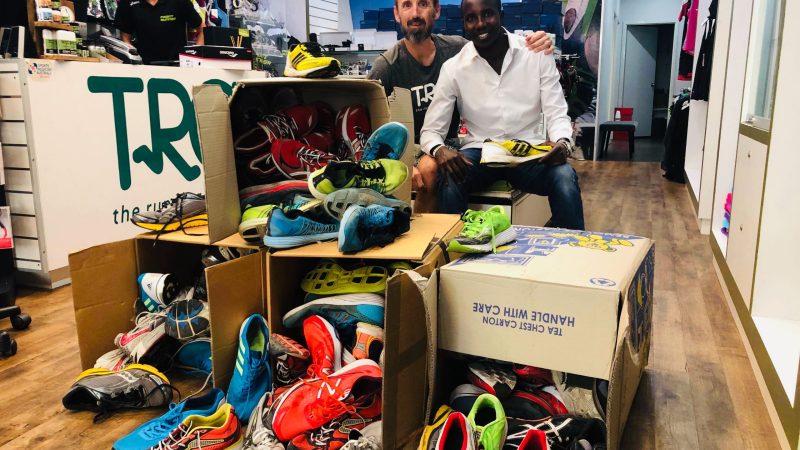
A few weeks ago I decided to send my running shoes to Kenya so they could hopefully inspire the next generation of runners, as long as they have size 10UK feet of course. I know the image below will probably make some people question my sanity but each shoe to me is like an old friend and I can, if questioned, relate back the history of each of them. So off with the Landson Foundation Shoe Donation , under the guidance of Alfred Sergent, to Africa they go, in May apparently, I hope it’s a large container.
The first few rows in the image, nearest me, were my Asics Kayano phase, 2008 -2012. These were my Comrade years where I believed you changed your shoes every 400k come what may !! I was a resellers dream ! ( Comrades is the largest ultra marathon in the world and should be on the bucket list of all runners. http://www.comrades.com . It will be the 100th anniversary of the first race in May 2021. This will be an epic adventure with entries capped at 34,000 to correspond to the 34 original runners.) In 2008 I was training for my first Comrades and these were the days before online purchasing really. We , as a running group, would keep an eye on our local running store and as soon as they had a deal on Kayano’s we would raid the place, usually coming out with 3-4 pairs ! Then Wiggle came online in the UK and they delivered Asics to Australia and that was the end of buying running shoes in your bricks and mortar store. These days I do try and support our local retailer as it’s an unfair playing field, truth be told, with the online warehouses buying in bulk and saving on staff and business rates/costs, support your local running store people !
Initially I was a big Asics fan, I mean this was a company that specialised in running shoes and had the history and knowledge to produce the best product. The only down side was cost and weight. The Kayano is a great shoe but was at the upper end of the price bracket and when I started to up my mileage the cost of replacing shoes became more and more difficult to hide from no1 Wife !! Thus I moved to the ‘best shoe on sale’ approach on UK Wiggle ( http://www.wiggle.co.uk ) . Luckily I found my feet would just about fit any shoe so brand loyalty was gone and as long as the reviews were convincing I moved between brands based on lowest price. (Note Wiggle UK stop selling Asics and Adidas at the request of local resellers as it was cheaper to buy the shoes and get them delivered than go to the local shop)
Too many shoes, or not enough ?
So what have been the stand out shoes of the last 12 years ? I’d say the original Nike Lunaraceris right up there. This was a game hanger, a lightweight shoe with a bit of bounce, the Vaporfly of its time. I have attached images of the mk1 and mk3 , great shoes. These really did change the landscape for marathon shoes. Before these bad boys we’d run the marathon is as light a show as possible. All about saving weight which, with hindsight, was probably a flawed logic as you’d put on 3-4kilo’s due to carbo-loading!!! I’ve ran marathons in racing flats to save a few grams but risking all types of injury when your legs are tired and your form has been destroyed by fatigue. How the landscape has changed these days with marathon shoes weighing less than racing flats but given your more support than a 70’s Rock Star in high heels ! (That’s a reference to the latest Nike Alpha’s in case you missed it.)
The original Nike Lunaracer. A thing of beauty but not for the wide foot runners amongst us. The fit was always a tad ‘snug’.
nike lunaracer mk3. A better design, slightly heavier but more forgiving, fit wise. You almost had the chance to survive the marathon with the odd toenail, almost?
Honourable mentions go to the Adidas Adios/Adizero Series and the Takumi sen 3. These are great shoes and the latest versions are still available. Very light but with a great Continental tread these were the shoes of choice pre-Vaporflys.
Weapons of mass destruction.
Adidas Adizero Haile .
Another great brand and a great shoe is the Saucony Kinvara. This was very similar to the Nike Lunaracer but more usable as an everyday training shoe , as well as a racing shoe. It gave you a good combination of lightness and some rebound with is cushioning sole. The image below is the mark 2 , which is my personal favourite but they are all great shoes and we’re up to mark 11 now I think. I’d certainly still use these and if they are ever on sale will try and pick up a few pairs.
For your normal training shoe, combining weight, cushioning and rebound my shoe of choice would be the Nike Pegasus or Adidas Boston . These shoes both have some longevity making them cost efficient as well. (and thats important right?)
Best shoe of the last 12 years, there can be only one ! The original Nike Vaporfly 4%, harder to get than Rocking Horse sh*t when they first came out and $100 more expensive than any competitor but a game changer in racing shoes. I even paid nearly 50% more for a pair on ebay at one point , crack cocaine to a marathon runner ! The second generation Flyknit was lighter but , for me, too narrow a fit and felt very unstable. They redeemed themselves with the Next% and I am wetting myself with excitement waiting for the AlphaFlys. If this was the Oscars the Flys would win best movie, actor and actress, they are that good ! Only downside is there is little support for the foot and I have heard of people complaining about injuries but if you use them to only race in you’ll be fine. (at their retail price you’d need to be a rock star to use them as your daily shoe!)
Worth a kidney, probably? The original Nike Vaporfly 4%.
This is the sort of post that I could just keep on typing , there are so many stories linked to each pair of shoes but ultimately you need to let go and, if they can be of use to someone else and spark the love of running , then it is a sacrifice I’m willing to make, giving up my collection. Although I feel like Golem in Lord of the Rings, giving up his precious, I know it was the right thing to do and I recommend anyone else out there sitting on a collection of memories does the same. Find a charity that can reuse your old shoes and make that call, you won’t regret it. Also it does allow you to start another collection of course but we’ll keep that between ourselves right…….
In less than two weeks I take on the 6 inch trail ultra marathon ( http://www.6inchtrailmarathon.com/ ) for the 11th time and will aim to try and improve my number of sub4 finishes from 8 to 9. Please note on both occasions I failed to go ‘sub 4’ I got lost but with any trail ultra that is a risk you take, although I seem to suffer more than most?
The last couple of months I have been building to this event and have been gradually increasing the time on legs but neglecting speed work and this has come back to bite me in both my last 10k races. Early November I ran a 37:36 at the John Gilmour track 10k and last Sunday I went slower at the Fremantle 10k, 37:56. The first time , on the track , was excusable as it was the last race I needed to win the WAMC age group 55-55 category but the time did sting. I was determined to go better and the Fremantle 10k gave me that opportunity. As with the previous 10k I started well enough but was unable to hold the pace and had to work very hard to keep sub 38 minutes , saved by a last minute sprint. A 15 second plus difference from kilometre 1 to kilometre’s 7-9 is not ideal pacing, you should be looking to hold the same pace throughout with maybe a faster last kilometre to account for the ‘kick’ finish. In my defence I was going slow enough that a ‘kick’ finish was achieved , albeit a very small ‘baby kick’?
Every race teaches you something and the last two have taught me I need to add pace to at least two of my weekly runs. I’m planning a Mona Fartlek at least once a week and then maybe a 10k tempo/threshold to try and bring my 10k time back under 36 minutes (as a minimum) next year. Of course this will have to wait as I have the trail ultra in a few weeks and then the Australia Day Ultra in January ( http://australiadayultra.com/ ) before the Delirious ( http://deliriouswest200miler.com.au/ ) in February, all ultra’s. !
Not a pretty sight?
I’ve written a few posts over the years on the 6 inch..probably worth a recap…
There’s more, just type in ‘6 inch’ in the search bar and you’ll find many, many amusing posts on this race and that’s the point of the 6 inch. It comes at the end of year, a few days before Christmas , where the finishing time is not important (as long as it’s under 4 hours). It’s more about the boys having a night away from our families and just being boys again, albeit for one night only. The experience of driving down Saturday , staying over Saturday night and watching ‘Run Fat Boy Run’ (an absolute classic film which all runners need to watch!) , running with some great friends on the Sunday morning and then a final get together to recount stories from the day, great times. It really is a special event and one all trail runners need to run sometime in their career.
A running classic?
So have I done enough over the last few months to guarantee a sub 4 finish ? I’d say at the moment I’m 50-50, conditions will dictate the final finish time I feel. Perfect conditions I got a chance, too hot and it’ll be a closer run thing. Either way I have a date with an esky at the finish so if I finish ahead of you I’d be careful where you choose your post race drink. It’s another great 6 inch tradition apparently. I’m excited about my 11th time taking on the 6 inch and hope to continue the tradition for many years to come, finishing sub 4 may not be on the cards for many more years but either way I know my old mate Mr.Esky will always be there to greet me at the end and that’s enough to keep me coming back for more. (and watching Run Fat Boy Run with the boys, again you all need to watch that film!)
Is it a case of too little too late?
Gotta love the heat…love my esky time at the end of the 6 inch !!
I cheated this post by using a link to Irwin Swinny’s podcast on a conversation we had a few weeks ago. (below) What’s better than reading about my ramblings, well listening to them of course. Let me know your feedback in the comments section of this post.
As I was taken down with the dreaded man-flu a week out from the Australia Day Ultra I will leave the race report to my usual partner in crime, Jon ‘swipe right’ Pendse. Jon is a marathon and ultra marathon running machine and it has been a honour to run with him over the last 10 years or so, after meeting in out office changing rooms.
In the early days Jon was a lot quicker than me and I regularly ran with him for the first 10-20k of a marathon before dropping off the pace. It wasn’t until the City to Surf Marathon of 2011 when I was able to pip him to the finish line by a few seconds after we both discussed finishing together. Sorry Jon but white line fever got the better of me !! Since then we have ran most events together and a large proportion of my training runs.
Anyhow I digress, Jon has written a great race report on the Australia Day Ultra which is certainly worth a read and it’s fitting he should be the first ‘guest writer’ for the blog as he has been involved with most of my posts in some manner and had to put up with man hours of BK putting the world to rights, which, truth be told has normally been a two way process… Enjoy.
Coming in to this year’s 100km ultra (http://australiadayultra.com/) I felt I had done my apprenticeship having completed the previous 3 years of ADU (having ran 8.53, 8.56, and 8.06), and this year was to be my first year ‘racing’ over 100km. This is a ‘race’, not a long training run right?
Although I had a breakthrough result in 2018, I didn’t really feel I was ‘racing‘ the distance at that time. Off the back of a consistent year with plenty of k’s in the legs (around 6,300 clocked up over the year), 2018 completing 7 marathons, 3 ultras, 5 half marathons, I felt I was ready to push for a sub8 hour 100km, given 2018 I only really aimed for sub 8.30 and managed 8.06!
Going in this year I set the following Goals; A sub 8 hours, B sub 8hrs-30, and C sub 9hours. Hmm an hour difference between an A goal and C goal, only races over 100km could you get away with such a large variance!
So here are my race splits;
Lap splits (12.5k) of 55, 57, 60, 67, 80, 80, 72, 64
25k splits of 112, 127, 160 (ouch), 136
Spoiler (it’s a very long race report!): I finished in 8:58:53
What I didn’t really consider was ‘racing’ in humid warm conditions, ok, even if its 18-20 degrees, the sun isn’t out so surely it’s not that bad? After all I’ve ran the previous years before in similar conditions (although I guess I treated those as long training runs), whereas this year I was going out at race pace, basically 10-15 minutes slower than a 50k race time.
To make things harder, my wingman & ultra-extraordinaire BK (www.runbkrun.com) narrowly avoided pneumonia only 2 nights before race night and gallantly chose to DNS rather than risk a death sentence.
So, this race was set to be a solo time trial. This is not a Sunday stroll! 😊
Unfortunately, I came undone in the 4th lap where I knew I was working way to hard and dropping too much time. 8 laps and sub 8 hour target even my 8-year-old can work out the pacing strategy… 1-hour laps or less and repeat x 8, easy?
Well the first lap was quick, but I felt good (probably due to the taper) and more importantly I felt in control. Second lap slightly slower but 57 was about spot on to where i needed to be (57-58), knowing I would need close to 10 minutes banked by 50k for the customary slow down on the second 50k. The plan was to hit 50k in 3.48-3.55 (which is 12-20 minutes slower than 50k race pace).
The 4th lap blowout meant I hit 50k just on 4hrs, at this point i knew sub8 was off the cards.
Suddenly I hit the dreaded marathon wall around 53k and was soon reduced to a walk/jog strategy… problem being hitting the wall in a marathon and you might have 10-15k left to go (I’ve hit the wall many times in marathons) … but this time around I still have 47k to go! I remember thinking how the f**k am i going to run the remaining 47k (which is the 6-inch trail marathon distance minus the hills). I was walking and could barely run. This km split was around 10minutes! Doing maths at this pace I’d be lucky to finish before noon! I should have been finishing around 8-8.30am.
This was never part of the plan, what the f**k can I do… (Please note Runbkrun does not condone this language but in the context of this post it is allowable!)
I did have a few positives going for me though… 1. Yes, I’ve hit the wall but it’s very early and only around 4.30am, the sun hasn’t even come up yet. 2. the chase pack (Margie and Chris) will very shortly be approaching 3. I wasn’t cramping or injured, so it was ‘possible’ I could regroup and rebuild.
So once Margie and Chris joined me, I soon found out they were in quite a similar state having hit a similar wall not that much earlier…
All 3 of us ran several km’s together, running low 6-minute k’s.
At this point I was happy just moving along and ticking of a few more km’s.
Margie told me she’d been running through a couple of niggles/injuries and was now seriously considering stopping. It was here I also agreed and said I’m seriously thinking of making it to 75k and calling it a day. Only in Ron’s race can you stop at any shorter distance and still claim a finishers medal albeit a shorter distance. (There was that famous DNF from Rhys a few years earlier when he stopped at 25k thus winning the race 3-4 hours before it had even started!) Besides 75km is still an ‘Ultra’ marathon and you get a finish time. That’s still a good day out in my books, and an experience to learn from for next time.
So, at my slower pace laps 5 & 6 I managed 80 minutes each, but usually in a marathon you get slower not quicker, and so after some more maths i was staring at 90 minutes for lap 7 and +90 minutes for the last lap… that would put me around a marginal sub10 hours.
This was all in the back of my mind, I’d now been dropped by Margie and Chris, and was heading back to complete my 5th lap.
It was here I saw Mick Francis on the middle aid station (must have been about 59km), and I quickly stopped for a brief chat, I heard he had to withdraw earlier with injury! But was still out supporting those remaining in the race, what a champ! [Mick’s our local legend and ultra-marathon god (he’s run more than 100 marathons and if that wasn’t enough has also ran more than 100 ultra-marathons), I’ve known mick for many years now, good mate and many races completed together], perfect place now for me to pick Mick’s running brain;
I told Mick I’d hit the wall at 50k and i could probably just make it to 75k and what’s the ultra-etiquette for pulling the pin…? Surely no point me running the extra 25km just to finish, that could be an extra 3hours in the sun walking and jogging! Besides I’ve run the 100km three times previous so have nothing to prove, surely he would agree and say yes stop at 75k call it a day recover and look for the next race, or try again next year.
Mick said it so simply… Jon are you injured? No. Then get back out and do the job. You’ll get respect and will teach you something you can’t read about. (Wise words from the man known as ‘Yoda‘ in the WA running community. A real , true blue Aussi’ Icon; Mick not Yoda.. please note I am assuming Yoda is not from the WA?)
Well the way he said it I was like why did I even ask, ha-ha. I knew the answer already, but I was also seeking acceptance that it would have been ok for me to stop. (Obviously I still could have stopped, but ultras aren’t for the faint hearted, those out there have something regular runners don’t have and many will never experience – no offence, but wait until you’ve done 100km, it will teach you many many lessons – I’m still learning).
This gave me a bit of a mental boost, and I continued my marathon shuffle at 6min k’s.
Margie was still a good 6 or 7 minutes ahead, I was stoked to see she went back out for the 6th lap which meant she’d make at least 75km, and likewise I went back out to start my 6th lap.
Meanwhile T-Train express had been setting a blistering pace in the 50km, well in front of his counterparts… he went on to win and smash out a PB and run 3hrs-27, wow!
But when T-Train was coming back on his final lap I yelled out to him phone BK at the finish line tell him Jon’s f’d, reckons he won’t break 10hours, can he do a quick poll in the BK Run Group and get the opinion on stopping at 75km?
I needed at least one person to say stop if anyone would the BK Group would… surely better to claim a 75km finishers medal than the +10hour potential finishing time (please).. Besides 75km is the point of no return, once you run past 75km there are no more finishers medals left other than the next barrier at 100km.
So, if you’re going to pull the pin, stop at 75km!
So now on this 6th lap I was still struggling and still shuffling.
I saw Margie again on the turnaround and she was going back out again for her 7th lap, wow what a champ especially with injuries and hitting the wall. Well that was it, if Margie is going to see it through, so am I (not that Mick hadn’t already told me earlier). And just before i went back out again for my 7th lap, T-Train looking fresh as ever… goes “spoke with BK he says it’s a 100km race not a 75km race.” (He lied, Tone never called me , though I would have said that !)
Alright decision made well and truly.
So, going back out now on my 7th lap things are warming up, but I’ve had almost 25k of shuffling along, and I’m starting to feel a slight second wind.
I started running a few sub 6-minute k’s, and soon enough was running around 5.30’s… so a lot more running and a lot less walking! Albeit tough and still a challenge ahead but at least I only have less than 2 laps to go! Things are starting to look up.
The whole race I’d been consistent with nutrition/hydration, had my strategy and didn’t really deviate. Setup my own esky at mid aid station, have a gel every 10k, and grab 2x250ml water bottles every time i passed that aid station. Although I’d been drinking around 600ml-700ml per hour (the other 300ml-400ml) I’d tip on my head to try and cool the core body temp) I still felt dehydrated and physically couldn’t take on any more fluids. It had been a long warm night that was for sure.
So with my new determination, I had the remaining 25k to go. Between 75k-82k I averaged around 6:30s, however I was definitely starting to feel some running legs returning, a lot less walking! The tide had turned. At the out turn-around I had a quick toilet stop, and then I was good to go. It was from here I was able to hold 5:15s, more importantly I was feeling great again, and could almost feel the finish line in sight although I did still have the final lap to run. Ron had chocolate medals this year right…! We often joke ultra-running is not actually about the running, it’s all about the food and my impartial attraction to the distance.
On completion of the 7th lap I clocked in at 7:54:05, which was a 1:12:45 lap time. Maths time again… I was feeling great, could it be possible I could break 9 hours? Sub 1:06 final lap?? Hmm. Challenge accepted. After all, given how I was feeling and could taste the finishers 100k medal, may as well go for it I had nothing to lose. Sub9 hours would be a fantastic result given where I was at 53km. Still managing to hold 5:15s, felt great at this speed again… I couldn’t work out what pace the sub 1:06 equated to, however if I could hold the 5:15s and get to the final turn-around in 33 minutes, then I would be in the ball park. And that’s exactly what happened, held the pace and got to the turnaround just under 33 minutes, a look at my watch slightly under 8hrs27. About bang on if I wanted to go under 9 hours. Still feeling great at this stage, no sign of cramping, and this was it, the final home stretch. Only 6.25km remaining and the last time I’ll see this end of the course for 12 months. It’s game on. I didn’t really have to do anything special, I didn’t need to speed up, just hold the pace and see it through to the finish. As I left the mid aid station, I yelled out to Mick I’ve got a sniff of a sub9 hour so bring it on. The final 3k was magical, this is how I had hoped I would run the final lap or at least this feeling, something you can’t replicate. I’d smashed my mental barriers and now I could enjoy the achievement of finishing my fourth 100km. I soaked up the atmosphere and ran beaming with smiles. Ok, not a sub8 and not a sub8:30, but who cares. I was so close to calling it a day, getting to this point everything was forgotten. The endorphin runners high here was more than worth hitting the wall at 53km.
This was a personal journey and my story of the day. Never give up. Respect. Pride. Proud. Redemption. And just plain mental! We are runners. And we are warriors.
I’ll be back next year to join the 500 Club -ADU Hall of Fame! Hopefully BK will have recovered by then and raring to go, I still have a sub8 hour in me?? (have I learnt anything, hmm)
Anyone interested here is my Australian 100 marathon club profile page as I endeavour to run 100 marathons (currently at 56 and 13 ultras).
This Sunday is the 14th running of the 6 inch trail ultra ( http://www.6inchtrailmarathon.com/ ) , probably my favourite race of the year as its not about the finishing time , the 6 inch really is all about the journey.
I’ve written various posts on this race over the course of this blog and they’re probably worth a revisit for some back ground before I wax lyrical about the main event…
Due to getting lost twice in the last three years (and three times in the last nine years!) I even went down to Dwellingup with the lads for a couple of recon runs this year. So am confident this year there will be no navigation errors. Saying that in previous years I’ve worn two Garmins and still managed to get myself lost, it’s a curse ! Funny thing is the 6 Inch is probably one of the easiest trail events around, on a proper trail race you might as well send out the search party now, I’m not coming home without help.
6 inch recon with the posse. 27k of fun on the trails…
This year we are expecting good conditions with a low of 14 and a high of 25, which for December in Perth is probably about as good as you are going to get. For example today was 38 ! Last year was unseasonably wet and driving to the start line Brett’s wipers could hardly keep up with the deluge. Once we got off the scarp things calmed down and we had a great mornings trail running.
The lads and I all stay at the Heritage Centre in Dwellingup the night before the race as it’s a 4:30am kick off and if you factor in a couple of hours driving from Perth and getting ready at the start it makes for a very early wake up call on Sunday morning. This way we get to lay-in until 3am!
The couple of recon runs this year has really wetted my appetite for the trial running and combined with the Choo-Choo run earlier in the year I feel I’m turning into a trail runner as I mature. The Choo-Choo is another trail run where this time we race a train, hence the name… worth a read..I digress…
So what to expect over the weekend. It’s a boy weekend away truth be told and a time to relax , albeit after racing 47k, and finish the year running with good friends on amazing trails looking forward to a few days break and Christmas with the family. The 6 Inch has found a place in mine and the boys hearts and if you are ever in Perth for the last Sunday before Christmas you really need to come and join us.. ho ho ho !
Footnote: I never published this post in time pre-race and now it’s Monday and the race has been and gone. I’ll post a full race report this week and it’s worth reading, it was a beauty !!
Gotta love the heat…love my esky time at the end of the 6 inch.
Follow me on
Tomorrow I’m having Extracorporeal Shockwave Therapy (ESWT) in my last attempt to finally get rid of this Plantar Fasciitis that has been hanging around since the Australian Masters Games in April this year. I know what most of you are thinking, ESWT sounds like something from ‘One flew over the cuckoo’s nest‘, (For all the younger readers of this blog that film is an absolute classic starring a young Jack Nicholson; he was a famous actor once !..worth watching, that and ‘The Shining’…I digress…)
Who here has got Plantar Fasciitis? Jack Nicholson at his very best, with Danny DeVito.
So what is ESWT ? Extracorporeal Shock Wave Therapy (ESWT) involves the conversion of a sound wave into a shock wave that is applied repeatedly to a specific area of the body. The technique is similar to lithotripsy, which is used to treat kidney stones. In recent years the technique has become popular in the treatment of a number of recalcitrant musculoskeletal conditions including tennis elbow, achilles tendinopathy, plantar fasciitis, and tendinitis of the shoulder.
There are several theories about how this treatment works but the most accepted theory is that the micro-trauma caused by the repeated shock waves increases the blood flow to the area and this promotes healing. The treatment is simple, quick and non-invasive.
I have heard good things from a number of my running friends who have had miraculous recoveries using ESWT so I figure I have nothing to lose and everything to gain. Currently there is very little chance of me completing my 10th Perth City to Surf Marathon (in a row) on August 26th and also continuing my sub3 streak. Of the two the sub3 streak is the most important so if I feel there is a DNF or a 3 hour plus finishing time I’m not risking racing. Reading the information on ESWT it seems three visits , spaced a week apart, is the minimum for a total cure; or at least get me to a point I can run unimpaired. This coincides with how long I have left before the marathon, just less than 3 weeks, what could possibly go wrong ?
Of course this is not a 100% guaranteed cure but the odds seem pretty good and they must be better than my current rehab programme which seems to have me going backwards rather than forward. Either way I’ll have something new to write about over the next few weeks and I’m sure a lot or runners reading this post have had, or are going to have, plantar fasciitis.
My most cherished possession…my sub 3 streak! Only a runner knows the feeling….
I’ve written posts lately about missing the lads as I spend hours running around in Kings Park, alone, hiding from the asphalt protecting my PF in my foot. If ESWT works I’ll be able to join this motley crew in a few weeks for another 42.2km of fun, fun , fun. Last year it was a duel between Jon, on the Keto diet, and Mark (and Matt Fitzgerald) going all in on the good old fashioned carbohydrates. ( https://www.runbkrun.com/2017/08/28/matt-fitzgerald-wins-by-a-muffin/ ) Unfortunately this year Mark has succumbed to a foot injury that has seen him sidelined since Boston but Jon is going from strength to strength and won the last marathon he entered. This was his fourth of the year and he is in the form of his life, maybe all that bacon and eggs really do work ? Worth investigating as , let’s face it people, bacon and eggs taste good, real good….
The last three months have been a dark time in my running career as I was struck down by first a blood disorder , mainly due to my “no lunch” diet (what was I thinking?) and lately a bad case of Plantar Fasciitis. The worst part of not running is not the not running part but missing time with my mates.
Over the years my non-running friends have fallen by the wayside as I became more and more focused on running and less and less focused on sociable activities, much to my Wife’s disgust. My Wife has often remarked how she’d like me to put on weight and drink more ! Not the normal grumblings of a partner of course, it’s usually the opposite. Anyhow when you’re injured there is no one to share your grief with. (because it is grief! ) Funnily enough I have written a post on grief , in relation to running… https://www.runbkrun.com/2017/04/17/injury-what-injury-the-five-stages-of-grief/
What run do I miss the most ? Need you ask, my Thursday morning 14k progressive, starting at 5:30am and finishing at the best café in Perth to take onboard the best muffin and coffee in the Southern Hemisphere. If you are lucky enough to live in Perth, or even Australia, you need to go to Yelo at Trigg and indulge with one of their banana and dark chocolate or even berry and chocolate muffins, warmed up of course. They really are so good, there is a caveat of course. Once you taste a Yelo muffin you will never be able to eat a muffin from another source, they really are that good. The coffee is also very good or that may be just because your taste buds are enjoying them muffin so much anything tastes good !
As this is a running blog and not a culinary one I need to justify that last paragraph. To earn the muffin and coffee combination we would have run a 14k progressive run which is one tough affair, with the obligatory sprint for the last 4-5k as each runner pushes themselves, and each other towards the Yelo café. To make this run special you need friends to initially talk to for the first 7k and then, finally, to run against for the final 7k. Runners pride will always make you put in that extra bit of effort when chasing (or being chased) by running mates.
Then there is the long runs on Sunday. These , for me, are mainly for the food and conversation after the run, to tell you truth I prefer to run twice a day compared to one long run , all bar the Sunday run. This is do able because of the company, by myself a long run is torture. We’ve had some great experiences over the years running long on Sundays , as most runners will attest to. As a group we tend to run at a reasonable pace on the outward journey but pick up the pace as we turn and head back towards the coffee and pancakes, I’m sure all running groups are the same. The photo below is from a 30k Yaberoo trail run a few months ago in the heat of the Perth summer. The T-train has organized a water drop but it was too little , too late for the journey home. As the group splintered it was every man for himself in the race back to the car and air conditioned safety.
Return journey, a few less smiles , more grimacing. ?
As well as the Sunday long runs there are the “special’ runs. These are organized, normally annually, and nearly always ‘up the ante’ with either more mileage or elevation. In the photo below its racing against a train which makes the ‘choo-choo’ run so special. Again I have written a couple of posts on this run which are worth a read and a chuckle… 2016 : https://www.runbkrun.com/2016/11/15/the-choo-choo-run-an-exercise-in-living-on-the-edge/ and last year https://www.runbkrun.com/2017/09/15/choo-choo-run-2017-man-against-train/ (Still not sure how Mike made it last year ? I suspect Uber?) For those living in Perth this run is scheduled for two weeks after the Perth City to Surf marathon, so probably early September. There is a facebook page somewhere ? Just heard from Simon Coates, the Choo-Choo this year is on September 23rd, the long weekend in WA. If you get lost at least you got a few days to get home…
Choc milk time at the Deli, job done.
Then there is the work lunch run. Working on St. Georges Terrace, Perth, we had some great running tops made up thanks to Rhys and Mel. This photo was taken at the height of the St Georges Terrace Running Club glory days when we always had a good contingent that would meet every midday at the lights outside the Woodside building. Together we’d explore the various bike paths around the city and trails in Kings park and it was a welcome relief from the work related problems that would often plague you. As with all runs they would start at a leisurely pace before Jeff or Andrea got to the front and then it was on for young and old. Today the group has splintered to some extent but most of the people pictured below still make an effort and regularly get out there just not together as much, all bar Big Paul (front right) who wandered to the dark side of lycra wearing cycling due to a bad knee.
The St. Georges Terrace Running club.
Couldn’t leave without one more photo of the Yelo café with some of the usual suspects, in the photo below you have Gareth, Mike and the elusive Mark Lee, a rare sight but always good for some quality banter. Happy days and I hope to be back with the lads soon, just got to get rid of this Plantar Fasciitis but that’s a post for another day….
After the Australian Masters Championship in April this year my running literally fell off a cliff. All of a sudden I was struggling to make 10k and pulled the plug on quite a few training runs early. Now this for me is unheard off ! A few times I even had that ‘sit on a fallen tree trunk and ponder ‘why am I doing this ?’ feeling’. As anybody who knows me will testify this is not what I do. I love running and for the last 10 years have made it my goal in life above all others to improve, everything has been sacrificed for this and I mean everything. They say you can do two things well and for me it’s running and family, though maybe my kids will disagree on the second point. The first point though is something that nobody can argue I don’t put in 100%. Dark nights, early mornings, hot midday runs are all taken onboard gladly and I’m always looking to the next race as one I will try and run faster than I have ever ran before. As I have said many times if I have a bib on my chest ‘it’s on for young and old’ , every race.
After a couple of visits to the Doctors and a blood test it was confirmed I had just run myself down with a poor diet of late not able to sustain my running program. This was purely self inflicted but a big lesson to learn. (My skip lunch diet and just eat free fruit at work is one to avoid apparently. You may drop a few kilos but feel like ‘weak as akitten‘ constantly and are unable to run. Not one of my brightest ideas!) No matter how good the engine if it runs out of fuel you stop, you can be the best runner in the world but with no fuel you still stop, simple really. I have said it so many times nutrition and hydration are so important and it really is common sense but sometimes even the most experienced runners forget this. Cost me 3-4 weeks of running on empty and generally questioning ‘why I was doing what I was doing’.? A few steak dinners later and a small fortune on supplements (still not sure about these but just in case….???) and my running is back, albeit curtailed by Plantar Fasciitis lately so mostly round and round grass ovals.
For racing success you need the grind of daily, weekly, monthly and yearly training, it doesn’t happen over night unfortunately. Once you reach a certain standard your goal is to maintain or improve.Of course other factors start to creep into the equation. I remember reading recently that the reason Kenyans do so well in marathons, and running generally, is their life is uncomplicated. Not for them the worry of mortgage payments, second cars, interest rates, credit card bills, private education or college fees for our American cousins. All these eventually start to wear down the Western runner. All the Kenyans worry about is should they have two teaspoons of sugar in their tea or should they splash out and have three, bless ’em. ? (I suppose in the back of their mind is always the possibility of getting eaten on their run but we probably have more chance of getting run over ? Swings and roundabout really…) An uncomplicated life makes a happy, better, runner and unfortunately we all seem to have forgotten this.
Happy little future Olympic Champions…with three sugars probably?
This week was the perfect example of this. So far this week my weekly total is 10k where I planned at least 50-60k as I’m tapering for the Perth marathon. (I digress but this aways reminds me of my mate Mike Adams who would always produce all these weekly predictions of massive totals and more often than not come nowhere near to hitting them, a lot of the times just flat lining with an injury. We joked that in planning there are many curves to record progress, the early curve, late curve, bell curve etc.. We always reckoned there should be the ‘Mike Adam’s flatline’ curve , basically just a straight line moving along the date axis on zero. The things you talk about on long runs. Sorry Mike ).. What happened you may ask ? Life just got in the way. I’m just about to complete a four unit development and as the same time we are submitting a tender at work in which I am heavily involved. Add into the mix the worst weather in Perth for many a year, what the English would call Summer, i.e. constant rain. Finally a head cold and Plantar Fasciitis finished me off and my running was a non starter. On the bright side I had enough sugar for my tea so at least that was a positive and we even managed to find a carton of Yorkshire Tea bags at work, best tea in the world accordingly to my mate Steve Dale ? This also explain this being the first post for nearly a month. The image below of my last few weeks sums it up perfectly, all consistency out the window, and as I have always maintained consistency is the key to running success.
Not a good few weeks…no consistency which will end in tears me thinks?
Right, the point of this post is to improve your running you need to work on the mental side as well as the physical and to this end make your life as simple as possible. Concentrate on good diet, as much sleep as possible and an uncomplicated social and professional life, basically make running your number one priority. As I mentioned at the start of this post you can do two things well in life, make one of them running. (Maybe best to keep that last snippet of information to yourself and not mention it to your significant other, just saying.) As always this ain’t rocket science but sometimes it just needs someone to state the obvious for you to take stock and reevaluate. I’ll say it again but the old saying ‘if the furnace is hot enough it’ll burn anything’ is basically crap, concentrate on your diet and make it the best it can be, within reason. Let’s face it you’re probably not an Olympic athlete and thus do not need to make the sacrifices they make but if you are serious about your running and want to be the best you can be then a good diet is paramount to success. Weight loss is 80% diet and 20% exercise so lets make some easy inroads and watch what we eat. (and that doesn’t mean eating with your eyes open !!!….)
The City Beach version? Please note this is the old carb-loving Jon, he’s a lot thinner now !!
“Suns out, Guns out” … well maybe a couple of pistols ?
It’s a flashback Friday post today. This is where I look back at the blog and find interesting articles I wrote when only my Mum followed me. (Truth be told my readership is probably not that much larger 18 months later but Mum always like a mention.)
All runners can relate to this post on weight. If you run , and worse, run competitively, you worry about weight and this then goes hand in hand with nutrition , another one of my favourite subjects.
Have I discovered the perfect diet yet, after many years of looking, the answer is no but I have found opportunities to improve my diet, lose weight and run faster. Of course this means sacrifices but this is a ‘runners lot’, what we do demands sacrifices. Friday night drinks with your work colleagues, sorry ‘going long’ Saturday. Game of kick around on the oval, no way baby, tight hammy’s ! Chasing kids around the back yard, are you mad, all that lateral change of pace, has long term injury written all over it . You get the picture, a runners life is one of sacrifices but these are sacrifices I am willing to make. (Never been one for Friday night drinks anyway and my footie kicking is poor at best!)
Diet unfortunately is another form of self sacrifice that can return dividends. The old days of the ‘if the furnace is hot enough, it burns anything’ approach is flawed and if you really want to improve your running you need to look at what you are using for fuel. Of course there will always be the runners that seem to survive on junk food but constantly produce jaw dropping times but these are few and far between and are normally just blessed with natural talent and genetics. I am not unfortunately, like 99% of the running population it is just plain old boring hard work that gets me where I need to be. Again I’m ok with that and must admit to enjoying the runners post long run pancakes or waffles as a form of recovery; it’s not all bad.
Carbohydrates or the high fat, low carb diet, I’ll leave it to you to decide but the most important final statistic is your racing results. Get it right and hit your racing weight and you’ll see the benefits, too low or high and you’ll also notice the difference. We’re all different of course but lets face it , when’s the last time you saw an over weight runner at the front of the pack. Sorry people the ‘just escaped form a concentration camp‘ look is the way to go, much to my Wife’s disgust. She often encourages me to put on weight, drink more and tries to butter me up with digestives (normally with dark chocolate!) , not many men can say that about their partners. I of course rebuke her advances and proudly mention I am at racing weight and have no need for any extra muscle as it serves no purposes for us runners. Muscle or fat are merely an extra weight we have to carry around the race distance and this need to be jettisoned as soon as possible. Sorry Karen but the ‘Schlinders List‘ look is what all us runners aspire to and no amount of chocolate digestives is going to derail me…..
I have mentioned weight in relation to running a few times on this blog but with all good subjects there is always another good article to highlight. It really is common sense that the lighter you are the faster you will run with the same amount of energy. My Dad use to always sprout ‘It’s Physics Son‘ at me on so many occasions over the years for numerous different scenarios, in this scenario it really is.
So to improve with the same amount of training all you need to do is put down that donut (Jon !) and pick up that lovely celery stick, Yum ! Hang on, to quote Homer Simpson ‘Donuts taste good‘ and I agree with Mr.Simpson whole heartedly but to work off a donut it’s about 30 minutes of moderate exercise, and who can stop at one donut which is why you buy Krispy Kremes in boxes of 6 or more. That’s 3 hours of running nearly a marathon for 10 minutes of pleasure. (Would you have to run the 3 hours straight after eating 6 donuts or can you wait, either way I would probably envisage trouble ahead.)
I can certainly testify that at my racing weight of 70kg I am considerably faster than if I let myself go and hit 72kg. You feel the difference and also in training with every step you moving that extra 2kg, remember physics, not a runners friend when he’s been embracing his friend Mr. Kreme.
So the answer is to find your racing weight and stick to it. How easy is that ? Actually not easy at all as your racing weight is always so damn low and to get to it in the first place you normally starve yourself or have to avoid all the food groups you love. Then when you hit the racing weight you spend all your time worrying about putting weight on. No one said being a runner was easy, we train hard in tough conditions, give up our social life, friends out with running are ignored and even sacrifice family time but to forego the donuts or worse the Yelo muffin, life is cruel.
Is there an answer to the weight conundrum, there may be. Rather than try and maintain your racing weight all year you can train using the periodisation technique. (Is it a technique or just a way of training, you decide?) . Periodisation is the theory and practice of how to vary a training program over time to bring the runner to a physical peak for major competitions. It is considered simply as planned and organized variety. The periodisation variables we can manipulate include frequency, intensity, recovery, variety, specificity, and duration of training. I suggest part of this could also involve Krispy Kreme donuts, though when Arthur Lydiard, first started experimenting with periodization in 1947 I’m not sure he had donuts at the forefront of his mind.? Anyhow you could define periods of your training when you can add a little weight and enjoy life a tad more than normal before then starving yourself back to your racing weight.
It would be easier of course if we didn’t have a sweet tooth and we could maintain our weight by enjoying the good things in life like cabbage, celery, carrots, swede or my favourite green peas. Not going to happen, so until they make chocolate calorie free it’s back to my old friend ‘hunger pains’ and the odd Yelo muffin when I can persuade myself that running 100 miles does justify one muffin as it normally contains fruit (mixed in with the chocolate)
Amanda MacMillan wrote this article for Runners World in 2014 but it still holds true today unfortunately. Worth a read but we all know what we should weigh, it’s our decision whether we reach that goal and when we do how long we can hold it for. That is of course until chocolate becomes calorie free then it’s on for young and old…
The root of all evil…
It may have been a while since you’ve stepped on a scale.
You’re fit, you feel great and you run, a lot. So who cares if your abs aren’t as flat as they used to be? Even if your weight’s not on your radar as a health issue, though, it should be as a performance one. Because there’s a good chance you’re not at your ideal racing weight—that is, the weight at which you run your fastest and feel your best.
Perhaps you have always had the same body and never considered what adding a few pounds of muscle or dropping a few pounds of flab might do for your performance. Alicia Shay, a professional runner and nutrition counselor in Flagstaff, Arizona, says weight shouldn’t be overlooked. “Anyone who cares how fast they’re running should consider their weight part of their overall training strategy,” she says.It’s most common for runners to find their weight has crept up over the years. Pete Magill, author of Build Your Running Body, didn’t think much about his own gradual weight gain until, at 44, his usual 15-minute 5K times began to suffer.“When I ran 16:20, I knew I was in trouble,” Magill says. “I’d been racingat 170 pounds since starting masters competition, almost 10 pounds over my race weight back in my 20s.” He couldn’t train any harder, so he went on a diet and dropped to 164. Over the next few years, he set the American men’s 45–49 record for the 5K, at 14:34.Magill’s not alone. “I can’t imagine you can talk to a competitive runner who doesn’t have a weight-loss-equals-faster-time story,” he says.But getting to that ideal number can be hard work—especially if you’re already logging major mileage and are used to eating whatever you want. And it’s a delicate balance: Dipping below it or losing weight in unhealthy ways could put you at risk for injury, illness and disordered eating behaviors.Why Lighter Equals FasterAs a general rule, runners move most efficiently when they’re at the low end of what’s considered a healthy body mass and body-fat percentage. “Running is really just a form of jumping,” says Matt Fitzgerald, certified sports nutritionist and author of Racing Weight: How to Get Lean for Peak Performance. “You can’t move forward without moving up, and the more you have to lift against gravity, the more energy it requires.” Imagine running with an extra 5 pounds strapped around your waist, he explains.Body weight affects performance in running more than it does in other sports, such as swimming and biking, according to a 2011 Swiss study on Ironman triathletes. And lower body-mass index seems increasingly important as race distances get longer: A 2014 study found that the optimal BMI for male 800m runners was between 20 and 21, while it dropped between 19 and 20 for male 10,000m and marathon runners. (Generalizations about BMI shouldn’t be used prescriptively, Shay says, because it doesn’t take into account lean muscle or body fat.)There are other reasons lighter means faster: Larger people are less efficient at delivering oxygen throughout the body. Losing weight doesn’t change your lung capacity or function, but it does mean that each breath doesn’t have to go as far.Leaner athletes can dissipate heat better, too, because they have a higher surface-area-to-body-weight ratio and less insulating fat tissue. They also burn carbohydrates more efficiently. So while weight isn’t everything, it’s certainly a big thing. “Four factors determine how fast you are,” says Sean Wade, a top masters athlete and coach of the Houston-based Kenyan Way running program. “Genetics, form, how hard and smart you train, and your weight—and not necessarily in that order.”
Age Makes a Difference
Masters runners may have the hardest time losing weight—no matter how much they run. Fred Zalokar, 54, averages more than 100 miles a week and for years oscillated between 170 and 180 pounds. But since he cleaned up his diet four years ago, he’s dropped more than 20 pounds, increasing his speed and turnover along the way.
“Weight loss has never just happened for me, even when I was regularly running ultras,” Zalokar says. “If I’m not consciously cutting my calories, I can make up for all that mileage without a second thought.”
That’s because adults begin losing muscle mass in their early 40s, which can impair performance and decrease metabolism, says Emily Brown, RD. Getting enough physical activity (including resistance training to maintain muscle) is especially important, as is cutting back on junk food and oversize food portions.
Tom Storey, 50, who has run Boston seven times, attributes his first qualifying run, in 2007, to weight loss. In just more than a year, he went from 205 to 150 pounds and shaved more than 30 minutes off his previously 4-hour marathon time. Today, maintaining his weight requires sacrifices he’s willing to make. “There aren’t a lot of things I can do to make myself a better athlete,” he says, “but if I can keep my weight down, I know I’ll be faster.”
Crunching the Numbers
Finding your ideal weight—the healthy weight at which you really perform your best—takes some time. “You can’t predict your optimal race weight beforehand,” Fitzgerald says. “You can move toward a goal, and when you have the race of your life, you weigh yourself and get your body composition tested, and there you have it.”
Andrew Lemoncello, 2012 Olympian for the U.K. and a coach for McMillan Running, didn’t find his ideal race weight until going pro after college. “I used to live by the saying, ‘If the furnace is hot enough, it will burn anything,’ “ he says. “I ate healthy foods, but I also loved desserts and never paid attention to my portions.”
When he began spending time with other pro runners, Lemoncello realized he needed higher-quality fuel for his furnace to run at its most efficient. He began planning his meals and stopped mindless eating, and he dropped from 150 pounds to 145. “I started setting PRs and had more energy and confidence,” he says. “If I’m eating well and training hard, that’s the weight my body naturally gravitates to.”
For any weight loss or gain, it helps to have something to aim for. Several online calculators, like Fitzgerald’s at RacingWeight.com, will estimate your ideal racing weight based on your age, gender and current fitness level. In this case, ideal is defined as what you would weigh if your body fat was at its lowest attainable-yet-healthy percentage, Fitzgerald explains.
Then there are the stats about how much quicker you’ll be by slimming down, like the commonly cited 2 seconds per mile, per pound you are above your ideal weight. But this will vary from person to person, says exercise physiologist Paul Vanderburgh, creator of the online Flyer Handicap Calculator, which helps runners see how their race times stack up against competitors of other ages and weights. Based on VO2 max estimates, it computes your predicted time if you were 25 years old and a scale model of yourself at 110 pounds for women or 143 pounds for men. “It’s strictly meant for comparisons,” he stresses, “not for figuring out the weight you should realistically be to hit a certain time.”
In Build Your Running Body, Magill and his co-authors plot a chart of estimates based on VO2 calculations—for example, that a 200-pound runner can shave 19 seconds off a 20-minute 5K time by losing 5 pounds. Wade takes a simpler approach: “One minute slower per 1 pound overweight is what I tell my marathoners,” he says.
These tools can be good motivators, according to Rasa Troup, a certified specialist in sports dietetics (CSSD), a 2008 Olympian and current nutritionist for Team USA Minnesota, but she adds that athletes shouldn’t take them as gospel. “My biggest concern is that they distract runners from listening to and understanding their own bodies, because they’re caught up in reaching some number,” she says. “It’s more important to be aware of how tired hungry or sluggish you are feeling.”
Kimberly Mueller, CSSD, owner of San Diego-based Fuel Factor Nutrition Coaching and a 2:52 marathoner, warns that calculators can skew too low with body-fat goals, as well. “Some have estimated my ideal body composition to fall around 12 percent,” she says, “but I know I lose my menstrual cycle if I fall below 14.”
How Much is Too Much?
Many runners could benefit from shedding a few pounds, Troup admits—but only if they have excess weight to lose and only if it’s done in a way that supplements their training, rather than sabotaging it. “Well-fueled athletes will perform well, and well-fueled means something different for every person,” she says. Of course, losing weight isn’t a good idea for all competitive runners. For those who are naturally very lean or who work hard to stay at the low end of their healthy weight, the threat of falling below that point at which you race your best is real.
Stephanie Bruce learned that the hard way when she finished a disappointing 16th at the 2013 Boston Marathon. She and her husband, pro runner Ben Bruce, have spent years perfecting their race-weight strategies, she says, and weigh themselves daily leading up to a big race.
“We didn’t have a scale in Boston, and it was difficult to get in as many calories the day before as I would have been able to at home,” she says. (Bruce has celiac disease and has to be careful about eating food prepared outside of her own kitchen.) “I was probably under by only 2 or 3 pounds on race morning, but it made a huge impact. I had no power; I just couldn’t hold the pace.”
Bruce says she works hard to maintain a healthy weight and has never dropped so low that her health has suffered. But many runners, without enough calories or nutrients, can develop weak bones and compromised immune systems.
That’s what Brian Rosetti figures happened to him. After he graduated from college, he spent two years training almost full-time. His mileage was increasing, but he was focused on low weight instead of nutrition for performance. Just as he made a breakthrough in his training, and as his weight dropped to an all-time low of 146 on his 6-foot-1 frame, he suffered a sacral stress fracture. “My bone density was below the median level, and I don’t think I was getting the right nutrients,” Rosetti says. “I was focused on keeping as light as I could. That’s a scary place to be.” The injury, in effect, ended his career.
Fitzgerald says impaired performance is usually the first sign that a runner has dipped into dangerous territory. “It’s the canary in the coal mine—your body’s signal that it’s under too much stress.”
For women, a missing menstrual period is also an indication of an unhealthy and unsustainable weight, with potential complications like infertility and osteoporosis. And while it’s less talked about, competitive men can struggle, too. A recent Southern Utah University study found that almost 20 percent of male high school cross country runners were at risk for disordered eating behaviors like bingeing and purging. Some boys expressed a desire to gain body weight to be more attractive, while others wanted to lose it to improve their running.
To keep your weight loss from becoming detrimental, the American Council on Exercise recommends maintaining a BMI that stays at or above the normal weight threshold of 18.5 and a body fat percentage above 14 percent for women and 6 percent for men. Some elites dip below these guidelines, Troup says, but it’s not recommended without careful monitoring.
Fitzgerald also recommends tracking your performance. “If you’re getting skinnier but your times are getting worse, you’ve passed the point of beneficial weight loss,” he says.
And above all else, Shay says, listen to your body and your mind. “If you’re starving all the time or you’re irritable and cranky or you’re bonking on runs, you’re probably being too ambitious and getting too light.”
Timing is Everything
The time to prioritize weight loss is in a four- to nine-week period before you start ramping up your workouts, while you’re building your base. “You can’t maximize fitness gain and weight loss simultaneously,” Fitzgerald says.
Mueller agrees. During a competitive season, athletes shouldn’t restrict themselves by more than 500 calories per day. For those who want to lose only a few pounds, 200 to 300 is even better. Stop restricting calories the week of a big race, she adds, because your body will perform best on a full tank.
Bruce says she goes into her training cycles about 3 to 5 pounds over her racing weight, a product of relaxed eating habits and less exercise during her offseason. “I like to have a reserve to pull from, because once I start working out harder, I lose it pretty easily,” she says.
Lemoncello follows a similar schedule during his training period, gaining 5 to 10 pounds when he’s not racing. “It’s good for my running,” he says. “The break helps me feel energized, and I come back motivated.”
After four weeks of solid training and a race every weekend I am well and truely knackered. (its a running term mean very tired!) Today I ran a recovery 10k at just under 5min/k pace and finished like I’d just ran a marathon. As I sat outside my house in a pool of sweat I realised that yet again I’d pushed myself too far and was certainly suffering from fatigue. Truth be told it is becoming the norm these days and I’m finding my daily runs are slowing but the effort seems to be increasing. All signs of over training. Will I take time to recover ? Probably not, I enjoy running too much to ‘back off’ but have made an effort to try and change by reading Mark Sisson’s book ‘Primal Endurance’. Mark is all about HFLC (high fat, low carb) paleo type diet with cross fit type fitness routines, short explosive workouts. This goes against the normal runners ‘run till you fall over training regime, gorging on carbs and sugar. ‘ Mark has some interesting ideas but it is certainly a challenge taking them onboard. His website is worth a visit. ( https://www.marksdailyapple.com) I’ll keep you abreast of my findings and I must admit I’m looking forward to eating more omelettes, bacon, salmon and yoghurt on a daily basis, not so sure about the cross fit training. ?
The new holy bible of running?
I’ve written so many posts on fatigue which are available on my website and can be easily accessed using the search dialog box, wonderful things these ‘computer thingy’s’…. Rather than reinvent the wheel I’ve attached a post I wrote in 2016 on the subject. Greg McMillan wrote a great article on recovering and its certainly worth a second visit, plus it lets me sneak off for a cup of tea early without spending the obligatory hour or two typing away. Remember people work smarter not harder, it even works for blogging.
I was sent this article by my friend Mike and it really does hit home. Will I take time off because of it, probably not but what I consider ‘down time’ is just running a lot less. My recovery still involves running albeit a lot less and I’ll be on this reduced training for at least a month. Is it better to have a complete break as advocated by this article by Greg McMillan in 2016 on his website.? ( https://run.mcmillanrunning.com/ )
Looking at my training log for the last 8 years I have has no real down time as such. Maybe a week off after the Rottnest Marathon as I vacation with the family counts ? Not as long as recommend by Greg in his article. I do have a ‘reduced workload’ period for 2-3 months over the summer months in Perth where most of the major races dry up due to the heat. Maybe this has been enough to keep me focused while still maintain the intensity and running goal times in the ‘running season’. Truth be told it isn’t reduced that much though when it gets really hot I jump on the bike and commute to work and reduce my running to once a day.
Maybe I’m actually following Greg’s advice without actually realising it ? Like all things running it is not a ‘one shoe fits all’ sport. What works for one person will not have the same affect with another. What Greg preaches is common sense and well worth considering and I will take it onboard. (maybe this will justify a trip to the local deli and another muffin ?) Spending more time with my family, that always put a strain on the marriage ? I’ll consult with my Wife before I embark down this road. I’m not so sure the family will appreciate more BK time…
THE LOST ART OF RECOVERING BETWEEN TRAINING CYCLES
I see a bad habit forming in many runners: the lack of a recovery cycle after their big races or racing seasons.Today, far too many are simply finishing one race (often a marathon) and immediately starting to train for the next one. You can get away with this a few times, but usually runners get burned out and leave the sport for new activities after doing this too often. The grind of always “training” weighs you down. Runners may also reach a performance plateau after a few races and fall well short of their true running potential, simply because they don’t allow a proper recovery phase.
In fairness, I understand this drive to move from one race to the next. I love running, too, and there is nothing better than being fully engaged in training for a big race. But never taking a break ignores one of the most important principles that we learned from great coaches and athletes over the last century: Top runners require a regular, full recovery cycle.
Great athletes build annual breaks into their training year. Not a reduced week or two of training every now and then, but weeks of complete rest. They don’t only rest, but they gain weight, too. Some add 5 to 15 pounds to their normally light frames while they enjoy time with their families, take vacations and generally do things they normally can’t because of their training.
If you follow many of today’s great runners, you’ll see that they, too, take the time to get away from the sport. Nick Symmonds goes fishing after the track season. Bernard Lagat talks about getting “fat” during his downtime, and the Hansons require their marathoners to take two weeks completely off after a marathon.
How can they do this? How can great athletes allow themselves to get out of shape? How can they tolerate the downtime without worrying about the competition?
While we worry about losing our fitness level, or that the competition is training and we’re not, these athletes know that planned annual breaks rejuvenate the body and mind in ways that outweigh losses in fitness. The worriers who plow through often take similar breaks, but rather than planned vacations, they are mandated by injuries, overtraining and burnout. Planned breaks take the pressure off — you don’t feel that your training is never-ending, jumping from one goal to the next. Science is discovering that the chemistry of the brain, the hormonal system and the immune system are compromised during hard training. Breaks rejuvenate these systems, allowing us to train better, more consistently and with more zeal across the next training plan.
Will you lose fitness? Yes. How much is hard to calculate and will depend on how long a break you take. But it’s not about how out of shape you get, but about how recovered you are and how ready to attack the next training cycle.
Remember that the recovery phase isn’t just the downtime, but also the time needed to rebuild mileage and pace. Many runners fail even when they do take time off, because upon their return, they jump right back into full training — again feeling the need to “get in shape.” You’ll need to plan on three to five weeks of rebuilding to your full training load. I usually start at 50 percent of full mileage, then increase 10 to 20 percent each week (with a recovery week of lower mileage every two to four weeks) until I’m back to 100 percent. Use common sense and build back slowly.
In the end, what’s the rush? A few weeks of downtime never ruined anyone’s running career — quite the opposite.
COACH’S NOTES
I took nearly a month off after my last marathon. I gained a few pounds. I enjoyed some new hobbies and time with family. But most of all, I rediscovered the desire, motivation and passion that drive me as a runner, and I couldn’t wait to challenge myself to do better. The next training cycle went even better than expected because I carried all the fitness from the previous cycle, plus my recharged motivation. I was able to run 2 minutes faster in the 15K than I had the year before. I’m convinced the recovery phase played a large role in this breakthrough.